
Chapter 2: Acids, Bases and Salts
Simplified Notes: Class 10 science chapter 2 ncert solutions Easy Acids, Bases, and Salts
Class 10 Science Notes | Chapter 2 | Explained Simply
1. The Two Teams of Chemistry: Acids and Bases
Dear students, We will learn about class 10 science chapter 2 ncert solutions Easy acid and base, In this chapter imagine that all chemical substances with opposite properties are divided into separate groups. We call these groups Acids and Bases.
How do we tell them apart?
- Acids: These are the “Sour” team. Think of the taste of a lemon or vinegar—that sharp sourness is because of acid.
- Bases: These are the “Bitter” team. If you accidentally taste soap or baking soda, it tastes bitter. Also, if you touch a base, it feels soapy or slippery.
Warning: In the lab, you cannot taste chemicals to check them! That is dangerous. Instead, we use “chemical detectives” called Indicators.
Indicators: The Color-Changing Detectives
Indicators are substances that change color depending on whether they are touching an acid or a base.
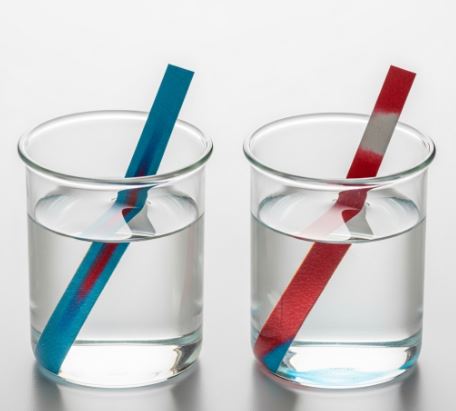
Litmus Test: Blue Litmus turns RED in Acid (Danger!). Red Litmus turns BLUE in Base.
- Natural Indicators:
— Litmus: Comes from lichens. (Acid=Red, Base=Blue).
— Hibiscus: Turns bright pink in acid and greenish in base. - Synthetic (Man-made) Indicators:
— Phenolphthalein: It is colorless in acid but turns Pink in a base.
— Methyl Orange: Turns Red in acid and Yellow in base. - Olfactory Indicators ( The Nose Test):
Some substances change their smell. For example, Onion and Clove Oil have a strong smell. If you add a strong base to them, their smell vanishes! But acids don’t change their smell.
2. Chemical Reactions: How They Behave
Acids and Bases interact with other things in very predictable ways. Let’s look at the patterns.
A. Reaction with Metals (The “Pop” Test)
When an acid meets a metal, it kicks out hydrogen.
Equation: Acid + Metal → Salt + Hydrogen Gas
Observation: You will see bubbles. If you bring a burning candle near these bubbles, the gas burns with a “Pop” sound. This proves the gas is Hydrogen. (Note: Strong bases can also do this with some metals like Zinc).
B. Reaction with Carbonates (The “Fizz” Test)
If you drop acid on marble or baking soda (Metal Carbonates), it fizzes violently.
Equation: Acid + Carbonate → Salt + Water + CO₂ Gas
This gas is Carbon Dioxide (CO₂). It can turn lime water milky.
C. Neutralization Reaction (The Cancellation)
What happens if you mix the two rivals, Acid and Base? They fight and destroy each other’s properties. We call this Neutralization. Neutralization Reaction Acid + Base → Salt + Water
Real Life Example: A bee sting injects acid into your skin, causing pain. If you apply baking soda (a mild base), it neutralizes the acid and stops the pain.
D. Reaction with Oxides
- Metallic Oxides are Basic: So, Acid + Metal Oxide → Salt + Water.
- Non-Metallic Oxides are Acidic: So, Base + Non-Metal Oxide → Salt + Water.
3. The Role of Water: The Activator
Here is a secret: An acid is not an acid unless it is wet! Water is what “activates” them.
- When dissolved in water, Acids release Hydrogen ions (H⁺).
- When dissolved in water, Bases release Hydroxide ions (OH⁻).
Because they create these floating ions, acid and base solutions can conduct electricity. Dry crystals cannot do this.
4. The pH Scale: Measuring Strength
How strong is an acid? Is it strong enough to burn skin or weak enough to drink? We measure this using the pH Scale (Power of Hydrogen). It is a ruler from 0 to 14. The pH Scale Acidic Neutral Basic 0 7 14
- pH = 7: Neutral (Like Pure Water).
- pH < 7: Acidic (0 is very strong acid).
- pH > 7: Basic (14 is very strong base).
pH in Everyday Life
Your body cares a lot about pH:
- Digestion: Your stomach creates Hydrochloric Acid to digest food. If it makes too much, you get “Acidity.” You take an Antacid (a base) to fix it.
- Teeth: If the pH in your mouth drops below 5.5 (due to bacteria eating sugar), your tooth enamel starts dissolving (rotting). Toothpaste is Basic to prevent this.
5. The Family of Salts
When Acid and Base neutralize, they make Salt. Common Salt (Sodium Chloride, NaCl) is just one member of a huge family. We use NaCl to make many other useful chemicals.
Important Chemicals made from Salt:
- Sodium Hydroxide (NaOH): Made by passing electricity through salt water (Brine). This is called the Chlor-Alkali process.
- Baking Soda (NaHCO₃): Makes cakes fluffy and acts as an antacid.
- Washing Soda (Na₂CO₃ · 10H₂O): Used for cleaning and removing hardness from water.
- Bleaching Powder (CaOCl₂): Used to clean drinking water and bleach clothes white.
Are dry crystals really dry?
Look at Copper Sulfate crystals. They look dry and blue. But if you heat them, they turn white and release water! This hidden water inside the crystal structure is called Water of Crystallization.
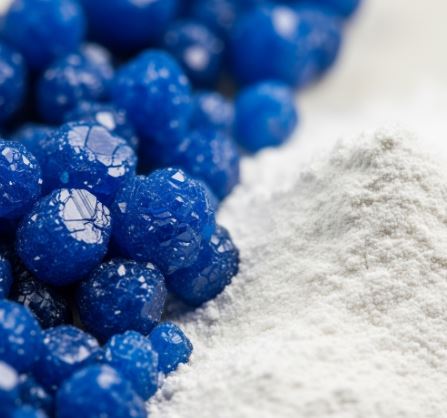
Plaster of Paris (POP): This is a famous salt used by doctors. It is white powder (CaSO₄ · ½H₂O). When you mix it with water, it re-absorbs the water and turns into a hard solid called Gypsum (CaSO₄ · 2H₂O). This hard gypsum supports broken bones.

6. Practice Questions & Solutions
Multiple Choice Questions (MCQ)
- A farmer finds his soil is too acidic (pH 5.0). Which substance would be most suitable to neutralize it?
(a) Lemon Juice (b) Wood Ash (basic) (c) Vinegar (d) Sugar solution
Answer: (b) Wood Ash.
Reasoning: To fix acidity, we need a Base. Wood ash is basic, while lemon and vinegar are acidic. - You add onion juice to two test tubes. You add HCl to A and NaOH to B. What will you observe?
(a) Smell vanishes in both. (b) Smell remains in A, vanishes in B. (c) Smell vanishes in A, remains in B. (d) Smell remains in both.
Answer: (b) Smell remains in A, vanishes in B.
Reasoning: Onion is an olfactory indicator. Its smell is destroyed by Bases (NaOH), but stays in Acids (HCl). - The chlor-alkali process produces Chlorine, Hydrogen, and what alkali?
(a) Calcium Hydroxide (b) Sodium Hydroxide (c) Magnesium Oxide (d) Potassium Hydroxide
Answer: (b) Sodium Hydroxide.
Reasoning: “Chlor” stands for Chlorine, and “Alkali” stands for Sodium Hydroxide (NaOH). - A colorless liquid turns pink with phenolphthalein. What is it?
(a) Strong acid (b) Pure water (c) Basic solution (d) Neutral salt solution
Answer: (c) Basic solution.
Reasoning: Phenolphthalein is a synthetic indicator that only turns pink in the presence of a Base. - Why is Plaster of Paris stored in airtight containers?
(a) To prevent reaction with oxygen. (b) To keep it from absorbing moisture and turning into gypsum. (c) To stop it from sublimating. (d) To protect it from sunlight.
Answer: (b) To keep it from absorbing moisture…
Reasoning: If POP touches moisture in the air, it hardens into Gypsum and becomes useless.
Short Answer Questions
- Dry bread doesn’t conduct electricity, but if moistened with salt water, it does. Why?
Answer:
Electricity is carried by moving charged particles (ions). Dry bread has no free ions. Salt water contains Sodium (Na⁺) and Chloride (Cl⁻) ions that are free to move. These moving ions conduct the electricity. - Identify the nature of three solutions: X turns red litmus blue. Y reacts with zinc to produce hydrogen. Z has a pH of 7.
Answer:
X is Basic: Bases turn Red litmus Blue.
Y is Acidic: Acids react with metals (Zinc) to give Hydrogen gas.
Z is Neutral: A pH of 7 is exactly in the middle (Neutral). - How can the reaction between baking soda and vinegar show a chemical change? Mention two observations.
Answer:
1. Gas Evolution: You will see vigorous fizzing/bubbles because Carbon Dioxide (CO₂) is produced.
2. Temperature Change: If you touch the container, it feels cold (Endothermic reaction).
Long Answer Questions
- Design an experiment to prove that a non-metallic oxide (like CO₂) is acidic using litmus paper.
Answer:
1. Light a candle inside a jar. The burning produces Carbon Dioxide (CO₂) gas, which is a non-metallic oxide.
2. Take a strip of moist blue litmus paper.
3. Lower it into the jar.
4. Observation: The blue paper turns Red.
5. Conclusion: The CO₂ mixed with the water on the paper to form an acid (Carbonic Acid), proving that non-metallic oxides are Acidic in nature. - You have two salts: Salt A (strong acid + weak base) and Salt B (weak acid + strong base). Predict the nature of their aqueous solutions.
Answer:
Salt A (Acidic): Since the Acid parent is Strong and the Base parent is Weak, the strong acid dominates. The solution will have a pH < 7 (Acidic) because of excess H⁺ ions.
Salt B (Basic): Since the Acid parent is Weak and the Base parent is Strong, the strong base dominates. The solution will have a pH > 7 (Basic) because of excess OH⁻ ions. It was complete Class 10 Science Chapter 2 NCERT Solutions. Hope you enjoyed it we will meet in next chapter
Read Also:
Class 10 Chapter 1- Chemical Reactions & Equations
For more check official website of
NCERT