
Chapter 8: Force and Law of Motion
1. Introduction: The “Why” Behind Motion | Class 9 Science Chapter 8 Force and Laws of Motion Notes
Hello students! In the previous chapter, we talked about how things move—their speed and velocity. But we never really asked why they move. Why does a ball roll? Why does it stop?
The answer is Force. For centuries, people thought being at rest was the natural state of an object. But scientists like Galileo and Newton showed us that motion is actually ruled by three simple laws.
2. What is Force?
Imagine you want to open a door. You either push it or pull it. That’s it! A force is basically a push, hit, or pull on an object.
What can Force do?
- It can make a stationary object move.
- It can stop a moving object.
- It can change the speed or direction of motion.
- It can change the shape of an object (like squeezing a lemon).
3. Balanced vs. Unbalanced Forces
Forces don’t always cause movement. It depends on whether they are balanced or not.
| Feature | Balanced Forces | Unbalanced Forces |
|---|---|---|
| Definition | Equal and opposite forces acting on an object. | Unequal forces where one is stronger than the other. |
| Result | Net Force is Zero. No change in motion. | Net Force is greater than Zero. The object accelerates (moves). |
| Example | Tug-of-war where both teams pull equally. The rope stays still. | Pushing a toy car. Your push is stronger than friction, so it moves. |
4. Newton’s Three Laws of Motion
Sir Isaac Newton gave us three golden rules that explain how force and motion work.
4.1 First Law: The Lazy Law (Inertia)
“An object at rest stays at rest, and an object in motion stays in motion unless disturbed by a force.”
Basically, objects are lazy. They want to keep doing what they are doing. This laziness is called Inertia.
- The Mass Connection: The heavier an object (more mass), the more lazy (more inertia) it is. It’s harder to move a truck than a bicycle.
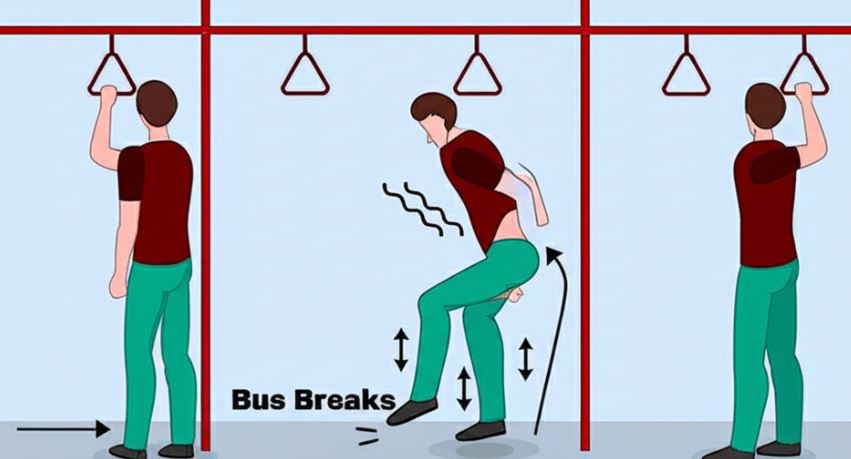
Real Life Example: When a bus stops suddenly, your feet stop with the bus, but your upper body wants to keep moving forward due to inertia. That’s why you fall forward!
4.2 Second Law: The Formula Law (F = ma)
This law connects Force, Mass, and Acceleration. But first, let’s meet a new friend: Momentum.
Momentum (p) is the “power” of a moving object. It depends on mass (m) and velocity (v).
Formula: p = m × v.
The Law States: The rate at which momentum changes is directly proportional to the force applied.
In simple math: Force = Mass × Acceleration (F = ma).
Why do cricket players pull their hands back?
By pulling hands back, the fielder increases the time taken to stop the ball. According to the formula, increasing time decreases the force of impact. This saves his hands from hurting!
4.3 Third Law: The Action-Reaction Law
“For every action, there is an equal and opposite reaction.”
This means forces always come in pairs. If you punch a wall, the wall punches your hand back with equal force (ouch!).
Key Point: These two forces act on two different objects, so they never cancel each other out.
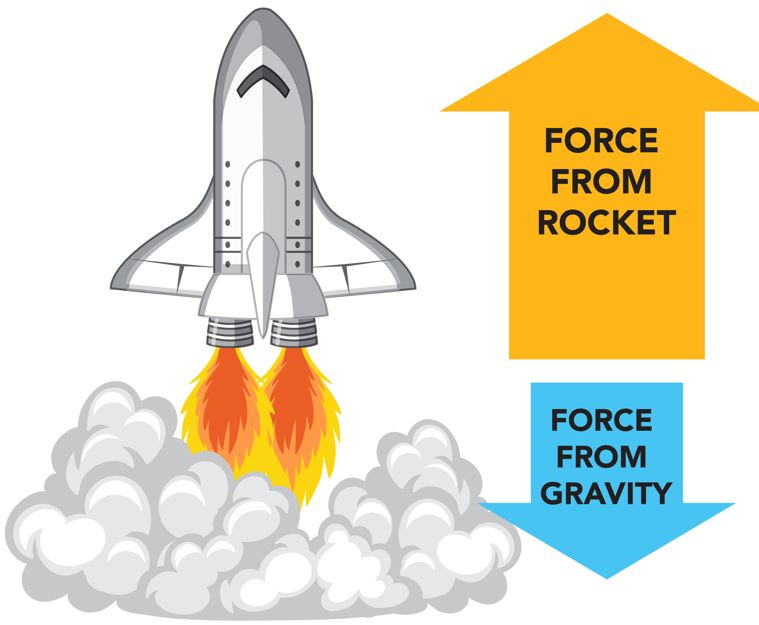
Rocket Launch: The rocket pushes gas down (Action), and the gas pushes the rocket up (Reaction).
5. Practice Questions & Answers
Part A: Multiple-Choice Questions (MCQs)
- Inertia is the property of a body to resist a change in its state of:
a) Motion only
b) Rest only
c) Rest or uniform motion
d) ShapeAnswer: c) Rest or uniform motion. (It resists any change in its current state).
- Newton’s first law of motion is also known as:
a) The law of action-reaction
b) The law of momentum
c) The law of inertia
d) The law of accelerationAnswer: c) The law of inertia. (Because it defines the property of inertia).
- A force of 10 N acts on an object of mass 2 kg. What is the acceleration produced?
a) 20 m/s²
b) 5 m/s²
c) 0.2 m/s²
d) 12 m/s²Answer: b) 5 m/s². (Using F = ma, so a = F/m. Therefore a = 10/2 = 5).
- When a gun is fired, it recoils. This phenomenon is explained by:
a) Newton’s first law of motion
b) Newton’s second law of motion
c) Newton’s third law of motion
d) The law of conservation of energyAnswer: c) Newton’s third law of motion. (Action: Bullet goes forward; Reaction: Gun moves backward).
- Momentum is the product of an object’s:
a) Mass and acceleration
b) Force and time
c) Mass and velocity
d) Force and distanceAnswer: c) Mass and velocity. (Formula: p = mv).
Part B: Short Answer Questions
- Why is it dangerous to jump out of a moving vehicle? Explain using the concept of inertia.
Answer: When you are in a moving bus, your whole body is in motion. If you jump out, your feet touch the ground and stop immediately due to friction. However, your upper body, due to inertia of motion, wants to keep moving forward. This conflict causes you to fall flat on your face and get hurt.
- Define one newton (1 N) of force.
Answer: One Newton is the amount of force required to accelerate a mass of 1 kg at a rate of 1 m/s².
- Why does a cricket fielder pull his hands backward while catching a fast-moving ball?
Answer: By pulling his hands back, the fielder increases the time it takes to stop the ball. According to Newton’s Second Law, if the time increases, the rate of change of momentum decreases. This means the force of impact on his hands is reduced, preventing injury.
- If action is always equal to the reaction, explain why a cart pulled by a horse moves forward. Why don’t the forces cancel each other out?
Answer: The Action and Reaction forces act on different objects, so they don’t cancel out.
1. The horse pushes the ground backward with its feet (Action).
2. The ground pushes the horse forward (Reaction).
3. This forward force on the horse is greater than the friction of the cart wheels, so the whole system moves forward. - Calculate the momentum of a 1200 kg car moving at a velocity of 72 km/h.
Answer:
Mass (m) = 1200 kg.
Velocity (v) = 72 km/h. First, convert to m/s: 72 × (5/18) = 20 m/s.
Momentum (p) = m × v
p = 1200 × 20 = 24,000 kg m/s.
Part C: Long Answer Questions
- State and explain Newton’s three laws of motion. Provide one real-life example for each law.
Answer:
1st Law (Inertia): An object resists change in its state of rest or motion. Example: Dust coming out of a carpet when beaten with a stick (dust stays at rest while carpet moves).
2nd Law (F=ma): Force equals mass times acceleration. Example: Pushing an empty shopping cart is easier (less force) than a full one (more mass requires more force).
3rd Law (Action-Reaction): Every action has an equal and opposite reaction. Example: Swimming—you push water back (Action), and water pushes you forward (Reaction). - A truck of mass 1500 kg starts from rest and rolls down a hill, traveling a distance of 200 m in 10 seconds with constant acceleration. (a) Find acceleration. (b) Calculate force.
Answer:
Given: u=0 (rest), s=200 m, t=10 s, m=1500 kg.
(a) Acceleration: Using the formula s = ut + (1/2)at²:
200 = (0 × 10) + (1/2) × a × (10)²
200 = 50a
a = 200/50 = 4 m/s².
(b) Force: Using F = ma:
F = 1500 × 4 = 6000 N. - What is the difference between balanced and unbalanced forces? Give examples.
Answer:
Balanced Forces: Equal and opposite forces. Net force is zero. Object doesn’t move. Example: A book lying on a table (Gravity pulls down, table pushes up equally).
Unbalanced Forces: Unequal forces. Net force is non-zero. Object moves/accelerates. Example: Kicking a football (Force of kick > Friction and air resistance). - An 8000 kg engine pulls a train of 4 wagons (2000 kg each). Engine force = 35,000 N, Friction = 3,000 N. Calculate: (a) Net accelerating force. (b) Acceleration.
Answer:
(a) Net Force: Engine Force – Friction Force
35,000 – 3,000 = 32,000 N.
(b) Acceleration:
Total Mass being pulled = Mass of 4 wagons
Mass = 4 × 2000 = 8000 kg.
Using F = m × a
32,000 = 8000 × a
a = 32,000 / 8,000 = 4 m/s². - A hockey ball of mass 200 g is traveling at 10 m/s. It is hit and returns at 5 m/s. Calculate change in momentum.
Answer:
Mass (m) = 200 g = 0.2 kg.
Initial velocity (u) = 10 m/s.
Final velocity (v) = -5 m/s (Negative because it returns in the opposite direction).
Initial Momentum (p1) = 0.2 × 10 = 2 kg m/s.
Final Momentum (p2) = 0.2 × (-5) = -1 kg m/s.
Change in Momentum: p2 – p1 = -1 – 2 = -3 kg m/s.
(The magnitude of change is 3 kg m/s).
Dear Student This was complete easy notes of Class 9 Science Chapter 8 Force and Laws of Motion Notes. Now we will meet in next Chapter with new easy notes
Read Also:
Class 9 Chapter 7-Motion
For more check official website of
NCERT