1. Introduction
Hello students! Welcome to Chapter 3 of your Class 9 Political Science journey. In our previous chapters, we learned that in a democracy, it is neither possible nor practical for all people to govern directly. Because of this, the most common form of democracy today involves people ruling through their elected representatives. But how do we actually choose them?
In this chapter, we will explore the entire process of elections. Step by step, we will break down how our representatives are elected, why elections are necessary, and how electoral competition benefits the public. By the end of these notes, you will easily be able to distinguish a truly democratic election from a fake one, and you will understand the immense role of the Election Commission of India. Let’s dive in!
2. Why Do We Need Elections?
Before we look at the complex steps of voting, let’s start with a basic understanding. Imagine trying to run a country without elections. Every single citizen would have to sit together every day to make laws. In a large country like India, this is practically impossible because not everyone has the time, knowledge, or experience to take decisions on all matters.
Based on this, we need a mechanism to choose our leaders:
During an election, the voters make several important choices. They decide who will make laws for them, who will form the government to take major decisions, and which political party’s policies will guide the nation. Regular elections also create healthy political competition. Even if a political party only cares about staying in power, this competition forces them to serve the people well, otherwise, they will be voted out in the next term!
3. Our System of Elections
To truly understand our democracy, we must analyze the step-by-step process of how elections are held in India. Let’s look at the main stages of our electoral system.
Feature 1: Electoral Constituencies
In our country, we follow an area-based system of representation. The whole country is divided into specific areas called electoral constituencies. For Lok Sabha (National) elections, India is divided into 543 constituencies, and the winner from each is called a Member of Parliament (MP). Similarly, states are divided into Assembly constituencies to elect MLAs.
Feature 2: Reserved Constituencies
Our Constitution makers worried that weaker sections of society might not have the resources to win open elections. To ensure fairness, some constituencies are reserved exclusively for people belonging to the Scheduled Castes (SC) and Scheduled Tribes (ST). This guarantees that our Parliament hears the voice of every social group.
Feature 3: The Voters’ List
Democracy is built on the fundamental principle of universal adult franchise. This means that every citizen aged 18 and above has the right to vote, regardless of their caste, religion, or gender. Before elections, a massive list of eligible voters is prepared, officially called the Electoral Roll, to ensure everyone gets an equal opportunity.
Feature 4: Nomination and Polling
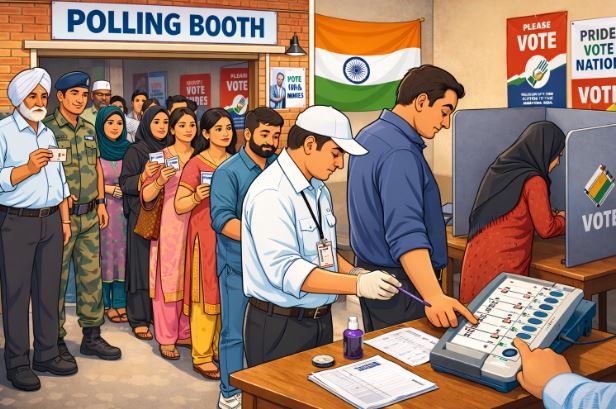
Anyone who is 25 years old can contest an election. Candidates must fill a nomination form and declare their assets, criminal records, and educational qualifications. On election day, voters go to a polling booth to cast their vote secretly. Today, we use Electronic Voting Machines (EVMs) where voters simply press a button next to their chosen candidate’s symbol.
4. Election Campaigns and the Code of Conduct
The main purpose of elections is to give people a chance to choose the policies they prefer. This requires open discussion, which happens during election campaigns. Let’s look at some famous campaign slogans from Indian history.
- Garibi Hatao (Remove Poverty): In the 1971 Lok Sabha elections, the Congress party led by Indira Gandhi gave this powerful slogan. They promised to reorient all government policies to focus on removing poverty from the country.
- Save Democracy: This slogan was used by the Janata Party under Jayaprakash Narayan in 1977. The party promised to undo the harsh excesses committed during the Emergency period and restore civil liberties to the citizens.
- Land to the Tiller: In the West Bengal Assembly elections of 1977, the Left Front used this slogan to focus on giving land ownership rights directly to the poor farmers who actually worked on the fields.
- Model Code of Conduct: To ensure campaigns are fair, all parties must agree to a code. They are not allowed to bribe or threaten voters, appeal in the name of caste or religion, use government vehicles, or spend more than the legal limit of money in their campaigns.
5. What Makes Indian Elections Democratic?
We often hear news about unfair practices like vote-rigging or using money power. So, is our system actually fair? Yes, and here is why.
Arguments For Democratic Elections in India
- Independent Election Commission: In India, elections are conducted by the Election Commission (EC), which is incredibly powerful and independent. Once the Chief Election Commissioner is appointed by the President, they cannot be easily removed, not even by the ruling government! The EC can punish candidates, control government officials during election time, and even order a re-poll if cheating occurs.
- Popular Participation: A true test of fairness is if people actually show up to vote. In India, voter turnout has remained stable or increased. Interestingly, unlike Western countries, the poor, illiterate, and underprivileged citizens in India vote in massive numbers because they feel their vote can bring real change.
- Acceptance of Results: If elections were completely rigged, the powerful ruling party would never lose. However, in India, ruling parties routinely lose elections at both state and national levels. Defeated candidates accept the electoral outcomes gracefully as the ‘people’s verdict’.
6. Challenges to Free and Fair Elections
So far, we have discussed the strengths of our system. However, the picture looks a bit different if we ask deeper questions. Are voters getting a real choice? Is the playing field truly level?
Even though our overall system is democratic, we face serious challenges. Candidates and parties with massive amounts of money enjoy a huge, unfair advantage over smaller parties and independent candidates. In some areas, politicians with criminal connections push others out of the race just to secure a party ticket.
Furthermore, dynastic succession is a huge problem where some families dominate political parties and distribute tickets only to their relatives. Finally, ordinary citizens often find that elections offer very little real choice, as the major political parties have become quite similar to each other in their policies and practices. Citizens and social activists constantly demand reforms to fix these deep-rooted issues.
7. Key Takeaways
- Elections are essential for a representative democracy to allow citizens to choose and change their lawmakers regularly.
- India is divided into electoral constituencies, with some seats reserved for SCs and STs to ensure equality.
- Every citizen aged 18 or above is included in the Voters’ List (Electoral Roll) under the principle of universal adult franchise.
- The Election Commission of India is a highly independent body that enforces the Model Code of Conduct and ensures fair polling.
- While Indian elections are broadly free and fair, challenges like money power, criminal connections, and dynastic politics still exist.
8. Practice Section: Master the Chapter!
Test your knowledge with these carefully crafted questions based on the notes above.
Part A: True or False (10 Questions)
- In a democracy, it is possible for all people to sit together daily and govern directly.
- For Lok Sabha elections, India is divided into 543 constituencies.
- A by-election is held in all constituencies of the country at the exact same time.
- Only candidates who have passed college are allowed to contest elections in India.
- The voters’ list is officially called the Electoral Roll.
- The Model Code of Conduct allows politicians to use places of worship for election propaganda.
- The Chief Election Commissioner is answerable to the President and can be removed easily by the Prime Minister.
- In India, the poor and underprivileged sections vote in larger proportions compared to the rich.
- Independent candidates do not get election symbols.
- One of the challenges of Indian elections is the massive use of money power by rich candidates.
Click to view True/False Answers
- False (It is impossible in a large country, which is why we need representatives)
- True
- False (A by-election is held only in one constituency to fill a sudden vacancy)
- False (There are no strict educational qualifications to contest elections in India)
- True
- False (The Code strictly prohibits using places of worship for campaigning)
- False (The EC is highly independent and the CEC is virtually impossible to remove by the government)
- True
- False (Independent candidates are allotted symbols by the Election Commission)
- True
Part B: Multiple Choice Questions (10 Questions)
- How many seats are reserved for Scheduled Castes (SC) in the Lok Sabha?
A) 47
B) 60
C) 84
D) 543
- What is the minimum age required to become a voter in India?
A) 18 years
B) 21 years
C) 25 years
D) 30 years
- Which leader gave the slogan “Garibi Hatao” in 1971?
A) Jayaprakash Narayan
B) N. T. Rama Rao
C) Devi Lal
D) Indira Gandhi
- What is the minimum age to be a candidate in Lok Sabha or Assembly elections?
A) 18 years
B) 21 years
C) 25 years
D) 35 years
- The party nomination given to a candidate is often informally called a:
A) Pass
B) Ticket
C) VVPAT
D) Ballot
- Who appoints the Chief Election Commissioner (CEC) of India?
A) The Prime Minister
B) The Chief Justice of India
C) The President of India
D) The Parliament
- What does EVM stand for?
A) Election Validation Machine
B) Electronic Voting Machine
C) Electoral Voter Mechanism
D) Early Voting Module
- What does voter turnout indicate?
A) The number of candidates contesting the election
B) The amount of money spent on campaigns
C) The percentage of eligible voters who actually cast their vote
D) The number of seats won by the ruling party
- Which of the following is NOT a challenge to free and fair elections?
A) Candidates with criminal backgrounds
B) Dynastic politics controlling party tickets
C) The independence of the Election Commission
D) Heavy use of money power
- According to the election law mentioned, what is the maximum amount a candidate can spend in a Lok Sabha constituency?
A) 10 Lakh
B) 25 Lakh
C) 50 Lakh
D) 1 Crore
Click to view MCQ Answers
- C) 84
- A) 18 years
- D) Indira Gandhi
- C) 25 years
- B) Ticket
- C) The President of India
- B) Electronic Voting Machine
- C) The percentage of eligible voters who actually cast their vote
- C) The independence of the Election Commission
- B) 25 Lakh
Part C: Short Answer Questions (5 Questions)
- What is a general election?
- Why did the Constitution makers introduce the system of reserved constituencies?
- What details must a candidate declare legally before contesting an election?
- Mention any two rules from the Model Code of Conduct.
- How do we know that Indian election outcomes are generally accepted by politicians?
Click to view Short Answers
- A general election is when elections are held in all constituencies at the same time, either on the same day or within a few days, usually after the five-year term of the Lok Sabha or Vidhan Sabha comes to an end.
- They were worried that in open competition, weaker sections might lack the resources, education, and contacts to win. Reserved constituencies for SCs and STs ensure that our Parliament has the voice of a significant section of our population.
- Every candidate must make a legal declaration providing details of serious criminal cases pending against them, details of their assets and liabilities, and their educational qualifications.
- Two rules from the Model Code of Conduct are: (1) No party or candidate can use any place of worship for election propaganda, and (2) No party can use government vehicles, aircraft, or officials for election campaigns.
- We know this because, barring very few disputed cases, the defeated parties usually accept the electoral outcomes as the “people’s verdict” and gracefully step down from power.
Part D: Long Answer Questions (5 Questions)
- Explain why electoral competition among political parties is considered good for democracy despite its demerits.
- Describe the various powers and functions of the Election Commission of India.
- What makes an election democratic? Mention the minimum conditions.
- How is the voters’ list prepared and maintained in India? Explain its importance.
- Discuss the major challenges to free and fair elections in India today.
Click to view Long Answers
- While electoral competition creates disunity and party-politics, it is ultimately beneficial. In real life, politicians are motivated by a desire to advance their careers. Regular competition creates a system of rewards and punishments decided by the people. If politicians raise issues the public cares about, their popularity increases. If they fail to do good work, they will not win the next election. Just like a shopkeeper must provide good service to keep customers, political competition forces parties to serve the people.
- The Election Commission of India is highly independent and powerful. Its functions include taking decisions on every aspect of the conduct and control of elections, from the announcement to the declaration of results. It implements the Model Code of Conduct and punishes violators. During elections, it can order the government to follow specific guidelines to prevent the misuse of official power. Furthermore, government officials on election duty work directly under the control of the EC, not the ruling government. It even has the power to order a re-poll if cheating is detected.
- An election is democratic if it fulfills some minimum conditions: First, everyone should have one vote and every vote must have equal value. Second, there must be something to choose from, meaning parties and candidates should be free to contest and offer real choices. Third, elections must be held at regular intervals. Fourth, the candidate preferred by the people should get elected. Finally, elections must be conducted in a free and fair manner where people can vote without fear or bribery.
- The voters’ list, or Electoral Roll, is the list of all citizens eligible to vote. It is prepared much before the election. Under universal adult franchise, everyone 18 years or older has the right to vote. The government is responsible for updating this list constantly. Names of young people turning 18 are added, while names of people who have moved away or died are deleted. A complete revision takes place every five years. This list is crucial because it ensures the first condition of democracy is met: everyone gets an equal opportunity to choose their representative.
- Despite a robust system, Indian elections face several challenges. The biggest challenge is money power; rich candidates and big parties have an unfair advantage over smaller ones. Another issue is candidates with criminal connections, who often muscle out good people to secure party tickets. Dynastic politics is also prevalent, where certain families dominate parties and distribute tickets to relatives. Finally, ordinary voters often face a lack of meaningful choice because major political parties share very similar policies, making it difficult for citizens to vote for real change.
Read Also:Class 9 Social Science All Chapters
Previous Chapter:Constitutional Design
For official syllabus and textbooks, visit theNCERT Official Website.