
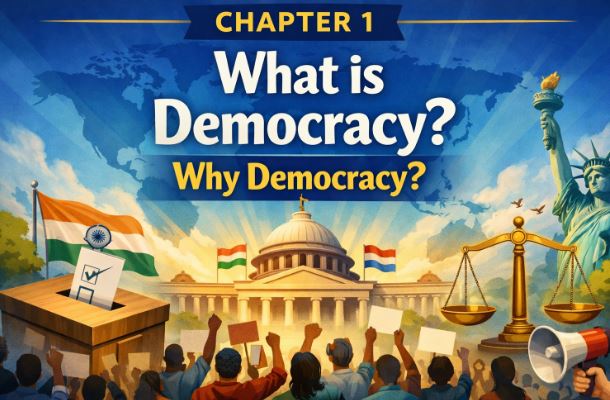
1. Introduction | Class 9 Civics Chapter 1 What is Democracy Why Democracy Notes
Hello students! Welcome to the very first chapter of your Class 9 Political Science journey. We hear the word “democracy” almost every day on the news, in newspapers, and in our classrooms. We know that India is a democratic country, and many other nations around the world proudly call themselves democracies too. But what does this word actually mean? Why is everyone so focused on it?
In this chapter, we will build a very simple, easy-to-understand definition of democracy. Step by step, we will break down the features of a truly democratic government so that you can easily spot the difference between a real democracy and a fake one. By the end of these notes, you will also understand why democracy, despite its flaws, is considered the best system of government available to us today. Let’s dive in!
2. What is Democracy?
Before we look at the complex features, let’s start with a basic understanding. The word “democracy” actually comes from a very old Greek word, ‘Demokratia’. In the Greek language, ‘demos’ means ‘people’, and ‘kratia’ stands for ‘rule’. So, at its very core, democracy simply means rule by the people.
Based on this, we can form a simple, working definition:
This simple definition is a great starting point because it immediately helps us separate democratic governments from non-democratic ones. For instance, army dictators or kings are not elected by the people, so their countries are not democracies. However, we must be careful! If we use this simple definition blindly, we might end up calling every single country that holds an election a democracy. In today’s world, many dictators pretend to hold elections just to look good. That is why we need to look closer at the actual features.
3. Features of Democracy
To truly understand if a country is democratic, we must analyze the simple definition deeply. By looking at different parts of the definition, we get the four main features of democracy.
Feature 1: Major Decisions by Elected Leaders
In a true democracy, the people who actually make the final decisions must be the ones the public voted for. It is not enough to just have a parliament if the real power is secretly held by someone else.
Feature 2: Free and Fair Electoral Competition
An election is only democratic if people have a real, genuine choice between different political parties and candidates. A true democracy must be based on a free and fair election where the people currently in power have a fair chance of losing. If the ruling party tricks the system so they can never be defeated, it is not a real democracy.
Feature 3: One Person, One Vote, One Value
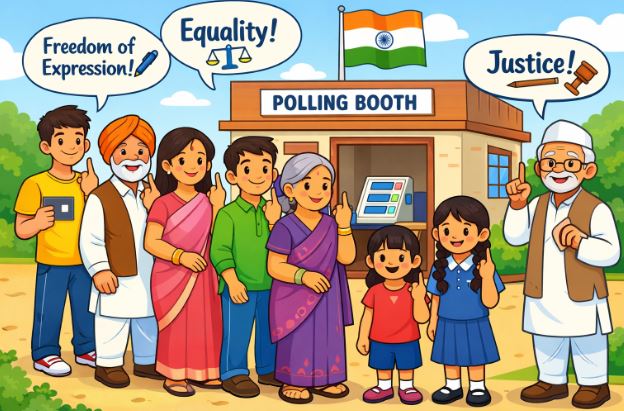
Democracy is built on the fundamental principle of political equality. This means that every single adult citizen, regardless of their wealth, gender, or religion, must have the right to cast one vote. Furthermore, each of those votes must carry the exact same value or weight.
Feature 4: Rule of Law and Respect for Rights
Winning an election does not give a government the power to do whatever it wants. A democratic government must rule within certain limits set by constitutional laws and must respect the basic rights of its citizens. There should be freedom to protest, express opinions, and be treated equally under the law.
4. Real-Life Examples to Understand the Features
Sometimes, looking at history is the best way to understand these concepts. Let’s look at four real-world examples where the core features of democracy were violated.
- Pakistan (The Illusion of Power): In October 1999, General Pervez Musharraf led a military coup and removed the elected government. He later called himself the President and held a fraudulent referendum. Even though they eventually held elections for assemblies, the real power was kept by military officers and Musharraf himself. Because the elected representatives could not take the final decisions, this was not a true democracy.
- China (No Real Choice): In China, elections are held every five years to elect the National People’s Congress. However, before anyone can contest the election, they must be approved by the Chinese Communist Party. Only members of this party or smaller allied parties are allowed to run. The people do not have any serious political alternatives, so this is not free and fair competition.
- Mexico (Dirty Tricks in Elections): From 1930 until 2000, every single presidential election in Mexico was won by one party called the PRI. Opposition parties existed, but they could never win because the PRI used dirty tricks. They forced government workers to attend party meetings, told teachers to force parents to vote for them, and shifted polling booths at the last minute to confuse voters.
- Zimbabwe (No Respect for Rights): After independence in 1980, Zimbabwe was ruled by the ZANU-PF party led by Robert Mugabe. Even though elections were held, Mugabe used unfair practices. He changed the constitution to give himself more power, harassed opposition workers, controlled the television and radio, and even pressured judges who went against him. He did not respect the limits set by the constitution.
5. Why Democracy? (Pros and Cons)
Now that we know what democracy is, we have to ask: Is it really the best system? No system is perfect, and people often argue about the merits and demerits of democracy. Let’s explore both sides.
Arguments Against Democracy (The Cons)
- Instability: Because leaders keep changing after elections, it can lead to political instability.
- Lack of Morality: Electoral competition is often just about power play, leaving little room for morals.
- Delays in Decisions: Because a democracy requires consulting many people, taking decisions can take a very long time.
- Bad Decisions: Sometimes elected leaders do not fully understand the best interests of the public, leading to poor choices.
- Corruption: The pressure to win elections can lead to massive corruption and use of black money.
Arguments For Democracy (The Pros)
If there are so many problems, why do we prefer it? Because compared to dictatorships or monarchies, democracy is far better.
- More Accountable Government: A democratic government is forced to respond to the needs of the people. For example, during 1958-1961, China suffered a massive famine killing nearly three crore people. India’s economy wasn’t much better, but India didn’t face a similar famine because its democratic government had to answer to the public and provide food security.
- Better Quality Decisions: While consultations take time, involving many people helps point out mistakes and reduces the chances of rash, irresponsible decisions.
- Peaceful Conflict Resolution: In diverse societies like India with different languages, religions, and castes, conflicts are natural. Democracy offers a peaceful way to handle this because no one is a permanent winner or loser.
- Enhances Human Dignity: This is the strongest argument. Democracy treats the poorest and least educated person with the exact same political status as the richest person. People are not subjects of a king; they are their own rulers.
- Room for Correction: When mistakes are made in a democracy, they cannot be hidden forever. There is public space to discuss these errors, and either the rulers fix their mistakes, or the public changes the rulers in the next election.
6. The Broader Meaning of Democracy
So far, we have only talked about democracy as a form of government. However, the concept of democracy is much broader. It is a fundamental principle of decision-making that can be applied to almost any sphere of life.
For example, a family can be democratic if everyone sits down together to discuss matters and arrive at a consensus, valuing the child’s opinion as much as the parents’. A classroom can be democratic if the teacher allows students to freely ask questions and express their thoughts. At its heart, a democratic decision is one that involves the consultation and consent of all those who will be affected by that decision.
Sometimes, we use the word ‘democracy’ to set an ideal standard. For example, someone might say that true democracy will only exist when no one goes to bed hungry, or when every citizen has equal access to education and resources. While no country is a perfect democracy today, keeping these high ideals in mind helps us constantly evaluate and improve our systems. The ultimate strength of a democracy depends not just on the politicians, but on active participation by all of us—the citizens.
7. Key Takeaways
- Democracy means “rule by the people,” but elections alone don’t prove a country is a true democracy.
- True democracy requires final power to rest with elected officials, free choice, equal voting weight, and respect for citizen rights.
- While it has flaws like delays and political instability, it is superior to dictatorships because it is accountable and protects human dignity.
- Democracy provides a peaceful framework to resolve conflicts, which is crucial for diverse nations.
- The democratic principle of equal consultation can be applied to governments, workplaces, and even families.
8. Practice Section: Master the Chapter!
Test your knowledge with these carefully crafted questions based on the notes above.
Part A: True or False (10 Questions)
- The word democracy is derived from a Latin word.
- In a democracy, the final decision-making power must rest with those elected by the people.
- General Pervez Musharraf established a true democratic government in Pakistan in 1999.
- In China, any independent candidate can contest the elections freely without permission.
- Until 2000, the PRI party won every single election in Mexico.
- Democracy guarantees that politicians will never make any mistakes.
- One major advantage of democracy is that it allows room to correct mistakes.
- In Saudi Arabia, women have always had the right to vote since the country was formed.
- Democracy is only applicable to the government of a country and cannot be applied to a family.
- A democratic government cannot do whatever it likes simply because it won an election; it must respect basic constitutional rules.
Click to view True/False Answers
- False (It comes from the Greek word ‘Demokratia’)
- True
- False (He led a military coup and became a dictator)
- False (Candidates need approval from the Chinese Communist Party)
- True
- False (Democracy does not guarantee good decisions, but it allows for corrections)
- True
- False (Until 2015, women in Saudi Arabia did not have the right to vote)
- False (It is a principle that can be applied to any organization, like a family or school)
- True
Part B: Multiple Choice Questions (10 Questions)
- What does the Greek word ‘demos’ mean?
A) Power
B) People
C) Rulers
D) Law
- Which party always won elections in Mexico until the year 2000?
A) ZANU-PF
B) Chinese Communist Party
C) PRI
D) Democratic Party
- In which country did Robert Mugabe rule after independence?
A) Pakistan
B) Zimbabwe
C) Chile
D) Estonia
- What is the primary argument against democracy mentioned in the text?
A) It responds to people’s needs
B) It enhances dignity
C) It leads to delays in decision making
D) It resolves conflicts peacefully
- Why was Pakistan not considered a democracy under General Musharraf?
A) They never held any elections
B) The military officers held the final decision-making power
C) Only one party was allowed to exist
D) Women were not allowed to vote
- Which principle states that each adult citizen must have one vote?
A) Rule of Law
B) Political Equality
C) Free Market
D) Representative Democracy
- How did India avoid the massive famine that hit China in 1958-1961?
A) India had much more wealth than China
B) India’s democratic government was accountable to respond to food scarcity
C) India received a massive international loan
D) India did not grow the crops affected by the famine
- Which feature prevents an elected government from acting like a dictatorship?
A) Allowing corruption to exist
B) Holding a referendum
C) Ruling within limits set by constitutional law
D) Consulting only with military leaders
- Why do modern democracies rely on representative democracy?
A) Because people don’t care about politics
B) Because kings told them to
C) Because it is physically impossible for millions of people to sit together and take collective decisions
D) Because only rich people are smart enough to rule
- A democratic decision involves:
A) The king commanding the people
B) The military deciding for the civilians
C) Consultation with and consent of all those affected by that decision
D) Only the wealthiest citizens voting
Click to view MCQ Answers
- B) People
- C) PRI
- B) Zimbabwe
- C) It leads to delays in decision making
- B) The military officers held the final decision-making power
- B) Political Equality
- B) India’s democratic government was accountable to respond to food scarcity
- C) Ruling within limits set by constitutional law
- C) Because it is physically impossible for millions of people to sit together and take collective decisions
- C) Consultation with and consent of all those affected by that decision
Part C: Short Answer Questions (5 Questions)
- State the simple definition of democracy.
- Why are the elections in China not considered truly democratic?
- Give two arguments against democracy.
- How does democracy enhance the dignity of citizens?
- What is the broader meaning of democracy beyond government?
Click to view Short Answers
- The simple definition of democracy is that it is a form of government in which the rulers are elected by the people. It helps distinguish basic democracies from dictatorships.
- In China, elections do not offer people a serious choice. Before contesting, candidates must get approval from the ruling Chinese Communist Party, ensuring only the ruling party’s choices can win.
- Two arguments against democracy are that it leads to delays in decision-making due to constant consultations, and the frequent change of leaders causes political instability.
- Democracy enhances dignity because it is based on the principle of political equality. It ensures that the poorest and least educated citizens have the same status and voting weight as the rich and highly educated.
- Beyond government, democracy is a principle of decision-making that can be applied to families, schools, or any organization. It means taking decisions through consultation and the consent of everyone affected by those decisions.
Part D: Long Answer Questions (5 Questions)
- Explain the four key features of a democratic government.
- Using the example of Pakistan under General Musharraf, explain why holding elections does not always mean a country is democratic.
- “Democracy provides a method to deal with differences and conflicts.” Explain this statement, especially in the context of a country like India.
- Compare the situation of the 1958-1961 famine in China and India to prove that democracy leads to a more accountable government.
- Why is it said that democracy allows us to correct its own mistakes? Provide an explanation.
Click to view Long Answers
- The four key features are: First, the final decision-making power must remain with those who have been directly elected by the public. Second, there must be free and fair electoral competition, giving the ruling party a real chance of losing. Third, the system must follow universal adult franchise—one person, one vote, one value. Finally, the government must rule within the limits set by the constitution and respect fundamental citizen rights.
- In 1999, General Pervez Musharraf took control of Pakistan through a military coup. Later, he allowed elections to take place for the national and provincial assemblies. However, the elected representatives were not given the actual power to make final decisions. The final power remained in the hands of the military officers and Musharraf himself, none of whom were elected. Therefore, despite having elections, it was a dictatorship, proving that holding elections is merely an illusion if elected officials lack true power.
- In any diverse society, people have different religions, languages, and interests, which naturally leads to conflicts. If a country uses brute force, the powerful group will crush the minority, leading to deep resentment. Democracy offers a peaceful solution because it relies on voting and consensus. No group is a permanent winner, and no group is a permanent loser. In a highly diverse country like India, democracy accommodates all these different groups, allowing them to live together peacefully and keeping the country united.
- During 1958-1961, a terrible famine hit the region, and nearly three crore people died in China. At the time, India’s economic condition was similar to China’s, yet India did not suffer mass starvation. Economists point out that India’s democratic setup forced the government to be accountable. Because of multi-party elections, free press, and an active opposition, the Indian government had to respond urgently to the food scarcity. China, being a one-party dictatorship, had no opposition or free press to pressure the government, showing that democratic rulers are forced to attend to the needs of the people.
- No form of government is immune to making bad decisions. However, in an authoritarian regime, mistakes are often hidden, and rulers do not allow criticism. In a democracy, there is an open space for public debate and discussion. When a democratic government makes a mistake, the media and opposition highlight it. The government is then forced to either correct the mistake to save its reputation, or the public will correct the situation by voting them out of power in the next election. This self-correcting mechanism is unique to democracy.
Read Also:Class 9 Social Science (Democratics Politics-I) All Chapters
Next Chapter:Chapter 2- Constitutional Design
For official syllabus and textbooks, visit theNCERT Official Website.