

1. Introduction: Is it Moving? | Class 9 Chapter-7 Motion
Hello students! Look around you. Is your chair moving? No. Is the ceiling fan moving? Yes. How do you know?
Motion is simply a change in position with time. But here is a trick: Motion depends on who is looking!
Imagine you are sitting in a moving train. To your friend sitting next to you, you are not moving (at rest). But to a person standing outside on the platform, you are moving fast! This means motion is relative.
Reference Point: To say where something is, we need a starting point. If I say “The school is 2 km away,” you will ask “From where?” That “where” (like your house or the railway station) is the Reference Point or Origin.
2. Distance vs. Displacement: The Long Way vs. The Shortcut
People often get confused between these two. Let’s clear it up.
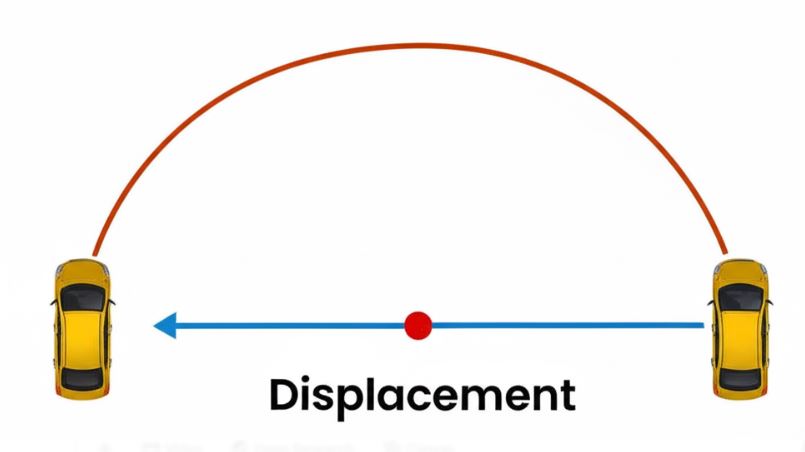
Look at the image: The curvy line is the path you actually walked (Distance). The straight arrow is the shortcut (Displacement).
- Distance: The total ground you covered. It doesn’t care about direction.
Example: If you walk 5m forward and 5m backward, your Distance is 10m. It is always positive. - Displacement: The shortest straight line from “Start” to “Finish”. It has direction.
Example: If you walk 5m forward and 5m backward to the same spot, your Displacement is Zero! (Because you are back where you started).
3. Types of Motion
- Uniform Motion: This is smooth driving on an empty highway. You cover equal distances in equal times (e.g., 60 km every hour). The graph is a straight line.
- Non-Uniform Motion: This is driving in city traffic. You speed up, slow down, and stop. You cover unequal distances in equal times.
4. Speed vs. Velocity
Speed tells you how fast you are going. Velocity tells you how fast AND in which direction.
- Speed: Calculated as Distance / Time. It is a scalar (only numbers). Unit: m/s.
- Velocity: Calculated as Displacement / Time. It is a vector (numbers + direction).
Formula: Average Velocity = (Initial Velocity $u$ + Final Velocity $v$) / 2.
5. Acceleration: Changing Speed
When you press the accelerator in a car, what happens? Your speed changes. Acceleration is the rate at which velocity changes.
Formula: $a = \frac{v – u}{t}$
- Positive Acceleration: Speeding up (e.g., a car starting).
- Negative Acceleration (Retardation): Slowing down (e.g., applying brakes).
- Unit: $m/s^2$.
6. Graphs: Telling a Story with Lines
Graphs help us see motion without reading numbers.
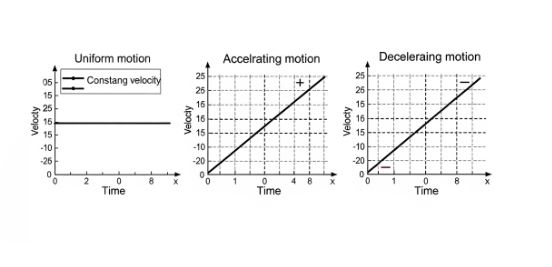
Velocity-Time Graphs: 1. Flat line = Constant speed (No acceleration). 2. Line going up = Speeding up (Acceleration). 3. Line going down = Slowing down (Deceleration).
Cheat Sheet for Graphs:
- Slope of Distance-Time Graph = Speed.
- Slope of Velocity-Time Graph = Acceleration.
- Area under Velocity-Time Graph = Displacement (Distance covered).
7. The 3 Equations of Motion
If an object is moving in a straight line with uniform acceleration, we can predict its future using these three famous formulas:
- $v = u + at$ (Relation between Velocity and Time)
- $s = ut + \frac{1}{2}at^2$ (Relation between Position and Time)
- $2as = v^2 – u^2$ (Relation between Position and Velocity)
Where: $u$ = initial velocity, $v$ = final velocity, $a$ = acceleration, $t$ = time, $s$ = distance.
8. Uniform Circular Motion
Imagine an athlete running on a circular track at a constant speed. Is his velocity constant? NO!
Why? Because his direction is changing at every single step. Since direction changes, velocity changes. Since velocity changes, this is an Accelerated Motion.
9. Practice Questions & Answers
Part A: Multiple-Choice Questions (MCQs)
- A car travels 10 km north and then 10 km east. What are the distance and the magnitude of the displacement?
a) Distance = 20 km, Displacement = 20 km
b) Distance = 20 km, Displacement = 14.14 km
c) Distance = 14.14 km, Displacement = 20 km
d) Distance = 20 km, Displacement = 0 kmAnswer: b) Distance = 20 km, Displacement = 14.14 km. (Distance is 10+10=20. Displacement is the hypotenuse of the triangle: $\sqrt{10^2 + 10^2} = \sqrt{200} \approx 14.14$).
- The slope of a velocity-time graph represents:
a) Speed
b) Displacement
c) Acceleration
d) DistanceAnswer: c) Acceleration. (Change in velocity over time is acceleration).
- An object moving in a circle at a constant speed is an example of:
a) Uniform motion
b) Uniform velocity
c) Uniformly accelerated motion
d) Motion with no accelerationAnswer: c) Uniformly accelerated motion. (Because the direction changes continuously).
- A bus starts from rest and accelerates uniformly to a speed of 12 m/s in 6 seconds. What is its acceleration?
a) 2 m/s²
b) 0.5 m/s²
c) 72 m/s²
d) 6 m/s²Answer: a) 2 m/s². (Formula: $a = (v-u)/t = (12-0)/6 = 2$).
- If an object travels from point A to point B and then returns to point A:
a) Its distance is zero, but its displacement is not.
b) Its displacement is zero, but its distance is not.
c) Both its distance and displacement are zero.
d) Its displacement is greater than its distance.Answer: b) Its displacement is zero, but its distance is not. (Start and end points are the same).
Part B: Short Answer Questions
- Distinguish between speed and velocity, giving two key differences.
Answer:
1. Direction: Speed has no direction (Scalar), whereas Velocity has direction (Vector).
2. Value: Speed can never be zero for a moving body, but Velocity can be zero (if displacement is zero). - What does the odometer of an automobile measure? Does it measure a scalar or a vector quantity?
Answer: The odometer measures the total distance travelled by the car. Since distance has no direction, it measures a scalar quantity.
- Can an object have zero displacement even if it has moved through a distance? Support your answer with an example.
Answer: Yes. If an object moves and returns to its initial starting point, the displacement is zero, but the distance is not. Example: A runner completing one full lap on a circular track.
- A train is traveling at 90 km/h. Brakes are applied to produce a uniform deceleration of 0.5 m/s². How far will the train go before it is brought to rest?
Answer:
Given: $u = 90 km/h = 25 m/s$, $v = 0$ (comes to rest), $a = -0.5 m/s^2$.
Using formula $2as = v^2 – u^2$:
$2(-0.5)s = 0^2 – 25^2$
$-1s = -625$
s = 625 meters. - Describe what a distance-time graph looks like for an object (a) at rest and (b) in uniform motion.
Answer:
(a) At Rest: A straight horizontal line parallel to the time axis.
(b) Uniform Motion: A straight inclined line passing through the origin.
Part C: Long Answer Questions
- A farmer moves along the boundary of a square field of side 20 m. It takes him 80 seconds to complete one round. What will be the magnitude of his displacement at the end of 4 minutes from his initial position?
Answer:
Side = 20m. Perimeter = 4 x 20 = 80m.
Time for 1 round = 80 sec.
Total time = 4 min = 240 seconds.
Number of rounds = Total Time / Time for 1 round = 240 / 80 = 3 rounds.
Since he completes exactly 3 full rounds, he returns to the starting point.
Therefore, Displacement = 0 meters. - Explain the difference between uniform and non-uniform motion. Draw and label the distance-time graphs for both types of motion.
Answer:
Uniform Motion: When an object covers equal distances in equal intervals of time (e.g., a clock hand). Graph: Straight Line.
Non-Uniform Motion: When an object covers unequal distances in equal intervals of time (e.g., a car in traffic). Graph: Curved Line. - Derive the first equation of motion, v = u + at, using a velocity-time graph for a body with uniform acceleration.
Answer:
Consider a velocity-time graph where velocity increases from $u$ (at t=0) to $v$ (at t=t).
The slope of the v-t graph represents acceleration ($a$).
Slope = Change in Y / Change in X
$a = (v – u) / (t – 0)$
$a = (v – u) / t$
$at = v – u$
v = u + at. - An artificial satellite is moving in a circular orbit of radius 42,250 km. Calculate its speed if it takes 24 hours to revolve around the Earth.
Answer:
Radius ($r$) = 42,250 km. Time ($t$) = 24 h.
Distance = Circumference = $2\pi r = 2 \times 3.14 \times 42250 \approx 265,330$ km.
Speed = Distance / Time
Speed = $265,330 / 24$
Speed ≈ 11,055 km/h. - A car accelerates uniformly from 18 km/h to 36 km/h in 5 seconds. Calculate: (a) acceleration, (b) distance covered.
Answer:
Convert to m/s: $u = 18 \times \frac{5}{18} = 5 m/s$, $v = 36 \times \frac{5}{18} = 10 m/s$, $t = 5s$.
(a) Acceleration: $a = \frac{v-u}{t} = \frac{10-5}{5} = \frac{5}{5} = \mathbf{1 m/s^2}$.
(b) Distance: $s = ut + \frac{1}{2}at^2$
$s = (5 \times 5) + \frac{1}{2} \times 1 \times (5)^2$
$s = 25 + 12.5$
s = 37.5 meters.
Motion
Read Also:
Class 9 Chapter 6- Tissues
For more check official website of
NCERT