1. The Invisible Threads of Nature: An Introduction
Hello, young scientists! Have you ever read in the news about wild elephants suddenly entering a village or a farm? Why do you think an animal that belongs in the deep forest would come near human settlements? Is it because they want to trouble us? Not at all!
In states like Assam, West Bengal, and Odisha, elephants often wander into farms looking for food like sugarcane or bananas. This usually happens when their natural forest homes dry up or when trees are cut down to build roads. Because their homes are shrinking, these gentle giants are forced to move into our spaces just to survive. This single example proves a massive scientific truth: everything in nature is deeply connected. To understand these magical connections, we have to look closely at our surroundings.
2. Habitats: Nature’s Residential Addresses
Just like you have a house address, every plant and animal has a specific place where it naturally lives and grows. We call this a habitat. A habitat can be as massive as an ocean, or as tiny as the rough bark of a single tree.
If you observe a simple pond, you will notice two main types of components making up that habitat:
- Biotic Components (The Living): These are all the living organisms. In a pond, this includes fish, frogs, turtles, snails, lotus plants, and microscopic algae.
- Abiotic Components (The Non-Living): These are the physical things that living creatures need to survive, such as water, sunlight, soil, air, and the right temperature.
A fish survives in a pond because the pond provides everything it needs: food (biotic) and oxygen dissolved in water (abiotic). Remember, different organisms in the exact same habitat might use it differently! For example, a snake might hunt at night when it’s cool, while a rodent might be active during the warm day. This is how different creatures share the same space peacefully.
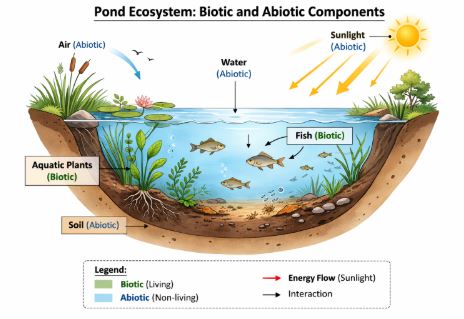
Figure-1: A pond habitat where biotic (living) and abiotic (non-living) components interact perfectly.
3. From Individuals to Ecosystems: The Ladder of Life
Nature is highly organized. Think of it like your school. A single student is an individual. All the students in Class 8 make up a population. All the different classes, teachers, and staff together make up the community. Let’s apply this to nature:
- Population: A group of the exact same type of organism living in a habitat. For example, all the lotus plants in a pond, or all the deer in a forest.
- Community: All the different populations living together in one habitat. A forest community includes the populations of deer, tigers, trees, birds, and insects.
- Ecosystem: This is the big boss! When the living community interacts with the non-living (abiotic) environment around them, it creates an ecosystem.
Ecosystems can be Terrestrial (land-based, like forests, grasslands, and farms) or Aquatic (water-based, like rivers, lakes, and oceans). Sometimes humans create their own ecosystems, called human-made ecosystems, like an agricultural farm or a park.
4. The Invisible Web: How Organisms Affect Each Other
Let’s look at a fascinating real-life mystery. Scientists once studied two ponds. Pond A had fish, and Pond B had no fish. Strangely, the flowering plants near Pond A produced way more seeds than the plants near Pond B. How could fish in the water affect flowers on the land?
Here is the chain of events the scientists discovered:
- Fish in Pond A loved to eat dragonfly larvae.
- Because the fish ate them, there were fewer adult dragonflies zooming around.
- Now, dragonflies usually eat small insects like bees and butterflies. With fewer dragonflies around, the population of bees and butterflies exploded!
- These bees and butterflies are pollinators. They visited the nearby flowers to drink nectar, carrying pollen from flower to flower.
- More pollination meant the plants produced more seeds!
Isn’t that mind-blowing? A change in the fish population directly impacted the plant population. This proves that every single organism, no matter how small, plays a critical role in the community.
5. The Food Kitchen of Nature: Producers, Consumers, and Decomposers
All these interactions mainly happen because everybody has to eat! Based on how they get their food, we group organisms into three amazing categories:
A. Producers (The Chefs)
Green plants are completely independent. Using sunlight, carbon dioxide, and water, they cook their own food through photosynthesis. Because they make their own food, they are called autotrophs (auto = self, troph = food) or Producers.
B. Consumers (The Diners)
Animals cannot make their own food. We must eat plants or other animals. Therefore, we are called heterotrophs (hetero = other) or Consumers. We can divide them further:
- Herbivores: Strictly vegetarian! They only eat plants (e.g., deer, hare).
- Carnivores: Meat-eaters! They hunt other animals (e.g., leopards, tigers).
- Omnivores: They enjoy a mixed diet of both plants and animals (e.g., crows, foxes, mice, humans).
C. Decomposers (The Clean-up Crew)
What happens to the waste and dead bodies in a forest? Why isn’t the forest filled with garbage? Meet the ultimate recyclers: the decomposers or saprotrophs (sapro = rotten). Microorganisms like bacteria and fungi (like mushrooms) break down dead plants and animals into simple nutrients. These nutrients mix into the soil, acting as natural fertilizer for new plants to grow. In nature, absolutely nothing is wasted!
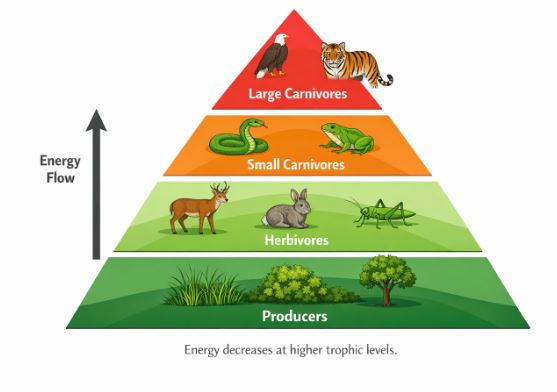
Figure-2: Trophic levels in an ecosystem. Energy flows from the bottom (Producers) to the top (Large Carnivores).
6. Who Eats Whom? Food Chains and Food Webs
If we draw a straight line to show who eats whom, we get a Food Chain. For example, in a grassland:
Grass → Grasshopper → Frog → Snake → Eagle
Each step in this chain is called a Trophic Level. The grass (producer) is the first trophic level, the grasshopper (herbivore) is the second, the frog is the third, and so on.
However, nature is never that simple. A frog doesn’t just eat grasshoppers; it might eat a fly or a mosquito. An eagle doesn’t just eat snakes; it might eat a mouse or a rabbit. When many different food chains interlink and cross over each other, they form a complex, tangled network called a Food Web.
7. Beyond Food: How Else Do We Interact?
Organisms don’t just interact by eating each other. They live as neighbors and form different types of relationships to survive. Let’s explore these fascinating friendships and rivalries:
- Competition: When two animals want the exact same thing. For example, two different birds fighting for the same fruit on a tree, or plants fighting for sunlight. This actually keeps the ecosystem healthy by making sure no single species overpopulates.
- Mutualism (Win-Win): A beautiful friendship where both organisms benefit. When a honeybee visits a flower, the bee gets tasty nectar, and the flower gets pollinated! Both are happy.
- Commensalism (Win-Neutral): One organism benefits, and the other simply doesn’t care. For example, a small orchid plant growing on the high branch of a massive tree. The orchid gets better sunlight, but the big tree is completely unaffected.
- Parasitism (Win-Lose): A toxic relationship where one benefits and the other is harmed. Think of a tick sucking blood from your pet dog. The tick gets a free meal, but the dog gets sick and itchy.
[Image showing examples of mutualism, commensalism, and parasitism in nature]
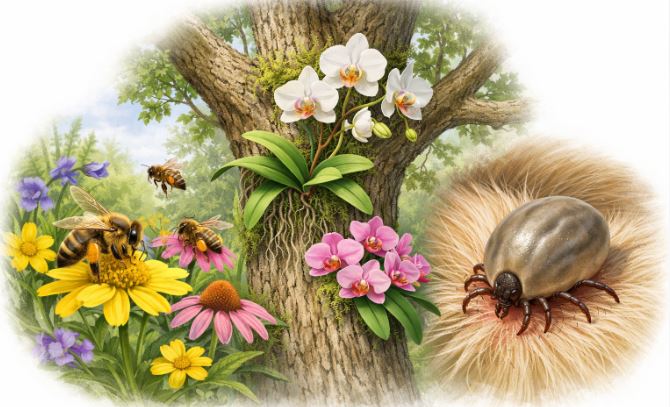
Figure-3: Different types of interactions in nature keep the ecosystem dynamic and balanced.
8. The Domino Effect: What Happens When Humans Interfere?
Nature has a perfect, delicate balance. But when humans greedily take too much, we knock over the first domino, causing a chain reaction of disasters.
Let me tell you a true story from India. In the 1980s, India was exporting a huge amount of frog legs (specifically the Indian bullfrog) to other countries for food. Because hunters caught so many frogs, the frog population in our ponds crashed. What happened next? Since frogs are the top predators of insects, the insect pest population exploded! These pests swarmed our agricultural fields, destroying crops. To save their crops, farmers had to spray heavy, toxic, synthetic pesticides, which polluted our soil and water, harming human health. Thankfully, the Government of India finally banned the export of frog legs to stop this ecological disaster. One small greedy action led to poisoned rivers. That is the domino effect!
9. Protecting Our Green Lifelines: Sundarbans and Sustainable Farming
Our ecosystems provide us with everything: fresh air, water, medicines, and food. Yet, we are destroying them. Take the Sundarbans, for example. It is the largest mangrove forest in the world, sitting right between India and Bangladesh where the Ganges and Brahmaputra rivers meet. UNESCO even declared it a World Heritage Site in 1987. These incredible trees act like a shield, protecting inland villages from deadly cyclones and floods. But today, they are dying because of pollution from industrial waste, illegal hunting, and cutting down trees for fuel.
The Problem with Modern Farming
We humans rely heavily on agriculture. During the Green Revolution (1950-1965), India used heavy machines and strong synthetic chemicals to grow more food and stop a food crisis. While it filled our stomachs, long-term use of these chemicals destroyed the soil. Chemical fertilizers killed the friendly soil microbes and destroyed the humus (organic matter that keeps soil soft and fertile). Without humus, soil erodes easily. Also, growing only one type of crop over and over again—a practice called monoculture—ruins crop diversity and drives away helpful pollinators.
To fix this, we must look backward to move forward. We need to embrace sustainable and organic farming. By using natural compost, rotating crops, and reducing chemicals, we can farm in harmony with nature without destroying it. Furthermore, our government has created Protected Areas like National Parks (e.g., Jim Corbett, Manas) and Wildlife Sanctuaries to keep these precious habitats totally safe from human destruction.
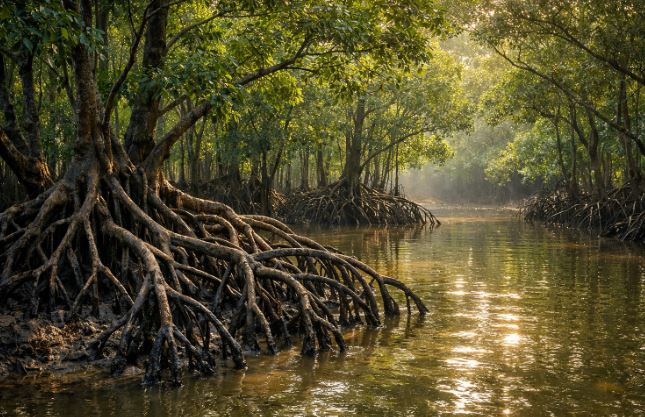
Figure-4: The mighty Sundarbans mangroves. They absorb carbon and block massive storm waves.
Common Misconceptions (Teacher’s Corner)
- Misconception: “Decomposers are harmful germs.”
Fact: While some bacteria cause illness, most decomposers (like soil bacteria and mushrooms) are the heroes of nature! Without them, dead matter would pile up endlessly, and plants would starve for nutrients. - Misconception: “Food chains always end with humans.”
Fact: Not at all! Many food chains exist purely in the wild without any human involvement, such as Algae → Small Fish → Shark.
Practice Questions (CBSE Pattern)
A. Very Short Answer Questions
Q1: Define a habitat.
Answer: A habitat is the natural home or environment where an organism lives, providing it with food, water, and shelter.
Q2: Give one example of an abiotic component and one of a biotic component in a forest.
Answer: Abiotic: Soil (or sunlight/water). Biotic: A deer (or trees/birds).
Q3: What term is used for organisms that can manufacture their own food?
Answer: Autotrophs or Producers.
B. Short Answer Questions
Q1: Differentiate between a population and a community using an example.
Answer: A population consists of individuals of the same species living in an area (e.g., all the lotus plants in a pond). A community is made up of all the different populations interacting in that same area (e.g., the lotus plants, fish, frogs, and turtles all living together in the pond).
Q2: Why is the practice of monoculture considered harmful to the ecosystem?
Answer: Monoculture is the practice of growing the exact same crop repeatedly on the same land. It is harmful because it reduces crop diversity, depletes specific nutrients from the soil, and negatively affects the populations of natural pollinators and helpful microbes.
Q3: Explain ‘Mutualism’ with a real-life example.
Answer: Mutualism is an interaction between two organisms where both of them benefit. For example, the relationship between a honeybee and a flower. The bee gets food (nectar) from the flower, and in return, the bee helps the flower reproduce by pollinating it.
C. Long Answer Questions
Q1: Describe the cascading effects on an ecosystem if all the top carnivores (like tigers and eagles) are hunted to extinction.
Answer: If top carnivores are removed, the ecological balance breaks down. Without predators, the population of herbivores (like deer and rabbits) would multiply rapidly. This massive number of herbivores would overgraze and eat all the available plants and producers. Soon, the forest cover would disappear, leading to soil erosion. Eventually, the herbivores themselves would starve to death due to a lack of food. The entire food web would collapse, proving that every trophic level is vital for harmony.
Q2: How do chemical fertilizers and synthetic pesticides affect soil health and agricultural sustainability over a long period?
Answer: While chemical fertilizers initially increase crop yield, their long-term use is destructive. They kill the friendly microorganisms and earthworms in the soil. This reduces the organic matter or ‘humus’, making the soil loose and prone to erosion. Furthermore, pesticides kill natural predators, which can ironically lead to a higher population of resistant pests. The chemicals also wash into water bodies, causing severe aquatic pollution. Therefore, moving towards sustainable and organic farming is essential.
D. Case-Based / Competency-Based Question
Read the following scenario and answer the questions:
Ravi visits a nearby lake and notices that the water is completely covered with thick, foul-smelling green algae. He sees dead fish floating near the banks. The local factory has been dumping untreated hot water and chemicals into the lake for months.
Q1: Identify the human-made change happening in this ecosystem.
Answer: The dumping of untreated factory chemicals and hot water, causing severe water pollution.
Q2: Based on your understanding of food webs, why are the fish dying?
Answer: The pollution may block sunlight or consume all the dissolved oxygen in the water. Without sufficient oxygen (an essential abiotic component), the fish (biotic component) cannot breathe and eventually die.
Q3: If the fish population dies out completely, what will likely happen to the population of mosquito larvae in that lake?
Answer: Since fish often eat insect larvae, the removal of fish (the consumer) will cause the mosquito larvae population to increase rapidly, leading to more mosquitoes in the area.
E. Assertion–Reason
Assertion (A): Decomposers like fungi and bacteria play a crucial role in maintaining the health of a forest.
Reason (R): Decomposers capture sunlight to produce fresh food for the herbivores in the forest.
Answer: Assertion is True, but Reason is False. Decomposers are vital because they break down dead organic matter and recycle nutrients back into the soil. They do not capture sunlight to make food; that is the job of producers (plants).
Read Also
For official syllabus and textbooks, visit the
NCERT Official Website.