1. What Is Science Really About?
Science is not only a subject where we learn facts. Science is a way of thinking. It begins with curiosity. Whenever we ask questions like why, how, or what will happen if, we are thinking like a scientist.
From lower classes, we have seen many things around us:
- Different plants
- Different animals
- Different shapes, colours, and patterns
Science helps us understand why such differences exist and how nature works. In earlier classes, we mostly observed things. Now, in Class 8, we move one step ahead and start investigating. Investigation means:
- Asking clear questions
- Planning simple experiments
- Observing carefully
- Drawing conclusions based on evidence
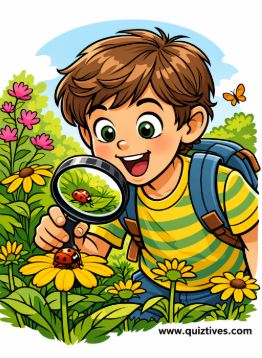
Figure-1: A curious student observing nature. Science starts with observation.
2. Journey from Curiosity to Investigation
Your journey in science has evolved over the years:
- In Grade 6: Science started with simple questions about our surroundings.
- In Grade 7: We learnt that science keeps changing. Old ideas improve when we get new evidence.
- In Grade 8: Science becomes more systematic.
Now we do not only ask questions, we also decide what to observe, what to change, and what to measure. This step-by-step process is called scientific investigation.
3. Who Is a Young Scientist?
A scientist is not only someone working in a laboratory. A student can also be a scientist if they:
- Observe carefully
- Ask meaningful questions
- Test ideas
- Think logically
Science does not need expensive equipment. Even daily life activities like cooking, playing, or watching the weather can become scientific investigations.
4. Importance of Observation in Science
Observation is the first step of science. It means noticing things carefully using our senses. Examples include noticing how dough rises, observing how water boils, or watching the movement of clouds.
Good observation helps us ask better questions. In the book design:
- Roots show strong basic knowledge.
- Kite shows imagination and curiosity.
Science works best when both are balanced.
5. From Small Things to Big Problems
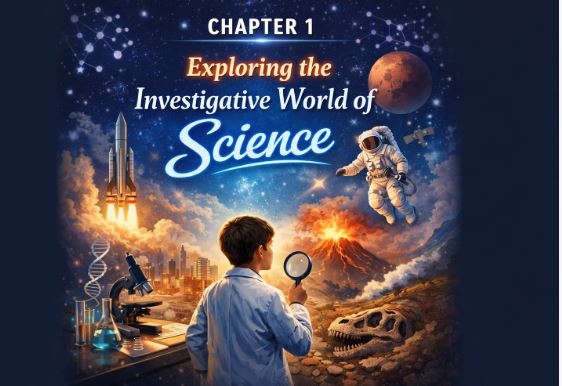
Science does not study only one size of problems. It starts from a drop of water (microorganisms), moves to human health, then to machines and electricity, and finally to the Earth and environment. This shows that science connects small observations to large real-world issues.
6. Microorganisms and Human Health
In a drop of water, there are many tiny living organisms called microbes. Some are helpful (help in digestion, used in medicines) and some are harmful (cause diseases and infections).
To stay healthy, our body needs nutritious food, exercise, medicines, and vaccines. Science helps us understand how these protect us from diseases.
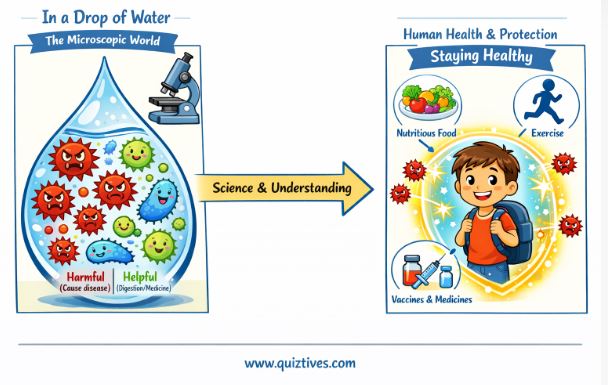
Figure-2: Understanding microbes helps us develop vaccines and stay healthy.
7. Role of Science in Daily Life
Science improves our life in many ways. Electric current is used for heating (heater, iron), running motors, and operating machines. These effects of electricity depend on forces.
8. Understanding Forces
A force can change speed, change direction, or stop motion. For example, a ball falls back due to gravity, and a car stops due to braking force. Understanding forces helps explain many daily events.
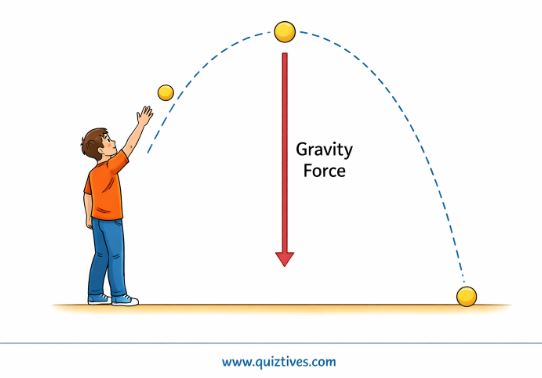
Figure-3: Forces like gravity affect the motion of objects, like a ball falling back to Earth.
9. Pressure and Weather
Pressure is related to force and area. In air, a small pressure difference creates a breeze, while a large pressure difference creates strong winds or cyclones. Thus, force and pressure help explain wind, storms, and cyclones, which affect agriculture, daily life, and human safety.
10. Particle Nature of Matter
Everything around us is made of tiny particles. In solids, particles vibrate but do not move freely. In liquids, particles move slowly. In gases, particles move freely. This explains why air can be compressed, why water flows, and why solids keep their shape.
11. Classification of Materials
Science classifies materials to understand them better. Materials are classified into:
- Elements: Pure substances.
- Compounds: Two or more elements chemically combined.
- Mixtures: Substances mixed physically (e.g., sugar dissolving in tea forms a solution).
12. Light and Its Behaviour
Light helps us see objects. Important properties include reflection from mirrors and bending of light through lenses (refraction). This explains the image in a spoon and the working of spectacles. Even rough surfaces reflect light.
13. Phases of the Moon and Calendars
The Moon does not produce light; it reflects sunlight. Different positions of the Earth, Moon, and Sun cause different phases of the Moon. Observing these phases helped humans make calendars and time systems. Our daily routines are linked to space movements.
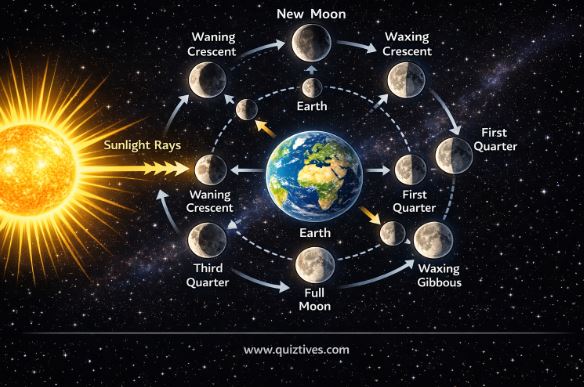
Figure-4: The changing positions of Earth, Moon, and Sun create the Moon’s phases.
14. Ecosystems and Earth
Living organisms depend on air, water, sunlight, and other organisms. Together, they form an ecosystem. Every organism has a role, from insects to trees.
Earth is a special planet because it is at the correct distance from the Sun, has liquid water, and has an atmosphere that provides oxygen and blocks harmful rays. Small changes in temperature can disturb this balance.
15. Human Activities and Climate Change
Human activities can increase temperature, change climate patterns, and cause extreme weather. Humans are both the cause of the problem and the solution. Science helps us understand changes and take correct action.
16. Thinking Like a Scientist: The Puri Example
Question: Why is one side of a puri thinner than the other? This shows how science works in daily life. A systematic investigation involves steps:
- Ask a clear question
- Decide what to change (variable, e.g., oil temperature)
- Decide what to observe (puffing, time)
- Change only one thing at a time
- Record observations
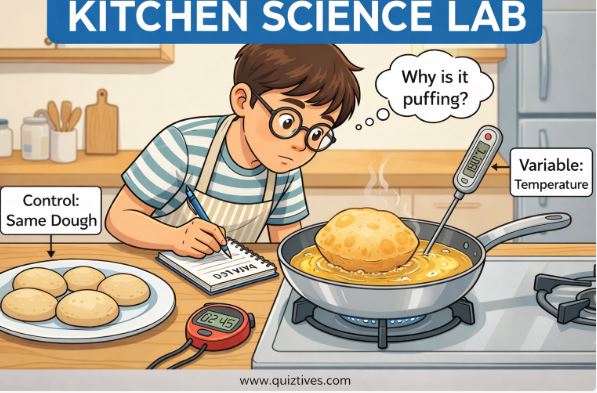
Figure-5: A simple kitchen experiment to understand scientific investigation.
17. Scientific Method in Simple Words
Scientific investigation includes: Observation, Question, Experiment, Measurement, and Conclusion. Even scientists do not know all answers. Science is always growing.
Practice Questions (CBSE Pattern)
A. Very Short Answer Questions
Q1: What is curiosity?
Answer: Curiosity is the desire to know or understand something.
Q2: What is scientific investigation?
Answer: A step-by-step method to study a problem using observation and experiment.
Q3: Name one example of force in daily life.
Answer: Braking of a car.
Q4: What are microbes?
Answer: Very small living organisms not visible to naked eyes.
B. Short Answer Questions
Q1: Why is observation important in science?
Answer: Observation helps us notice details and ask correct scientific questions.
Q2: How does science help in daily life?
Answer: Science provides electricity, medicines, machines, and better living conditions.
Q3: What causes different phases of the Moon?
Answer: Different relative positions of Earth, Moon, and Sun.
C. Long Answer Questions
Q1: Explain the role of pressure in weather changes.
Answer: Differences in air pressure cause wind movement. Large pressure differences result in storms and cyclones.
Q2: Describe the steps of scientific investigation using an example.
Answer: Scientific investigation includes observation, asking questions, experimenting, measuring, and concluding. Example: observing how puri puffs when fried.
D. Case-Based Question
A student changes oil temperature while frying puris but keeps dough thickness same.
Q1: What is the variable changed?
Answer: Oil temperature.
Q2: Why should only one factor be changed at a time?
Answer: To get correct and clear results.
E. Assertion–Reason
Assertion: Science is always changing.
Reason: New evidence improves old ideas.
Answer: Both assertion and reason are true, and reason explains assertion.
Read Also
For official syllabus and textbooks, visit the
NCERT Official Website.