
1. Introduction: The Invisible Forces Around Us | Class 8 Science Chapter 6 Pressure Winds Storms and Cyclones Notes
Have you ever struggled to walk against a strong wind? Or noticed how leaves swirl in circles before a rainstorm? These aren’t just random events; they are the result of invisible forces acting all around us. In this chapter, we are going to act like detectives uncovering the secrets of Air and Pressure.
We often think of air as “nothing” because we cannot see it. But air is actually very powerful. It pushes, it presses, and when it moves fast, it can even lift heavy roofs! To understand storms and cyclones, we first need to understand the basic concept of Pressure.
2. Understanding Pressure
Imagine you are trying to push a drawing pin into a notice board. If you push the flat head against the board, it won’t go in. But if you push the sharp point, it slides in easily. Why? You are using the same amount of strength (force) in both cases.
The answer lies in the Area. The sharp point has a very tiny area, while the flat head has a larger area. This brings us to the scientific definition:
Pressure is the force acting on a unit area of a surface.
Formula: Pressure = Force / Area
This formula tells us two very important things about how nature works:
- Smaller Area = Higher Pressure: This is why knives are sharp (small area cuts easily) and why nails are pointed.
- Larger Area = Lower Pressure: This is why school bags have broad straps. A thin strap would put all the weight on a thin line on your shoulder, causing pain (high pressure). A broad strap distributes the weight over a larger area, reducing the pressure and making it comfortable.
The Unit of Pressure: Since Force is measured in Newtons (N) and Area in square metres (m²), the unit is N/m². In honour of the scientist Blaise Pascal, we call this unit the Pascal (Pa).
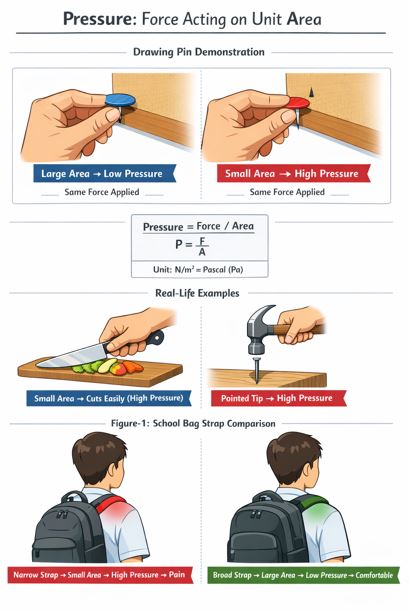
Figure-1: Broad straps reduce pressure on shoulders by increasing the contact area, making heavy loads easier to carry.
3. Pressure Exerted by Liquids and Gases
It is not just solid objects like nails or bags that exert pressure. Fluids (liquids and gases) do it too. Let’s look at how water behaves.
A. Liquid Pressure Depends on Depth
Have you noticed that water tanks are always placed on the roof of a house, never in the basement? This is because the pressure of water increases with height (or depth). The taller the column of water, the more pressure it exerts at the bottom. If you poke holes in a bottle at different heights, the water from the lowest hole will shoot out the farthest because the pressure is highest at the bottom.
B. Liquids Exert Pressure in All Directions
Water doesn’t just push down; it pushes sideways too. If you fill a balloon with water and poke a hole on the side, water spurts out. This proves that liquids exert pressure on the walls of the container as well.
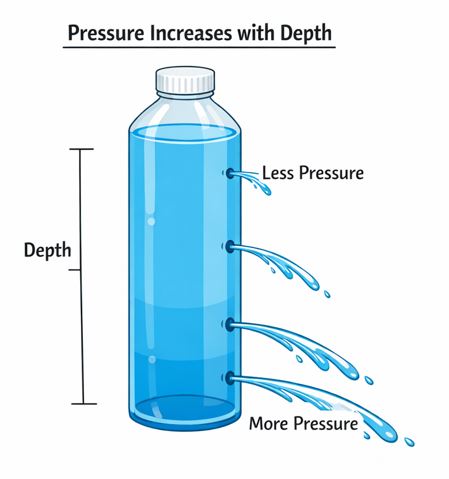
Figure-2: Water jets from the bottom hole travel farthest, proving that liquid pressure increases with depth.
4. The Weight of Air: Atmospheric Pressure
We live at the bottom of a massive ocean of air called the Atmosphere. This air has weight, and it pushes down on us constantly. This push is called Atmospheric Pressure.
You might be surprised to know that the air column over your head exerts a force equal to a large car (about 2250 N on a small 15×15 cm area)!
“Teacher, if the pressure is so high, why don’t we get crushed?”
That is a great question! The reason we aren’t crushed is that the fluids (blood and air) inside our bodies exert an equal pressure outwards. This internal pressure balances the external atmospheric pressure.
Experiment: The Rubber Sucker
When you press a rubber sucker hook against a wall, you squeeze out the air between the cup and the wall. Now, the atmospheric pressure outside is much higher than the pressure inside. This outside air pushes the sucker firmly against the wall, making it stick. To pull it off, you need to use enough force to overcome the atmospheric pressure.
5. How Wind is Formed: The Movement of Air
Air is never still. When air moves, we call it Wind. But what makes it move?
Nature hates imbalance. Air always moves from a region of High Pressure to a region of Low Pressure. The greater the difference in pressure, the faster the wind blows.
Uneven Heating of the Earth
The main cause of wind is the uneven heating of the Earth by the Sun:
- Equator vs. Poles: The equator gets maximum heat. Warm air rises (creating Low Pressure), and cooler air from the latitudes (0-30 degrees) rushes in to take its place. This creates wind currents.
- Land vs. Water (Sea Breeze): During the day, land heats up faster than the sea. The air over land gets hot and rises, creating a Low-Pressure zone. Cool air from the sea (High Pressure) rushes towards the land. This is the refreshing Sea Breeze. At night, the process reverses.
6. High-Speed Winds and Reduced Air Pressure
This is one of the most interesting concepts in science, often called the Bernoulli principle (though you just need to know the effect for now).
Golden Rule: High-speed winds are accompanied by reduced air pressure.
The Balloon Experiment
If you hang two balloons slightly apart and blow air purely between them, what happens? You might think they will move apart, but they actually move towards each other!
Why? When you blow fast air between them, the pressure in that space drops (decreases). The air on the outer sides of the balloons is still at normal (higher) pressure. This higher outside pressure pushes the balloons inward.
Why Roofs Blow Off
During a storm, wind blows at high speed over the roof of a house. This creates Low Pressure above the roof. Inside the house, the air is still, so the pressure is High. This pressure difference creates an upward force that can lift the roof and blow it away. This is why we are advised to open windows during a storm—to equalize the pressure inside and outside.
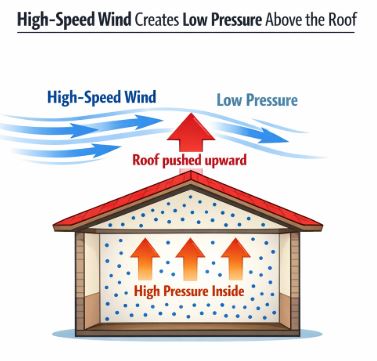
Figure-3: High-speed wind over a roof creates low pressure, while high pressure inside pushes the roof upwards.
7. Thunderstorms and Lightning
In hot and humid areas like India, thunderstorms are common. Here is the recipe for a thunderstorm:
- Heat: The sun heats the ground, causing air to rise (convection).
- Moisture: This rising air carries water vapour.
- Freezing: As it goes higher, it cools down, and water vapour condenses and freezes.
- Friction: The falling water droplets and rising ice crystals collide. This rubbing creates Static Electricity.
Positive charges collect at the top of the cloud, and negative charges collect at the bottom. When the charge difference becomes too large, the air (which is usually an insulator) cannot stop the flow. ZAP! A streak of electricity connects the charges. This is Lightning.
The lightning heats the air instantly to 30,000°C! This explosive expansion of air creates the loud boom we call Thunder.
8. Cyclones: The Rotating Storms
Under specific conditions, a storm can evolve into a cyclone. Cyclones are giant engines that use warm, moist air as fuel.
Formation of a Cyclone
- Warm Water: Cyclones only form over warm oceans. The heat causes water to evaporate rapidly.
- Rising Air: This warm, moist air rises, creating a strong Low-Pressure area at the surface.
- Spiral Movement: Cool air rushes in to fill the gap. Due to Earth’s rotation, this rushing air starts to spin.
- The Eye: The center of the cyclone is a calm, cloudless area called the Eye. But around the eye, there is a wall of clouds with violent winds and heavy rain.
When the cyclone hits land (landfall), it loses its supply of warm moisture and gradually dies down. But before that, it causes destruction through strong winds and storm surges (rising sea water).
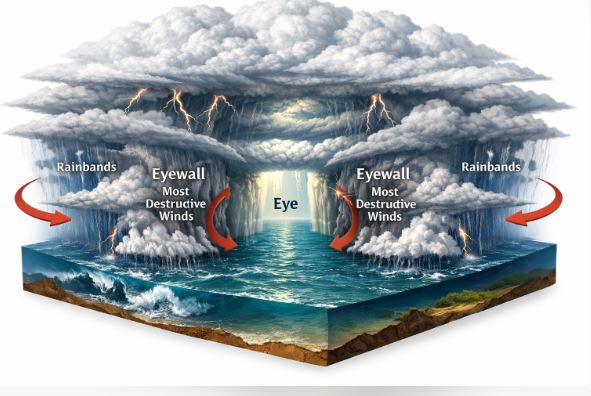
Figure-4: A cross-section of a cyclone. The ‘Eye’ is calm, but the eyewall has the most destructive winds.
9. Safety and Technology
We cannot stop storms, but we can stay safe. Science and technology have given us great tools:
- Satellites and Radars: These help the India Meteorological Department (IMD) track cyclones days in advance.
- Alerts: Warnings are broadcasted on radio and TV every hour when a cyclone is near.
- Lightning Conductors: Metal rods placed on tall buildings transfer the electric charge of lightning safely into the ground, protecting the building.
Safety Tip: If you are caught in a thunderstorm, do not stand under an isolated tree. If you are in a cyclone zone, keep an emergency kit ready and listen to official advice.
Practice Questions (CBSE Pattern)
A. Very Short Answer Questions
Q1: What is the SI unit of pressure?
Answer: The SI unit of pressure is the Pascal (Pa), which is equal to 1 Newton per square metre (N/m²).
Q2: Name the instrument used to measure atmospheric pressure.
Answer: Barometer.
Q3: Which region of a cyclone is calm and free of clouds?
Answer: The Eye of the cyclone.
B. Short Answer Questions
Q1: Why are the rear wheels of tractors or heavy trucks made very broad?
Answer: Heavy vehicles exert a large force (weight) on the ground. By making the tires broad, the area of contact increases. Since Pressure = Force/Area, increasing the area reduces the pressure on the ground, preventing the tires from sinking into soft soil.
Q2: Explain why a tin can gets crushed when cold water is poured over it after heating.
Answer: When water is boiled in the can, steam drives the air out. When the can is sealed and cold water is poured, the steam inside condenses into water, creating a partial vacuum (low pressure). The external atmospheric pressure is now much higher than the internal pressure, crushing the can inwards.
Q3: Why is it advised not to carry fountain pens while travelling in an aeroplane?
Answer: At high altitudes, the atmospheric pressure decreases. The pressure of the ink inside the pen remains higher than the outside air pressure. This pressure difference forces the ink to leak out.
Q4: “High-speed winds are accompanied by reduced air pressure.” Give one daily life example to prove this.
Answer: When we hold a strip of paper near our mouth and blow over it, the paper lifts up. This happens because the fast-moving air above the paper creates a region of low pressure, while the air below the paper is at higher normal pressure, pushing the paper upwards.
C. Long Answer Questions
Q1: Describe the formation of a thunderstorm and how lightning occurs.
Answer: A thunderstorm forms when hot, humid air rises rapidly. As it reaches higher altitudes, the moisture freezes into ice crystals. The swift movement of falling water droplets and rising air causes friction, leading to a separation of charges. Positive charges collect near the top of the cloud and negative charges at the bottom. When the magnitude of accumulated charges becomes very large, the air insulation breaks, and electric current flows between the clouds or to the ground as a bright streak called lightning.
Q2: Suggest safety measures one should take during a cyclone.
Answer:
- Do not ignore warnings issued by the meteorological department.
- Make necessary arrangements to shift essential household goods and cattle to safer places.
- Keep an emergency kit ready with food, water, and first aid.
- Switch off electrical mains and gas supply.
- Stay indoors and away from windows.
- If outside, avoid touching wet electric wires and fallen power lines.
D. Case-Based / Competency Question
Case: Rohan observed that during the summer, the wind usually blows from the sea towards the land in the afternoon. However, when he visited the seaside at night, he noticed the wind direction had reversed.
Q1: What is the wind blowing from sea to land during the day called?
Answer: Sea Breeze.
Q2: Explain the scientific reason behind the reversal of wind direction at night.
Answer: At night, both land and sea cool down. However, land cools down faster than water. Therefore, the air over the sea remains warmer (creating low pressure) compared to the air over the land (high pressure). Air moves from high to low pressure, so the wind blows from the land towards the sea (Land Breeze).
E. Assertion–Reason
Assertion: It is difficult to pull a rubber sucker off a smooth surface.
Reason: The pressure of air inside the sucker is much higher than the atmospheric pressure.
Answer: (c) Assertion is true, but Reason is false.
Explanation: The sucker sticks because the air inside is pushed out, creating a vacuum or low pressure. The high atmospheric pressure outside pushes it against the wall, not the pressure inside.
Read Also
For official syllabus and textbooks, visit the
NCERT Official Website.