
Introduction | Class 12 Physics Chapter 8 Electromagnetic Waves Notes
Welcome, students! We have reached a fascinating turning point in our Physics journey. In previous chapters, we established a very strong relationship between electricity and magnetism, but it was somewhat one-sided.
Let’s recap what we know. Oersted discovered that a current-carrying wire produces a magnetic field. Then, Faraday showed us the reverse: a changing magnetic field produces an electric field (EMF). This naturally leads to a very scientific question: Is nature symmetrical? If a changing magnetic field creates an electric field, does a changing electric field create a magnetic field?
For a long time, the answer wasn’t clear. It took the genius of James Clerk Maxwell to say “Yes!” and prove it mathematically. This chapter isn’t just about waves; it is about the unification of electricity, magnetism, and optics. We will see how light itself is just a ripple in the electromagnetic field. Let’s dive in!
1. The Inconsistency in Ampere’s Law
1.1 Spotting the Flaw
Recall Ampere’s Circuital Law from Chapter 4. It states that the line integral of the magnetic field $\vec{B}$ around a closed loop is equal to $\mu_0$ times the total current threading the loop.
$$\oint \vec{B} \cdot d\vec{l} = \mu_0 I$$
This law works perfectly for steady currents. However, Maxwell found a major logical flaw when applying this to a capacitor that is being charged.
The Capacitor Paradox:
Imagine a parallel plate capacitor being charged by a battery. Current $I(t)$ flows through the wires.
- Case A: Consider a loop around the wire outside the capacitor plates. Current passes through the surface bounded by this loop. Ampere’s law gives $B = \frac{\mu_0 I}{2\pi r}$. This makes sense.
- Case B: Now, imagine a pot-shaped surface that shares the same loop rim but dips between the capacitor plates. Inside the capacitor, there is no wire, and thus no conduction current ($I=0$). According to standard Ampere’s law, the magnetic field $B$ should be zero.
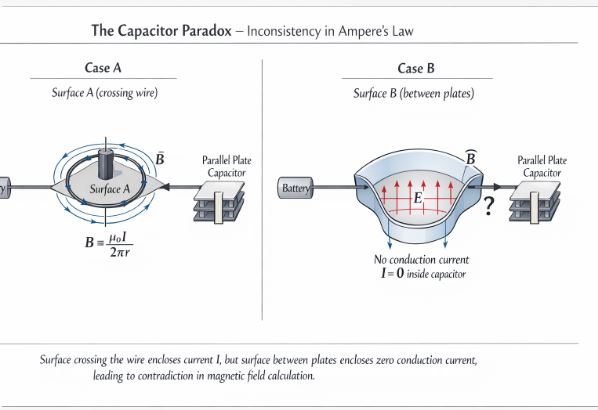
Figure-1: The surface crossing the wire has current I, but the surface passing between plates has zero current, creating a contradiction in calculating Magnetic Field B.
The Contradiction: Physically, the magnetic field at a specific point cannot depend on which imaginary surface we choose to calculate it. The field exists continuously. Therefore, something was missing from Ampere’s Law to account for the gap between the plates.
1.2 Maxwell’s Solution: Displacement Current
Maxwell argued that while there is no charge flowing between the plates, there is a changing Electric Field ($E$). As the capacitor charges, the charge $Q$ on plates increases, and since $E = \sigma / \epsilon_0 = Q / (A\epsilon_0)$, the Electric Field increases with time.
Maxwell proposed that this time-varying electric field acts as a “source” of the magnetic field, just like a current does. He called this the Displacement Current ($I_d$).
Derivation:
Electric Flux $\Phi_E = E \times A = \frac{Q}{\epsilon_0 A} \times A = \frac{Q}{\epsilon_0}$.
Differentiating with respect to time:
$$\frac{d\Phi_E}{dt} = \frac{1}{\epsilon_0} \frac{dQ}{dt}$$
Since $dQ/dt$ is the current $I$:
$$I = \epsilon_0 \frac{d\Phi_E}{dt}$$
This quantity is the Displacement Current ($I_d$).
Teacher’s Analogy:
Think of a relay race. Outside the capacitor, the “Conduction Current” carries the baton. As soon as it hits the capacitor plate, it hands the baton over to the “Displacement Current” which carries it across the gap. On the other side, it hands it back to the Conduction Current. The path is continuous!
2. The Ampere-Maxwell Law
With the discovery of displacement current, Maxwell corrected the fourth equation of electromagnetism. The total current is the sum of conduction current ($I_c$) and displacement current ($I_d$).
The Generalized Formula:
$$\oint \vec{B} \cdot d\vec{l} = \mu_0 (I_c + I_d)$$
$$\oint \vec{B} \cdot d\vec{l} = \mu_0 I_c + \mu_0 \epsilon_0 \frac{d\Phi_E}{dt}$$
Implications:
- In a steady wire, $\frac{d\Phi_E}{dt} = 0$, so we get back the old Ampere’s Law.
- In empty space with no wires ($I_c=0$), a changing electric field can still create a magnetic field. This is the secret to how waves travel through a vacuum!
3. Maxwell’s Equations: The Foundation of Electrodynamics
Just as Newton has three laws for Mechanics, Electromagnetism relies on four fundamental equations known as Maxwell’s Equations. You must memorize the physical meaning of these for your board exams.
- Gauss’s Law for Electricity: $\oint \vec{E} \cdot d\vec{A} = Q/\epsilon_0$
Meaning: Electric charges produce electric fields. Field lines start on positive and end on negative charges. - Gauss’s Law for Magnetism: $\oint \vec{B} \cdot d\vec{A} = 0$
Meaning: Magnetic monopoles do not exist. Magnetic field lines are always closed loops; they don’t start or end at a point. - Faraday’s Law: $\oint \vec{E} \cdot d\vec{l} = – \frac{d\Phi_B}{dt}$
Meaning: A changing magnetic field produces an electric field. - Ampere-Maxwell Law: $\oint \vec{B} \cdot d\vec{l} = \mu_0 I_c + \mu_0 \epsilon_0 \frac{d\Phi_E}{dt}$
Meaning: A magnetic field is produced by an electric current OR a changing electric field.
4. Electromagnetic Waves: Source and Nature
4.1 How are they produced?
This is a very common conceptual question.
- Stationary Charge? Produces only a static Electric field. No waves.
- Charge moving at constant velocity? Produces a static Magnetic field and Electric field. No waves.
- Accelerated Charge? Bingo! An oscillating or accelerating charge produces a time-varying electric field, which produces a time-varying magnetic field, which regenerates the electric field… and the wave propagates!
Example: An electron oscillating in an antenna produces Radio Waves. An electron jumping energy levels in an atom produces Light or X-rays.
4.2 Nature of EM Waves
Electromagnetic waves are Transverse Waves. This means the oscillation of the fields is perpendicular to the direction the wave is moving.
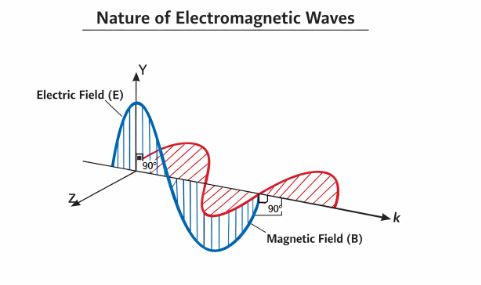
Figure-2: Propagation of an EM Wave. Notice that the Electric Field (E), Magnetic Field (B), and Direction of Propagation (k) are mutually perpendicular.
Key Properties (Board Exam Checklist):
- Self-Sustaining: They do not require a material medium. They can travel through a vacuum.
- Perpendicularity: $\vec{E} \perp \vec{B} \perp \text{Direction of Propagation}$.
- Phase: The peaks of the Electric field and Magnetic field occur at the exact same time and place. They are in the same phase.
- Speed in Vacuum: All EM waves travel at the speed of light ($c$).
$$c = \frac{1}{\sqrt{\mu_0 \epsilon_0}} \approx 3 \times 10^8 \text{ m/s}$$ - Relation between E and B: The magnitude of the electric field is much stronger than the magnetic field.
$$c = \frac{E_0}{B_0}$$
or $E_0 = c B_0$. - Energy Transport: They carry energy and momentum. If a wave hits a surface, it exerts a pressure called Radiation Pressure.
5. The Electromagnetic Spectrum
Students, this is the “general knowledge” part of the chapter, but it is crucial for exams. The spectrum classifies waves based on their frequency (or wavelength).
Mnemonic to Remember Order (Low Freq to High Freq):
“Radio Martians Invaded Venus Using X-ray Guns”
(Radio, Micro, Infrared, Visible, UV, X-ray, Gamma)
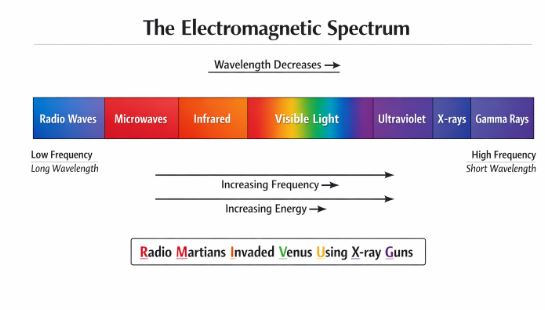
Figure-3: The Electromagnetic Spectrum. Note how Wavelength decreases as Frequency increases. Energy also increases from Radio to Gamma.
Let’s break them down briefly:
| Wave Type | Source / Production | Key Applications |
|---|---|---|
| Radio Waves | Rapid acceleration of electrons in aerials (antennas). | Radio & TV broadcasting, Cellular phones. |
| Microwaves | Klystron or Magnetron valves; Gunn Diodes. | Radar systems (Aircraft navigation), Microwave Ovens, Speed guns. |
| Infrared (Heat Waves) | Hot bodies and molecules; Vibration of atoms. | TV Remotes, Physiotherapy (Heat lamps), Night vision goggles, Greenhouse effect. |
| Visible Light | Electrons moving from higher to lower energy levels in atoms. | Vision, Photography, Optical Fibre communication. |
| Ultraviolet (UV) | Very hot bodies (Sun), special lamps. | Water purification (kills germs), LASIK eye surgery. Caution: Causes sunburn. |
| X-rays | Bombarding heavy metal targets with high-energy electrons. | Medical diagnosis (Fractures), Cancer treatment, Airport security scanning. |
| Gamma Rays | Radioactive decay of atomic nuclei. | Cancer treatment (Radiotherapy), Sterilizing medical equipment. |
6. Solved Numericals (Teacher’s Walkthrough)
Physics is incomplete without math. Let’s look at how to tackle the standard problems from this chapter.
Numerical 1: Calculating Magnetic Field Amplitude
Question: A plane electromagnetic wave travels in free space. The electric field amplitude is $E_0 = 120 \text{ N/C}$. Calculate the amplitude of the magnetic field ($B_0$).
Solution:
We know the relationship $c = \frac{E_0}{B_0}$.
Rearranging for $B_0$:
$$B_0 = \frac{E_0}{c}$$
Substitute values ($c = 3 \times 10^8 \text{ m/s}$):
$$B_0 = \frac{120}{3 \times 10^8} = 40 \times 10^{-8} \text{ T}$$
$$B_0 = 4 \times 10^{-7} \text{ Tesla (or 400 nT)}$$
Teacher Tip: Notice how small $B$ is compared to $E$. This is why we usually detect the electric part of the wave in antennas.
Numerical 2: Frequency and Wavelength
Question: A radio station broadcasts at 100 MHz. What is the wavelength of the wave?
Solution:
Formula: $c = \nu \lambda$ (Speed = Frequency $\times$ Wavelength).
Given $\nu = 100 \text{ MHz} = 100 \times 10^6 \text{ Hz} = 10^8 \text{ Hz}$.
$$\lambda = \frac{c}{\nu} = \frac{3 \times 10^8}{10^8}$$
$$\lambda = 3 \text{ meters}$$
Numerical 3: The Equation of a Wave
Question: The magnetic field in a plane EM wave is given by $B_y = 2 \times 10^{-7} \sin(0.5 \times 10^3 x + 1.5 \times 10^{11} t)$ T. Write the expression for the electric field.
Solution:
1. Identify direction: The term $(kx + \omega t)$ implies propagation along the negative x-direction.
2. Identify orientation: B is along the y-axis ($B_y$). Since propagation is along x, and $\vec{E} \times \vec{B}$ gives propagation direction, E must be along the z-axis.
3. Calculate Amplitude: $E_0 = c B_0 = (3 \times 10^8)(2 \times 10^{-7}) = 60 \text{ V/m}$.
4. Write Equation: The phase part $(kx + \omega t)$ remains exactly the same.
$$E_z = 60 \sin(0.5 \times 10^3 x + 1.5 \times 10^{11} t) \text{ V/m}$$
7. Real-Life Examples (Concept Application)
- The Greenhouse Effect: Why does the inside of a car get hot in the sun? Visible light passes through the glass easily. It heats the dashboard. The dashboard re-radiates this energy, but as Infrared waves. Glass is opaque to infrared! The heat gets trapped. This is exactly how the Earth’s atmosphere keeps us warm.
- Microwave Ovens: These ovens use a specific frequency of microwaves that matches the resonant frequency of water molecules. The waves make the water molecules vibrate wildly, generating heat. That’s why dry plates don’t get hot, but the food (containing water) does.
- X-Rays at the Dentist: Why do they put a lead apron on you? Lead is dense enough to block X-rays, protecting your vital organs while the dentist takes a picture of your teeth.
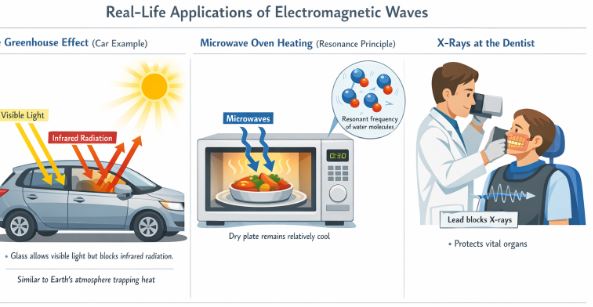
Figure-4: Microwave ovens utilize the principle of resonance to transfer energy efficiently to water molecules in food.
8. Important Board Exam Summary
For your Class 12 Boards, focus on these areas:
- Definitions: Displacement current and the inconsistency in Ampere’s Law.
- Diagrams: Drawing the E and B fields of a propagating wave (Make sure they are perpendicular!).
- Uses: Memorize at least two uses for every part of the EM spectrum. This is a guaranteed 2-mark question.
- Formulas: $c = E/B$ and $c = 1/\sqrt{\mu_0\epsilon_0}$.
Class 12 Physics Chapter 8 Practice Set
I have designed this set based on the latest CBSE pattern. Try solving these without looking at the solutions first!
Section A: Very Short Answer (1 Mark)
Q1. The charging current for a capacitor is 0.25 A. What is the displacement current across its plates?
Answer: The displacement current $I_d$ is always equal to the conduction current $I_c$ inside the circuit. Therefore, $I_d = 0.25$ A.
Q2. To which part of the electromagnetic spectrum does a wave of frequency $5 \times 10^{19}$ Hz belong?
Answer: This is a very high frequency. Using $c=\nu\lambda$, the wavelength is extremely small. This range corresponds to Gamma Rays.
Section B: Short Answer (2-3 Marks)
Q3. Why are infrared waves often called “heat waves”? Explain their role in maintaining Earth’s average temperature.
Answer: Infrared waves are called heat waves because they are readily absorbed by water molecules and other atoms in materials. This absorption increases the kinetic energy (vibration) of the molecules, which manifests as a rise in temperature.
Role in Earth’s Temperature: The Earth absorbs visible light from the sun and re-radiates it as Infrared radiation. Greenhouse gases (like $CO_2$ and water vapor) trap this infrared radiation, preventing it from escaping into space, thereby keeping the planet warm enough for life (Greenhouse Effect).
Q4. Show that the average energy density of the electric field equals the average energy density of the magnetic field in an electromagnetic wave.
Answer:
Electric Energy density $u_E = \frac{1}{2}\epsilon_0 E^2$.
Magnetic Energy density $u_B = \frac{1}{2\mu_0} B^2$.
We know $E = cB$ and $c = \frac{1}{\sqrt{\mu_0\epsilon_0}}$.
Substitute $E = cB$ into $u_E$:
$$u_E = \frac{1}{2}\epsilon_0 (cB)^2 = \frac{1}{2}\epsilon_0 \left( \frac{1}{\mu_0\epsilon_0} \right) B^2$$
$$u_E = \frac{1}{2\mu_0} B^2 = u_B$$
Hence proved.
Section C: Long Answer (5 Marks)
Q5. (a) Identify the part of the electromagnetic spectrum used in (i) Radar systems, (ii) Eye surgery.
(b) Prove that electromagnetic waves carry momentum and hence exert pressure.
Answer:
(a) (i) Radar systems use Microwaves due to their short wavelength suitable for directional beams.
(ii) Eye surgery (LASIK) uses Ultraviolet (UV) rays because they can be focused into very narrow, precise beams.
(b) An electromagnetic wave transports energy. If total energy transferred to a surface in time $t$ is $U$, then the total momentum delivered is $p = U/c$. When these waves strike a surface, they impart this momentum to the atoms of the surface. By Newton’s Second Law, the rate of change of momentum is Force ($F = dp/dt$). Since the wave exerts a force over an area, it creates pressure, known as Radiation Pressure.
Section D: Case-Based Question (4 Marks)
Case: A student is learning about communication technologies. He finds that different frequency bands are used for different purposes. Standard AM broadcast is used for long-distance radio, while FM is used for local high-quality audio. Cell phones use much higher frequencies.
1. What is the frequency range for standard AM broadcast?
2. Why are TV signals not transmitted via sky waves (ionosphere reflection)?
3. What acts as the source of these electromagnetic waves in the transmission tower?
Answer:
1. The AM (Amplitude Modulation) band ranges from approximately 540 kHz to 1600 kHz.
2. TV signals usually have frequencies in the range of 54 MHz to 890 MHz. These high frequencies penetrate through the ionosphere rather than being reflected by it. Therefore, sky wave propagation is not possible; they rely on line-of-sight or satellite communication.
3. The source is an accelerating charge (oscillating electrons) within the antenna of the transmission tower.
Section E: Assertion-Reason
Q6. Assertion (A): The velocity of electromagnetic waves depends on the electric and magnetic properties of the medium.
Reason (R): Velocity of EM waves in free space is constant.
A) Both A and R are true and R is correct explanation of A.
B) Both A and R are true but R is NOT correct explanation of A.
C) A is true, R is false.
D) A is false, R is true.
Answer: (B). Both statements are factually true. The velocity in a medium is $v = 1/\sqrt{\mu\epsilon}$, which depends on the medium’s properties. The velocity in free space is a constant $c$. However, the constancy in vacuum does not explain why it changes in a medium.
End of Notes.
Students, make sure to practice the numericals involving the relationship between frequency, wavelength, and the speed of light. Good luck!
Read Also:
Class-12 Chapter 7 – Alternating Current
For more check official website of
NCERT