
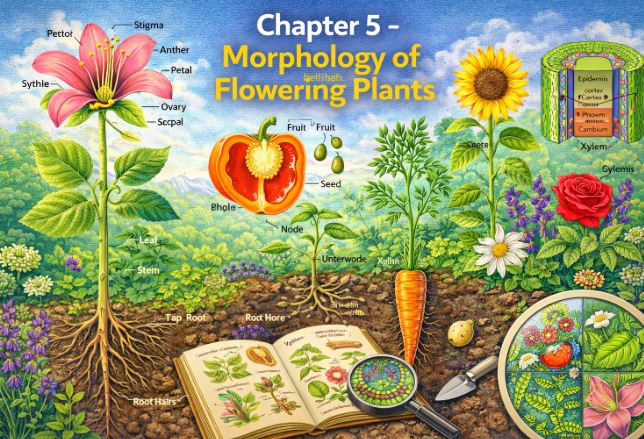
Introduction | Understanding the Form of Life
Hello students! Welcome back to our biology class. Today, we are going to step out of the microscopic world of cells and look at the beautiful, visible world of plants around us.
Have you ever taken a stroll through a garden or a farm and noticed the sheer variety of plants? Some are massive trees with thick trunks, while others are tiny herbs creeping on the ground. Despite these massive differences in how they look, all higher plants (specifically, the flowering plants or angiosperms) share a basic structural blueprint. They all have roots, stems, leaves, flowers, and fruits.
The study of these external, visible structures is called Morphology (from the Greek words morph meaning “form” or “shape”, and logos meaning “study”). In the early days of biology, before we had fancy microscopes to look at cells or DNA, naturalists relied entirely on observing the external features of plants to classify and understand them. This detailed observation is the foundation of plant biology. In this chapter, we will learn the standard technical terms used by scientists worldwide to describe the different parts of a flowering plant. Think of this as learning a new, precise language that will help you describe any plant you see!
1. The Root System: The Underground Anchor
If you have ever tried to pull out a weed from your garden, you know that plants are firmly anchored into the soil. The underground part of the plant axis is the root system. Roots generally grow downwards into the soil (they are positively geotropic) and away from sunlight. But how do they form?
1.1 Types of Root Systems
When a seed germinates, a tiny root-like structure called the radicle emerges. What happens to this radicle determines the type of root system the plant will have:
- Tap Root System: In most dicot plants (like mustard, gram, and mango), the radicle elongates directly to form a primary, thick main root that goes deep into the soil. From this main root, smaller lateral branches grow out, called secondary and tertiary roots. This creates a strong, deep-anchoring tap root system.
- Fibrous Root System: Monocot plants (like wheat, rice, and grasses) do things differently. Their primary root is short-lived. Very quickly, it is replaced by a large cluster of thin, thread-like roots that originate right from the base of the stem. This bushy network is the fibrous root system, which is great at holding topsoil together and preventing erosion.
- Adventitious Roots: Sometimes, roots rebel! Instead of developing from the radicle, they sprout from completely different parts of the plant, like the stem or leaves. Think of the massive hanging pillars of a Banyan tree or the roots holding up sugarcane stalks. These are called adventitious roots.
Classroom Question: What do roots actually do? Most of you will say they absorb water and minerals, and provide anchorage. That is perfectly correct! But remember, roots also store reserve food (like in carrots or radishes) and synthesize important plant growth hormones.
1.2 Regions of the Root
If we take a root and look closely at its very tip, we can divide it into distinct zones of activity:

Figure-1: The different regions of a growing root tip. Notice how root hairs only appear in the mature zone.
- The Root Cap: As the root pushes through the hard soil, its tender apex needs protection. It wears a microscopic, thimble-like helmet called the root cap.
- Region of Meristematic Activity: Just a few millimeters above the root cap lies a zone of rapid cell division. The cells here are tiny, have thin walls, and are packed with dense protoplasm. They are constantly dividing to create new cells.
- Region of Elongation: The newly formed cells don’t just sit there; they rapidly elongate and enlarge. This stretching action is what actually pushes the root deeper into the soil and increases the root’s overall length.
- Region of Maturation: Above the elongation zone, the cells finally stop growing and start differentiating into specific tissues with specific jobs. From the outer layer of this mature region, extremely fine, delicate, thread-like structures emerge. These are the root hairs. They are the true heroes that absorb water and dissolved minerals from the soil.
2. The Stem: The Ascending Axis
While the root grows down from the radicle, the stem grows upwards from the plumule of the germinating seed. The stem is the central pillar of the shoot system, bearing branches, leaves, flowers, and fruits.
How do you definitively tell a stem apart from a root? The golden rule is the presence of Nodes and Internodes.
- Nodes: These are the specific, slightly swollen points on the stem where leaves and branches are born.
- Internodes: This is simply the empty stretch of stem between two consecutive nodes.
Think of a sugarcane stalk. The tough rings you see are the nodes, and the sweet, juicy part you chew is the internode. Roots never have nodes or internodes!
The primary job of the stem is to spread out branches to ensure leaves get maximum sunlight, and to act as a two-way highway: conducting water and minerals up from the roots, and transporting the food made by leaves down to the rest of the plant. However, stems can also modify themselves to store food (like the underground potato), provide support, or protect the plant.
3. The Leaf: The Green Food Factory
Leaves are lateral, flattened structures borne on the stem. They originate at the nodes and always have a tiny bud in their axil (the angle between the leaf and the stem). This axillary bud can later grow into a whole new branch. Leaves are the ultimate solar panels, perfectly designed for photosynthesis.
3.1 Parts of a Typical Leaf
A standard leaf has three main components:
- Leaf Base: The part that attaches the leaf to the stem. In some plants (like legumes/pulses), this base becomes swollen and is called a pulvinus. In monocots like grasses, the base expands into a sheath that wraps around the stem.
- Petiole: The stalk of the leaf. A long, flexible petiole allows the leaf blade to flutter in the wind, which cools the leaf and brings fresh air to its surface.
- Lamina (Leaf Blade): The broad, green, flat part of the leaf. If you look closely, you will see a network of lines. These are the veins and veinlets. The prominent, thick vein running straight down the middle is called the midrib. Veins provide structural skeleton/rigidity to the delicate lamina and act as pipelines for water and food.
3.2 Venation: The Pattern of Veins
The specific arrangement of veins and veinlets within the leaf lamina is called Venation. This is a brilliant shortcut to identify a plant’s category without even looking at its seeds!
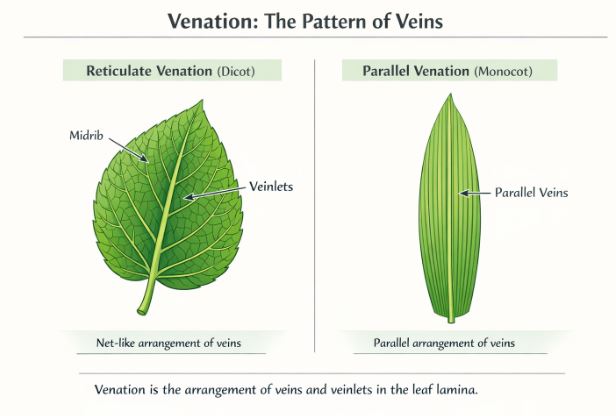
Figure-2: Reticulate venation forms a messy net, typical of dicots. Parallel venation features straight, parallel lines, typical of monocots.
- Reticulate Venation: When the veinlets branch out and form a complex, tangled network (like a spiderweb). This is the hallmark of Dicotyledonous plants (e.g., Mango, Rose, Neem).
- Parallel Venation: When the main veins run strictly parallel to each other from the base to the tip, without forming a network. This is characteristic of Monocotyledonous plants (e.g., Banana, Wheat, Grass, Bamboo).
3.3 Simple vs. Compound Leaves
A leaf is Simple when its lamina is completely intact, or even if it has cuts/incisions on the edges, those cuts do not reach all the way deep to the midrib.
However, when the incisions are so deep that they touch the midrib, the single leaf blade breaks apart into multiple smaller pieces called leaflets. This is a Compound Leaf.
Teacher’s Note: How do you know if you are looking at a branch with simple leaves, or a single compound leaf with leaflets? Look for the axillary bud! A bud is present in the axil of a petiole in both simple and compound leaves, but there is NO bud at the base of individual leaflets.
Compound leaves come in two main styles:
- Pinnately Compound: Leaflets are attached along a central common axis called the rachis (which is basically the modified midrib). Example: Neem.
- Palmately Compound: All the leaflets are attached together at a single common point at the very tip of the petiole, looking like fingers radiating from the palm of a hand. Example: Silk cotton tree.
3.4 Phyllotaxy: The Art of Arrangement
Plants are smart. They arrange their leaves on the stem in specific geometric patterns to ensure every single leaf gets maximum sunlight and they don’t overshadow each other. This pattern of leaf arrangement is called Phyllotaxy.
- Alternate: A single leaf arises at each node, alternating sides as you go up the stem (e.g., China rose, Mustard, Sunflower).
- Opposite: A pair of leaves arises at the exact same node, facing perfectly opposite to each other (e.g., Guava, Calotropis).
- Whorled: More than two leaves arise from a single node, forming a circular whorl or ring around the stem (e.g., Alstonia).
4. The Inflorescence: Floral Architecture
A flower is technically a highly modified shoot. Instead of producing leaves, the tip of the shoot (shoot apical meristem) changes into a floral meristem and starts producing floral appendages (petals, sepals) at highly condensed nodes.
When a shoot tip transforms into a flower, it forms a solitary flower. But very often, flowers bloom in clusters or groups. The specific arrangement of these flowers on the main floral axis is called an Inflorescence. Based on how the main axis grows, we have two major types:
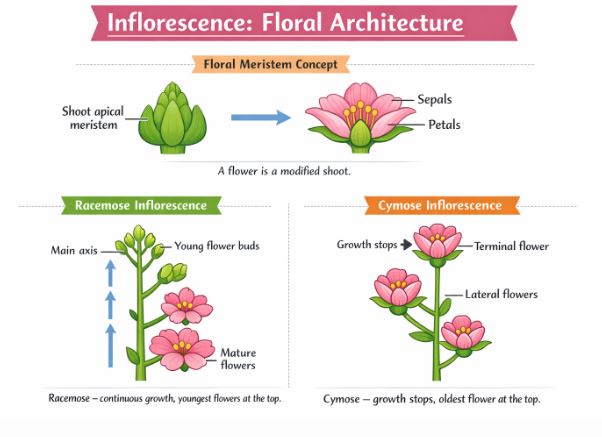
Figure-3: In Racemose, new flowers keep forming at the top. In Cymose, the oldest flower sits right at the top, stopping further upward growth.
- Racemose Inflorescence: The main axis never terminates in a flower; it just keeps growing and growing. Flowers are born laterally on the sides in an acropetal succession (this means the oldest, largest flowers are at the bottom, and the youngest, smallest buds are at the growing top).
- Cymose Inflorescence: The main axis terminates in a flower almost immediately. Because the tip becomes a flower, its upward growth is strictly limited. New flowers must sprout from lower down. This arrangement is basipetal (the oldest flower is at the very top/center, and younger flowers grow below or around it).
5. The Flower: The Reproductive Marvel
The flower is the reproductive unit of an angiosperm, designed specifically for sexual reproduction. A typical flower sits on a swollen, flattened end of a stalk (the pedicel) known as the thalamus or receptacle.
Think of the thalamus as a stage, and upon this stage, four distinct whorls (rings) of floral parts are arranged:
- Calyx (Sepals): The outermost green, leaf-like whorl that protects the flower when it is still a delicate bud. If sepals are fused together, it’s called gamosepalous; if they are free, it’s polysepalous.
- Corolla (Petals): The brightly colored, fragrant whorl designed to attract insects for pollination. Like sepals, petals can be united (gamopetalous) or free (polypetalous).
- Androecium (Stamens): The male reproductive organ. Each stamen has a slender stalk (filament) and a swollen top (anther) that produces pollen grains. A sterile stamen that cannot produce pollen is called a staminode. Stamens can sometimes attach to the petals (epipetalous, like in brinjal) or fuse into bundles (monoadelphous in china rose, diadelphous in peas).
- Gynoecium (Carpels/Pistil): The female reproductive organ located at the very center. A carpel has three parts: the sticky top to catch pollen (stigma), the long tube (style), and the swollen base containing ovules (ovary). If a flower has multiple carpels that are completely free from each other, it’s apocarpous (lotus, rose). If they are fused together into a single unit, it’s syncarpous (mustard, tomato).
Note: Calyx and Corolla are just accessory organs (helpers). Androecium and Gynoecium are the actual essential reproductive organs. If a flower has both, it’s bisexual. If it has only one, it’s unisexual. Sometimes, like in a Lily, the calyx and corolla look exactly the same and cannot be distinguished; this combined whorl is called a Perianth.
5.1 Floral Symmetry and Ovary Position
Just like animals, flowers exhibit symmetry:
- Actinomorphic (Radial Symmetry): You can cut the flower into two equal halves through any radial plane passing through the center (like cutting a circular pizza). Examples: Mustard, Datura, Chilli.
- Zygomorphic (Bilateral Symmetry): You can only cut the flower into two equal halves along one specific vertical plane (like the left and right sides of a human face). Examples: Pea, Gulmohur, Bean.
- Asymmetric: Cannot be divided into equal halves by any plane. Example: Canna.
Position of the Ovary: Based on where the calyx, corolla, and androecium attach to the thalamus relative to the ovary, we classify flowers into three types:
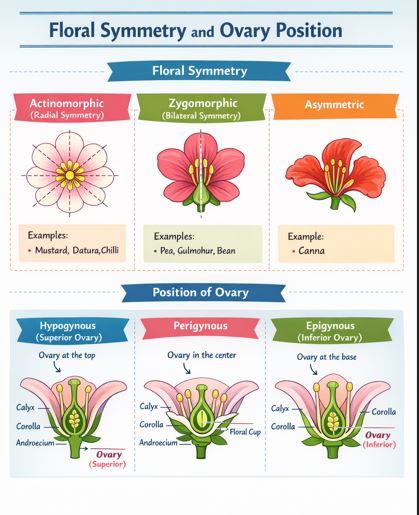
Figure-4: Notice how the ovary is at the very top in Hypogynous, while it is completely sunken and enclosed in Epigynous flowers.
- Hypogynous (Superior Ovary): The gynoecium sits at the absolute highest point on the conical thalamus. All other parts attach below it. Example: Mustard, China rose, Brinjal.
- Perigynous (Half-Inferior Ovary): The thalamus forms a cup-like rim. The ovary sits in the center, and the other parts attach on the rim, almost at the same level. Example: Plum, Rose, Peach.
- Epigynous (Inferior Ovary): The thalamus grows all the way up, completely enclosing and fusing with the ovary. The other floral parts arise above the ovary. Example: Guava, Cucumber, Sunflower ray florets.
5.2 Aestivation and Placentation
Aestivation is the specific mode of arrangement of sepals or petals in the floral bud before it opens.
- Valvate: Margins just touch each other without overlapping (Calotropis).
- Twisted: One margin overlaps the next in a continuous, directional spiral (China rose, Lady’s finger).
- Imbricate: Margins overlap, but in no particular direction or pattern (Cassia, Gulmohur).
- Vexillary (Papilionaceous): Found in peas/beans. One massive petal (standard) covers two side petals (wings), which cover two tiny fused bottom petals (keel).
Placentation refers to how the ovules (which will become seeds) are arranged on the cushions of tissue (placenta) inside the ovary.
- Marginal: Ovules form two rows along the side ridge (ventral suture). Easiest example is opening a pea pod!
- Axile: Ovary has multiple chambers (locules), and ovules attach to the central axis. Cut a tomato or lemon horizontally to see this beautifully.
- Parietal: Ovules attach to the inner wall or periphery of a single-chambered ovary (Mustard). Sometimes a false septum forms, making it look two-chambered.
- Free Central: Ovules are on a central pillar, but there are no separating walls or septa (Dianthus).
- Basal: A single ovule is attached to the very base of the ovary (Sunflower, Marigold).
6. The Fruit and The Seed
Once fertilization happens, the flower’s job is mostly done. The petals and sepals dry up and fall off. The ovary matures and ripens into a Fruit, and the ovules inside mature into Seeds.
Fascinating Fact: If an ovary somehow turns into a fruit without any fertilization happening, it produces a seedless fruit called a Parthenocarpic fruit (like commercial bananas).
6.1 Structure of a Fruit
A true fruit consists of seeds enclosed by a fruit wall called the Pericarp. The pericarp can be dry (like in groundnuts) or thick and fleshy. When fleshy, it differentiates into three layers:
- Epicarp: The outer skin.
- Mesocarp: The middle layer.
- Endocarp: The innermost layer covering the seed.
The Drupe: Mangoes and Coconuts are classic examples of a drupe. They develop from a single-carpel, superior ovary and have exactly one seed. In a mango, the epicarp is the peel, the mesocarp is the sweet yellow pulp we eat, and the endocarp is the hard, stony pit protecting the seed inside. In a coconut, the mesocarp is the fibrous husk we strip away, and the endocarp is the hard brown shell.
6.2 Structure of the Seed
A seed contains a protective seed coat and a baby plant called an embryo. The embryo consists of a radicle (future root), a plumule (future shoot), and cotyledons (seed leaves).
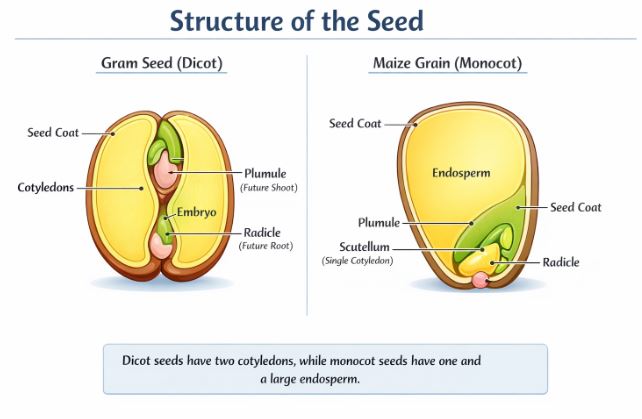
Figure-5: Notice the two large cotyledons in the dicot seed, compared to the massive endosperm and single scutellum in the monocot seed.
Dicotyledonous Seeds (e.g., Gram, Pea, Bean):
They have two thick, fleshy cotyledons that act as the food storage for the baby plant. The outer seed coat has two layers: the tough outer testa and inner tegmen. You will see a small scar called the hilum where the seed attached to the fruit, and right above it, a tiny pore called the micropyle (where water enters during germination). Because the cotyledons absorb all the endosperm’s nutrients before the seed matures, these are usually non-endospermous seeds (exception: Castor is a dicot but keeps its endosperm).
Monocotyledonous Seeds (e.g., Maize, Wheat, Rice):
These typically have only one cotyledon and are mostly endospermic. Let’s look at a corn/maize grain. The seed coat is fused completely with the fruit wall. Inside, a massive, bulky endosperm stores food. The tiny embryo sits in a groove at the bottom. It consists of one large, shield-shaped cotyledon uniquely named the scutellum. To protect the delicate growing tips as they push through rough soil, the plumule is covered by a sheath called the coleoptile, and the radicle is covered by a sheath called the coleorhiza. An outer protein layer called the aleurone layer separates the embryo from the endosperm.
7. Semi-Technical Description of a Flowering Plant
Botanists cannot write a 10-page essay every time they discover a plant. They use a standardized shorthand—a floral formula and a floral diagram—to summarize a plant’s entire morphology.
Decoding the Formula Symbols:
- Br: Bracteate (has tiny reduced leaves at flower base)
- K: Calyx (sepals)
- C: Corolla (petals)
- P: Perianth (when K and C look identical)
- A: Androecium (stamens)
- G: Gynoecium (carpels). A line below G (G) means Superior ovary. A line above G means Inferior ovary.
- ⊕: Actinomorphic (Radial symmetry)
- % : Zygomorphic (Bilateral symmetry)
- Numbers: Show how many parts are in that whorl.
- Brackets ( ): Tell us the parts are fused (e.g., Gamopetalous).
- An arc over two letters: Tells us there is adhesion between two different whorls (e.g., stamens attached to petals).
Family Spotlight: Solanaceae (The Potato Family)
This is a very important family distributed across the tropics and temperate zones.
Vegetative Characters: Mostly herbs or shrubs. Stems are mostly herbaceous, solid or hollow, sometimes modified into underground tubers (like potato – Solanum tuberosum). Leaves are alternate, simple, with reticulate venation.
Floral Characters:
- Inflorescence: Solitary or cymose.
- Flower: Bisexual, Actinomorphic (⊕).
- Calyx (K): 5 sepals, united, persistent (they stay attached even to the fruit, like the green crown on a tomato or brinjal). Valvate aestivation.
- Corolla (C): 5 petals, united. Valvate aestivation.
- Androecium (A): 5 stamens, epipetalous (attached to petals).
- Gynoecium (G): Bicarpellary (2 carpels), syncarpous (fused), superior ovary. The placenta is uniquely swollen with many ovules in an axile placentation.
- Fruit: A berry or a capsule.
Economic Importance: You interact with Solanaceae daily! It gives us food (tomatoes, potatoes, brinjal), spices (chilli), powerful medicines (belladonna, ashwagandha), fumigatory products (tobacco), and beautiful ornamentals (petunia).
Real-Life Examples to Understand Morphology
- The Kitchen Tour: Go to your kitchen. An onion is a modified underground stem with fleshy scale leaves. A potato is a modified underground stem (you can see the ‘eyes’ which are actually axillary buds at nodes). A sweet potato, however, is a modified adventitious root. Nature loves to innovate!
- The Tomato Test: Slice a tomato exactly in half horizontally. You will see multiple chambers filled with jelly and seeds attached to the center. This is the perfect real-world example of Axile placentation in a syncarpous ovary. And the little green starry cap on top? Those are the persistent sepals of the calyx!
Key Takeaways & Summary
- Roots: Evolve from radicle (tap root) or elsewhere (adventitious/fibrous). Key zones are cell division, elongation, and maturation (featuring root hairs).
- Stems: Differentiated from roots by the presence of nodes and internodes. Develop from the plumule.
- Leaves: Lateral photosynthetic organs. Characterized by venation (reticulate in dicots, parallel in monocots) and phyllotaxy (alternate, opposite, whorled).
- Inflorescence: Racemose (continuous growth, acropetal) vs. Cymose (terminates in flower, basipetal).
- Flower: Has four whorls (Calyx, Corolla, Androecium, Gynoecium) situated on the thalamus. Ovary can be superior (hypogynous), half-inferior (perigynous), or inferior (epigynous).
- Fruits & Seeds: A mature ovary is a fruit. A mature ovule is a seed. Seeds can be dicot (usually non-endospermic) or monocot (usually endospermic with aleurone layer and scutellum).
Common Student Misconceptions
Misconception 1: “All roots are underground, and all stems are above ground.”
Correction: Not true! The potato, ginger, and turmeric are all stems that grow horizontally underground to store food. The key identifiers of a stem are nodes and internodes, not its location. Conversely, Banyan trees have massive aerial roots growing above ground.
Misconception 2: “Vegetables are distinct from fruits in biology.”
Correction: In the kitchen, a tomato or a green chilli is a vegetable because it is savory. But in pure botanical morphology, anything that develops from a ripened, fertilized ovary and contains seeds is a Fruit. So tomatoes, brinjals, cucumbers, and pumpkins are all scientifically fruits!
Practice Set: Test Your Knowledge (CBSE Pattern)
Very Short Answer Questions (1 Mark)
Q1. What is a parthenocarpic fruit?
Answer: A fruit that develops from an ovary without the process of fertilization, making it completely seedless (e.g., some varieties of banana).
Q2. Name a plant that exhibits whorled phyllotaxy.
Answer: Alstonia is a classic example where more than two leaves arise from a single node forming a whorl.
Q3. Define Venation. What type of venation is seen in monocot leaves?
Answer: Venation is the arrangement of veins and veinlets within the leaf lamina. Monocot leaves typically exhibit parallel venation.
Short Answer Questions (2-3 Marks)
Q4. How is a pinnately compound leaf different from a palmately compound leaf?
Answer: In a pinnately compound leaf (e.g., Neem), multiple leaflets are attached laterally along a common central axis called the rachis (which represents the midrib). In a palmately compound leaf (e.g., Silk cotton), all leaflets are attached together at a single common point at the very tip of the petiole, resembling fingers spreading from a palm.
Q5. Differentiate between Apocarpous and Syncarpous ovary.
Answer: When a flower’s gynoecium has multiple carpels, and these carpels remain entirely free and separate from one another, it is an apocarpous ovary (e.g., Lotus, Rose). If the multiple carpels are fused together into a single structure, it is a syncarpous ovary (e.g., Mustard, Tomato).
Long Answer Questions (5 Marks)
Q6. Describe the various regions of a typical root tip with their respective functions.
Answer: A growing root tip is divided into four main regions from the apex upwards:
1. Root Cap: A thimble-like structure covering the very apex. It protects the tender root meristem as the root pushes aggressively through hard soil particles.
2. Region of Meristematic Activity: Located a few millimeters above the root cap. Cells here are very small, thin-walled, have dense protoplasm, and constantly divide to generate new cells for root growth.
3. Region of Elongation: Found just proximal to the meristematic zone. Cells here undergo rapid stretching, elongation, and enlargement. This zone is responsible for the actual increase in the length of the root.
4. Region of Maturation: Located above the elongation zone. Here, the elongated cells differentiate and mature into specialized tissues. Epidermal cells in this region form delicate, fine thread-like extensions called root hairs, which massively increase the surface area to absorb water and minerals from the soil.
Q7. What is placentation? Describe the different types of placentation found in flowering plants with examples.
Answer: Placentation refers to the specific physical arrangement of ovules on the placenta within the ovary. The major types are:
1. Marginal: The placenta forms a ridge along the ventral suture of the ovary. Ovules are arranged in two distinct rows on this ridge. (e.g., Pea).
2. Axile: The ovary is multi-chambered (multilocular), and ovules attach to a central axis running through the middle. (e.g., Tomato, Lemon, China rose).
3. Parietal: The ovules develop on the inner wall of the ovary or the peripheral part. It starts as a single chamber, but a false septum can form, making it look two-chambered. (e.g., Mustard, Argemone).
4. Free Central: The ovules are borne on a central axis, but there are absolutely no septa or walls dividing the ovary into chambers. (e.g., Dianthus, Primrose).
5. Basal: The placenta develops strictly at the base of the ovary, and only a single ovule is attached to it. (e.g., Sunflower, Marigold).
Case-Based / Competency-Based Question (4 Marks)
Q8. Read the situation and answer the questions.
During a biology field trip, a student plucks a plant from the soil. She observes that the plant has a single, thick, dominant root going straight down with smaller branches coming off it. Upon looking at the leaves, she notices a complex, net-like pattern of veins spanning the leaf blade.
(a) Identify the type of root system and the type of leaf venation the student has observed.
(b) Based on these two observations, what broad category of angiosperms does this plant belong to? (Monocot or Dicot)
(c) Based on your classification in part (b), what kind of seed structure would you expect to find inside the fruit of this plant? (Explain briefly in terms of cotyledons).
Answer:
(a) The thick dominant root indicates a Tap Root System. The net-like pattern on the leaves indicates Reticulate Venation.
(b) The combination of a tap root system and reticulate venation is the classic hallmark of a Dicotyledonous (Dicot) plant.
(c) Since it is a dicot, the seed will typically have two large, fleshy cotyledons (seed leaves) that store food for the developing embryo. It will likely be non-endospermous at maturity.
Assertion-Reason Question
Q9. For the following question, two statements are given—one labeled Assertion (A) and the other labeled Reason (R). Select the correct answer from the codes (a), (b), (c), and (d) as given below.
(a) Both A and R are true, and R is the correct explanation of A.
(b) Both A and R are true, but R is not the correct explanation of A.
(c) A is true, but R is false.
(d) A is false, but R is true.
Assertion (A): Mango and coconut are classified botanically as drupes.
Reason (R): They develop from monocarpellary superior ovaries and generally contain only one seed.
Answer: (a). Both statements are factually correct. The biological definition of a drupe is exactly what is stated in the reason: a fleshy fruit developing from a single carpel (monocarpellary) with a superior ovary, containing a single seed enclosed in a stony endocarp. Thus, R perfectly explains why A is true.
End of Notes.
Students, mastering plant morphology requires visualization. Whenever you eat a fruit or see a flower, try to identify its parts, its symmetry, and its venation. Biology is happening all around you. Happy studying!
Read Also:
Class-11 Biology All Chapters
For official syllabus and textbooks, visit the
Official Education Portal.