
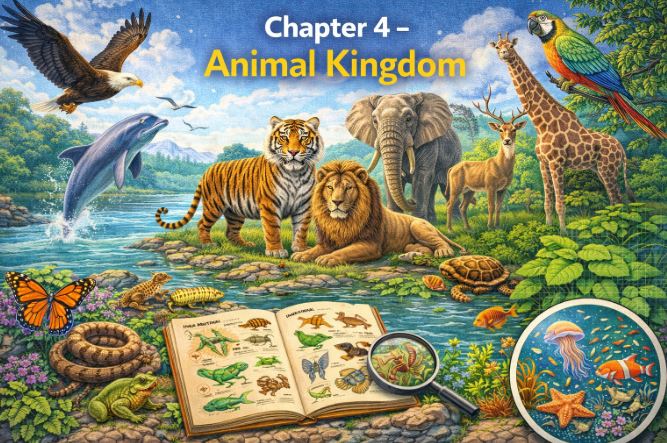
Introduction | Class 11 Biology Chapter 4 Animal Kingdom notes
Hello students! Welcome back to another exciting chapter in Biology. Take a moment to look around you. You might see a bird flying by the window, an ant crawling on the wall, or perhaps your pet dog resting in the corner. Have you ever wondered how scientists keep track of the millions of different animal species on our planet?
With over a million species of animals described to date, studying them one by one is practically impossible. Imagine trying to find a specific book in a library that has no sections, no shelves, and no indexing. Pure chaos, right? That is exactly why we need classification. Classification gives us a systematic framework to group animals based on similarities and differences, helping us assign a proper systematic position to even newly discovered species. In this chapter, we are going to learn how biologists organize this massive library of life, starting from the simplest sponges to complex mammals like ourselves!
1. The Basis of Classification
You might be thinking, “A sea sponge looks nothing like a tiger! How do we even begin to compare them?” Despite the obvious outward differences in form and structure, animals share fundamental features at the cellular and physiological levels. Biologists use these basic ground rules—the “Basis of Classification”—to divide the animal kingdom into major groups. Let’s explore these foundational criteria.
1.1 Levels of Organization
Every animal is multicellular. However, not all animals use their cells in the same way. Think of it like a factory:
- Cellular Level: The simplest animals, like Sponges (Porifera), have loose aggregates of cells. There is a basic division of labor, but the cells do not coordinate to form tissues.
- Tissue Level: Moving a step higher, in animals like Coelenterates (jellyfish), cells performing the same function group together to form distinct tissues.
- Organ Level: In flatworms (Platyhelminthes), tissues group together to form specialized organs, each dedicated to a specific function.
- Organ-System Level: In higher animals like Annelids, Arthropods, and Chordates, organs work together to form highly complex functional systems (like a complete digestive or circulatory system).
1.2 Body Symmetry
Symmetry refers to how the body parts of an animal are arranged around a central axis.
- Asymmetrical: You cannot divide the animal into two equal halves through any central plane. Sponges are a classic example.
- Radial Symmetry: Imagine cutting a round cake. Any vertical plane passing through the central axis divides the organism into two identical halves. Animals with this symmetry, like starfish (adult echinoderms) and coelenterates, can interact with their environment from all directions.
- Bilateral Symmetry: Think of the human body or a crab. The body can be divided into identical left and right halves in only one specific plane. This allows for forward movement and a concentrated nervous system (a head!).
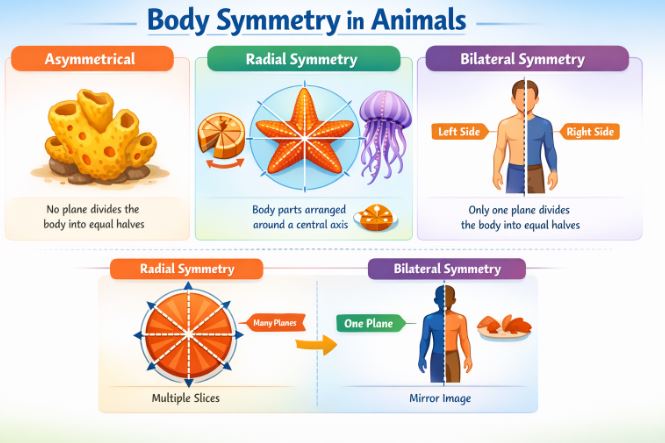
Figure-1: Radial symmetry (like a wheel) versus Bilateral symmetry (left and right sides are mirror images).
1.3 Diploblastic and Triploblastic Organization
When an animal embryo develops, it forms layers of cells called germ layers. These layers eventually give rise to all the tissues and organs.
- Diploblastic: Animals with only two germ layers—an outer ectoderm and an inner endoderm. They have an undifferentiated jelly-like layer called mesoglea in between. Example: Coelenterates.
- Triploblastic: Animals possessing a third, middle layer called the mesoderm. This layer is crucial because it gives rise to muscles, bones, and blood. All animals from Platyhelminthes to Chordates are triploblastic.
1.4 Coelom (The Body Cavity)
Teacher’s Tip: This is a favorite topic for examiners! Pay close attention to the mesoderm.
A coelom is a fluid-filled body cavity located between the digestive tract (gut wall) and the outer body wall, and most importantly, it is entirely lined by the mesoderm.
- Coelomates: Animals with a true coelom (e.g., Annelids, Arthropods, Chordates). This cavity protects internal organs and allows them to grow independently.
- Pseudocoelomates: Animals with a “false” cavity. The mesoderm is present as scattered pouches between the ectoderm and endoderm, not as a continuous lining. Example: Aschelminthes (roundworms).
- Acoelomates: Animals with no body cavity at all. The space is filled with solid tissue. Example: Platyhelminthes (flatworms).
1.5 Segmentation and Notochord
Segmentation: In some animals, the body is externally and internally divided into repeating segments. If you look closely at an earthworm, it looks like a train made of similar compartments. This serial repetition of organs is called metameric segmentation or metamerism.
Notochord: This is a flexible, rod-like structure derived from the mesoderm, found on the dorsal (back) side during embryonic development.
Animals with a notochord are called Chordates. Animals without it (from Porifera to Echinoderms) are Non-chordates.
2. Classification of Non-Chordates (The Invertebrates)
Now that we have our sorting rules, let’s open the catalog of life and study the different phyla within the Non-chordates, starting from the simplest!
2.1 Phylum Porifera (The Sponges)
Sponges are ancient, primitive multicellular animals mostly found in marine environments. They are mostly asymmetrical. The coolest thing about sponges is their water transport or canal system. Water enters through tiny pores called ostia into a central cavity (spongocoel) and exits through a large opening called the osculum. This constant flow of water brings in food, facilitates respiratory exchange, and washes away waste. Special collar cells called choanocytes line this system. They are hermaphrodites (sexes are not separate).
Examples: Sycon, Spongilla (freshwater sponge), Euspongia (bath sponge).
2.2 Phylum Coelenterata (Cnidaria)
These are aquatic, radially symmetrical animals. They get their name “Cnidaria” from cnidoblasts—specialized stinging cells on their tentacles used for anchoring, defense, and capturing prey. They have a single opening (mouth on hypostome) serving as both mouth and anus. Many exhibit two body forms: a stationary, cylindrical Polyp (like Hydra) and a free-swimming, umbrella-shaped Medusa (like Jellyfish). Some, like Obelia, show alternation of generations (Metagenesis), switching between these two forms.
Examples: Physalia (Portuguese man-of-war), Adamsia (Sea anemone).
2.3 Phylum Ctenophora (Sea Walnuts)
Commonly known as comb jellies, these are transparent, marine, radially symmetrical organisms. Their hallmark feature is the presence of eight external rows of ciliated comb plates, which act like little oars helping them swim. They also show beautiful bioluminescence (the ability to emit light).
Examples: Pleurobrachia and Ctenoplana.
2.4 Phylum Platyhelminthes (Flatworms)
Imagine a creature flattened like a leaf or a ribbon; that’s a flatworm. They are bilaterally symmetrical, triploblastic, but are acoelomates. Many are dangerous endoparasites living inside other animals, including humans. Parasitic forms possess hooks and suckers to attach to the host’s intestines. They have specialized cells called flame cells for excretion and osmoregulation.
Examples: Taenia (Tapeworm), Fasciola (Liver fluke), and Planaria (famous for high regeneration capacity).
2.5 Phylum Aschelminthes (Roundworms)
If you cut them in cross-section, they appear circular, hence the name roundworms. They are triploblastic, bilaterally symmetrical, and are our classic pseudocoelomates. They can be free-living or parasitic. Unlike flatworms, they have a complete alimentary canal with a distinct muscular pharynx. Also, sexes are separate here (dioecious), and usually, the females are distinctively longer than males.
Examples: Ascaris (Roundworm), Wuchereria (Filaria worm), Ancylostoma (Hookworm).
2.6 Phylum Annelida (Segmented Worms)
The name Annelida comes from the Latin word annulus, meaning “little ring”. Their bodies are distinctly marked into metameric segments. They are the first true coelomates we encounter. They have longitudinal and circular muscles for movement. Aquatic ones, like Nereis, have fleshy side appendages called parapodia for swimming. They use coiled tubes called nephridia for excretion.
Examples: Pheretima (Earthworm), Hirudinaria (Blood-sucking leech).
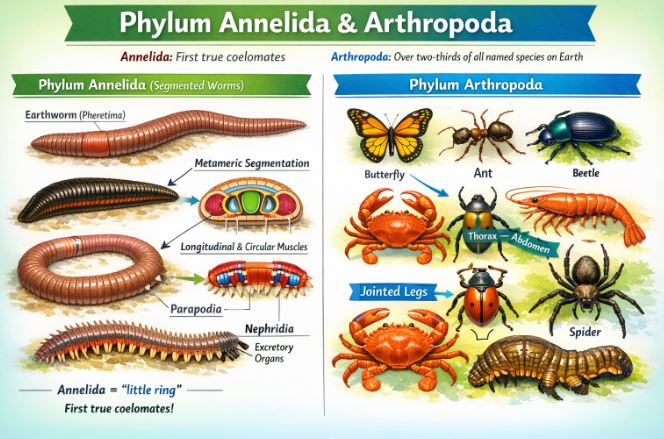
Figure-2: Phylum Arthropoda represents over two-thirds of all named species on Earth.
2.7 Phylum Arthropoda (Jointed-Legged Animals)
Welcome to the largest phylum in the animal kingdom! Over two-thirds of all named species are arthropods. Why are they so wildly successful? Mostly due to their tough, protective chitinous exoskeleton and adaptable jointed appendages (arthros = joint, poda = appendages). Their body is divided into head, thorax, and abdomen. They respire through gills, book gills, book lungs, or a tracheal system. Excretion occurs through Malpighian tubules.
Examples: Apis (Honey bee), Bombyx (Silkworm), Anopheles (Mosquito), Locusta (Locust).
2.8 Phylum Mollusca (Soft-Bodied Animals)
The second-largest animal phylum. Molluscs are soft-bodied, unsegmented animals usually protected by a hard calcareous shell. Their body is uniquely divided into a distinct head, a muscular foot (for moving), and a visceral hump (containing organs). A soft, spongy layer of skin forms a mantle over the hump. Inside the mouth, they have a file-like rasping organ called a radula used for feeding.
Examples: Pila (Apple snail), Octopus (Devil fish), Pinctada (Pearl oyster).
2.9 Phylum Echinodermata (Spiny-Skinned Animals)
These are exclusively marine animals with an endoskeleton made of calcareous ossicles. They show a fascinating symmetry shift: the larvae are bilaterally symmetrical, but as they grow into adults, they become radially symmetrical!. Their most distinctive feature is the Water Vascular System. It acts like a hydraulic network helping them in locomotion, capturing food, and respiration. Interestingly, they lack a dedicated excretory system.
Examples: Asterias (Star fish), Echinus (Sea urchin).
2.10 Phylum Hemichordata (The Half-Chordates)
Earlier, biologists thought these were a sub-phylum of Chordata, but they are now placed separately as non-chordates. They are small, worm-like marine animals. They have a rudimentary structure in their collar region called a stomochord, which only looks similar to a notochord. Their body consists of an anterior proboscis, a collar, and a long trunk.
Examples: Balanoglossus and Saccoglossus.
3. Phylum Chordata
Now we step into our own territory! Animals in Phylum Chordata are characterized by three fundamental hallmarks present at some stage of their life:
- A Notochord: The supportive dorsal rod.
- A Dorsal Hollow Nerve Cord: Runs above the notochord, which in higher animals becomes the brain and spinal cord.
- Paired Pharyngeal Gill Slits: Openings in the pharynx (throat) area.
Additionally, they possess a post-anal tail and a closed circulatory system (blood runs strictly in vessels).
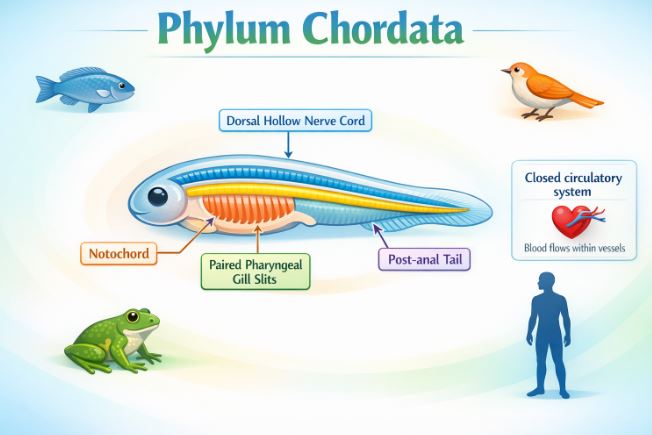
Figure-3: The fundamental features shared by all chordates at some point in their development.
3.1 Division of Chordata
Phylum Chordata is split into three subphyla:
- Urochordata (Tunicata): The notochord is present only in the larval tail. Example: Ascidia.
- Cephalochordata: The notochord extends from head to tail and persists throughout their whole life. Example: Branchiostoma (Amphioxus).
- Vertebrata: These are the most advanced. They possess a notochord during the embryonic period, but in adults, it gets replaced by a cartilaginous or bony vertebral column (backbone).
Pause and Think: Thus, we can confidently state, “All vertebrates are chordates, but all chordates are not vertebrates.” Because Urochordates and Cephalochordates are chordates, but they never develop a backbone!
4. Subphylum Vertebrata
Vertebrates are further divided based on whether they have jaws or not:
Agnatha (lack jaws) and Gnathostomata (bear jaws).
4.1 Class Cyclostomata (Jawless Fishes)
These are bizarre, primitive aquatic animals. All living members are ectoparasites on other true fishes. They have an elongated body, 6-15 pairs of gill slits, and a circular, sucking mouth without jaws. They lack scales and paired fins. Interestingly, they live in the ocean but migrate to freshwater rivers to spawn (lay eggs), dying shortly after. The larvae metamorphose and swim back to the sea.
Examples: Petromyzon (Lamprey), Myxine (Hagfish).
4.2 Super Class Pisces (The Fishes)
Fishes (bearing fins) are divided into two main classes based on their skeleton:
Class Chondrichthyes (Cartilaginous Fishes):
These are marine predators like sharks and stingrays. Their entire endoskeleton is made of cartilage, not hard bone. Their mouth is ventral (underneath), their gills have no protective cover (operculum), and their skin contains tough, tiny placoid scales. Because they lack an air bladder to control buoyancy, they must swim constantly to avoid sinking. They have a 2-chambered heart and are cold-blooded (poikilothermous).
Examples: Scoliodon (Dog fish/Shark), Trygon (Sting ray).
Class Osteichthyes (Bony Fishes):
Found in both marine and freshwater, these fishes have a hard, bony endoskeleton. Their mouth is mostly terminal (at the tip). They have four pairs of gills covered by an operculum, and they do possess an air bladder to regulate buoyancy (so they can float still in the water). They are also cold-blooded with a 2-chambered heart.
Examples: Hippocampus (Sea horse), Labeo (Rohu).
4.3 Super Class Tetrapoda (Animals with four limbs)
Class Amphibia: As the name indicates (Amphi = dual, bios = life), amphibians can live in aquatic and terrestrial habitats. They are the transitional animals. They have moist skin without scales (they breathe through it!). They lay eggs in water. Their heart is 3-chambered, and they are cold-blooded.
Examples: Rana (Frog), Bufo (Toad), Salamandra.
Class Reptilia: These animals truly conquered the land. Their name comes from their creeping or crawling locomotion. They are mostly terrestrial, and their body is covered by dry, cornified skin and epidermal scales or scutes (preventing water loss). They do not have external ear openings. The heart is generally 3-chambered (but fully 4-chambered in crocodiles!). They are cold-blooded and lay shelled eggs.
Examples: Chelone (Turtle), Naja (Cobra), Crocodilus.
Class Aves (Birds): The masters of the sky. The most characteristic feature is the presence of feathers. Their forelimbs are modified into wings for flight, while hindlimbs are adapted for walking or clasping. To make flying easier, their long bones are hollow with air cavities (pneumatic bones). They have a fully 4-chambered heart and are warm-blooded (homoiothermous), meaning they can maintain a constant body temperature regardless of the weather.
Examples: Columba (Pigeon), Struthio (Ostrich – flightless), Pavo (Peacock).
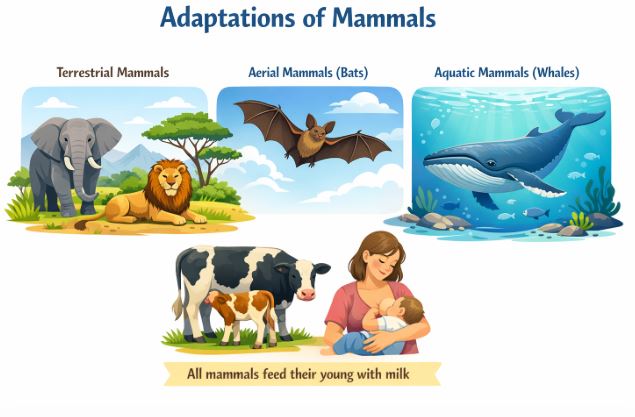
Figure-4: Mammals have adapted to land, air (bats), and water (whales), but all feed their young with milk.
Class Mammalia: Our own class! Mammals are incredibly adaptable, found from polar ice caps to scorching deserts. The most unique, defining characteristic of all mammals is the presence of milk-producing glands (mammary glands) used to nourish their young. Another unique feature is the presence of hair on the skin and external ear structures called pinnae. They have a 4-chambered heart, are warm-blooded, and the vast majority are viviparous (giving birth to live young rather than laying eggs).
Examples: Macropus (Kangaroo), Panthera leo (Lion), Balaenoptera (Blue whale), Ornithorhynchus (Platypus – a rare egg-laying mammal!).
Real-Life Examples to Understand Classification
- The Supermarket Analogy: Just like a supermarket sorts items into ‘Produce’, ‘Dairy’, and ‘Bakery’, biologists sort animals into Phyla. Within the ‘Produce’ section, you have ‘Fruits’ and ‘Vegetables’ (like Classes), and further down you have specific items like ‘Apples’ (Species).
- Why do spiders crunch? If you’ve ever accidentally stepped on a cockroach or seen a crab shell, that “crunch” is their chitinous exoskeleton—the defining feature of Arthropods that acts like medieval armor!
- Whales aren’t fish! A blue whale swims in the ocean and looks like a giant fish. But if you look closely, it has no gills (it breathes air through a blowhole), it has a 4-chambered heart, is warm-blooded, and feeds its calves milk. Thus, it’s firmly a Mammal, not a Pisces!
Key Takeaways & Summary
- Animals are classified based on common fundamental features like symmetry, coelom, and level of organization.
- Porifera (sponges) are the simplest with a cellular level of organization, while higher phyla have organ-system levels.
- Arthropoda is the most abundant animal group, known for jointed legs and an exoskeleton.
- Chordates possess a notochord, dorsal hollow nerve cord, and pharyngeal gill slits at some developmental stage.
- Vertebrates are chordates that replace their notochord with a vertebral column (backbone).
- Birds (Aves) and Mammals are the only homoiothermous (warm-blooded) classes.
Common Student Misconceptions
Misconception 1: “All animals with a backbone are the only chordates.”
Correction: While all vertebrates (animals with backbones) are chordates, there are primitive protochordates (like Urochordata and Cephalochordata) that have a notochord but never develop a true bony backbone.
Misconception 2: “Sponges are underwater plants.”
Correction: Because they are sessile (they don’t move around), people often mistake sponges for plants. However, they are multicellular, heterotrophic (they don’t make their own food), and lack cell walls, classifying them strictly under Kingdom Animalia (Phylum Porifera).
Misconception 3: “Amphibians and reptiles are basically the same.”
Correction: A major evolutionary jump happened here! Amphibians have moist, scaleless skin and must lay their eggs in water. Reptiles evolved dry, scaly skin to prevent dehydration and lay tough, shelled eggs, completely freeing them from water dependency.
Practice Set: Test Your Knowledge (CBSE Pattern)
Very Short Answer Questions (1 Mark)
Q1. Which phylum includes animals that possess a water vascular system?
Answer: Phylum Echinodermata. This system helps them in locomotion and capturing food.
Q2. What is the role of the air bladder in fishes, and which class possesses it?
Answer: The air bladder regulates buoyancy, allowing the fish to float without constantly swimming. It is present in Class Osteichthyes (bony fishes).
Q3. Name the specialized stinging cells found in Coelenterates.
Answer: Cnidoblasts or cnidocytes.
Short Answer Questions (2-3 Marks)
Q4. Justify the statement: “All vertebrates are chordates but all chordates are not vertebrates.”
Answer: To be a chordate, an animal must possess a notochord at some stage in its life. Protochordates (like Ascidia) have a notochord but never develop a backbone. Vertebrates are a specific sub-group of chordates where the embryonic notochord is replaced by a cartilaginous or bony vertebral column in adulthood. Hence, while all vertebrates meet the chordate criteria, not all chordates achieve vertebrate status.
Q5. How do Chondrichthyes differ from Osteichthyes based on gills and mouth position?
Answer: In Chondrichthyes (cartilaginous fishes), the mouth is located ventrally (underneath), and their gill slits are separate without an operculum (gill cover). In Osteichthyes (bony fishes), the mouth is mostly terminal (at the tip), and their four pairs of gills are protected by an operculum.
Q6. What are the unique modifications observed in birds (Aves) that help them fly?
Answer: Birds have several flight adaptations: their forelimbs are modified into wings, their body is covered with feathers to provide an aerodynamic shape, and their long bones are pneumatic (hollow with air cavities) to keep their body weight light.
Long Answer Questions (5 Marks)
Q7. Describe the importance of the coelom. Classify animals based on the nature of the coelom with suitable examples.
Answer: The body cavity between the gut wall and the body wall is called a coelom. Its presence or absence is a vital classification tool. A true coelom is lined by the mesoderm, providing a cushioned space for internal organs to grow, develop, and move independently of the outer body wall.
Based on this, animals are classified into three types:
1. Coelomates: Animals possessing a true, mesoderm-lined coelom. Examples include Annelids, Arthropods, Molluscs, and Chordates.
2. Pseudocoelomates: The body cavity is not lined by the mesoderm. Instead, the mesoderm exists as scattered pouches between the ectoderm and endoderm, forming a “false” coelom. Example: Aschelminthes (Roundworms).
3. Acoelomates: Animals where the body cavity is completely absent, and the space is filled with tissue. Example: Platyhelminthes (Flatworms).
Q8. Detail the distinguishing characteristic features of Phylum Arthropoda. Why are they considered the most successful group of animals?
Answer: Phylum Arthropoda is the largest phylum, containing over two-thirds of all named species. Their distinguishing features include:
– Organ-system level of organization, bilateral symmetry, triploblastic, and coelomate body plan.
– The presence of jointed appendages which give them their name and allow for versatile movement.
– The body is divided distinctly into head, thorax, and abdomen.
– Sensory organs: They possess antennae, eyes (compound and simple), and statocysts for balance.
– Respiration & Excretion: Respiration is via gills, book lungs, or a tracheal system, while excretion happens through Malpighian tubules.
They are incredibly successful mainly due to their hard, chitinous exoskeleton. This armor protects them from predators and prevents water loss, allowing them to conquer almost every terrestrial and aquatic habitat on Earth.
Case-Based / Competency-Based Question (4 Marks)
Q9. Read the situation and answer the questions.
During a biology field trip, a student finds an animal crawling in the damp soil. It has a long, cylindrical body. Upon closer inspection, the student notices that the body is divided externally into small, repeating ring-like segments. The teacher confirms it belongs to the phylum Annelida.
(a) What is the scientific term for this repeating ring-like segmentation?
(b) What type of body cavity (coelom) does this animal possess?
(c) Name the specialized organs this animal uses for osmoregulation and excretion.
(d) Provide a common example of an animal belonging to this phylum that is often called a “farmer’s friend.”
Answer:
(a) The phenomenon of the body being divided into serial repeating segments is called metamerism (or metameric segmentation).
(b) It is a Coelomate; it possesses a true coelom lined by mesoderm.
(c) Nephridia.
(d) Earthworm (Pheretima).
Assertion-Reason Question
Q10. For the following question, two statements are given—one labeled Assertion (A) and the other labeled Reason (R). Select the correct answer.
(a) Both A and R are true, and R is the correct explanation of A.
(b) Both A and R are true, but R is not the correct explanation of A.
(c) A is true, but R is false.
(d) A is false, but R is true.
Assertion (A): Mammals and Birds are referred to as homoiothermous animals.
Reason (R): They lack the capacity to regulate their body temperature and must rely on the environment.
Answer: (c) A is true, but R is false. Mammals and birds are indeed homoiothermous (warm-blooded), but this means they *are* able to maintain a constant, regulated internal body temperature regardless of the external environment. The reason provided describes poikilothermous (cold-blooded) animals.
End of Notes.
Students, remember to practice drawing the simple flowcharts of classification and comparing different phyla side-by-side. Focus heavily on the exceptions and unique features! Happy studying!
Read Also:
Chapter 3- Plant Kingdom
For official syllabus and textbooks, visit the
NCERT Official Website.