

Introduction | Class 11 Biology Chapter 1 The living world notes
Hello students! Welcome to the fascinating realm of Biology. Up until Class 10, science was a combined journey, but now we are diving deep into the science of life itself. Have you ever paused to look around and marvel at the sheer variety of life forms? From the microscopic bacteria on your hands to the massive banyan tree in your neighborhood, the living world is incredibly diverse.
In this very first chapter, we are going to set the ground rules for how we study biology. Think of it like organizing a massive, messy library. Before you can read the books, you need a system to sort them, name them, and place them on the right shelves. We will learn how scientists identify, name, and group millions of living organisms so that a biologist in India and a biologist in Brazil can understand exactly what they are talking about without any confusion. Let’s begin this exciting journey!
1. Diversity in the Living World
1.1 Understanding Biodiversity
When you step out into a garden, you see birds, insects, potted plants, and maybe a pet dog. If you travel to a dense forest, the variety explodes. Every single distinct kind of plant, animal, or microorganism you observe represents a unique species.
Currently, scientists have identified and described roughly 1.7 to 1.8 million species on Earth. This staggering number and variety of organisms is what we call Biodiversity. However, remember that this is just the tip of the iceberg! As we explore extreme habitats like the deep ocean trenches or dense rainforests, new organisms are being discovered every single day.
1.2 The Problem with Local Names
Imagine you are in a different state or country. You ask for a “Pyaaz” (onion). A local person might just stare at you blankly because they call it something else entirely. Local or common names vary from region to region, and sometimes even within a single country. A “woodchuck” and a “groundhog” are the exact same animal! This creates massive confusion for scientists trying to communicate their research.
2. Nomenclature and Identification
To solve the local name confusion, we need a universal language. Nomenclature is the step-by-step scientific process of giving a standardized name to a living organism so that it is known by the exact same name all over the entire globe.
But wait! You cannot name an organism unless you know what it is. You have to describe its features correctly and figure out if it’s a new discovery or an existing one. This process of recognizing the essential character traits of an organism is called Identification. You identify first, and then you name.
To ensure nobody makes up their own random rules, scientists have established international rulebooks:
- ICBN: International Code for Botanical Nomenclature (for naming plants).
- ICZN: International Code of Zoological Nomenclature (for naming animals).
3. Binomial Nomenclature
This is one of the most crucial topics for your exams. Pay close attention to the rules!
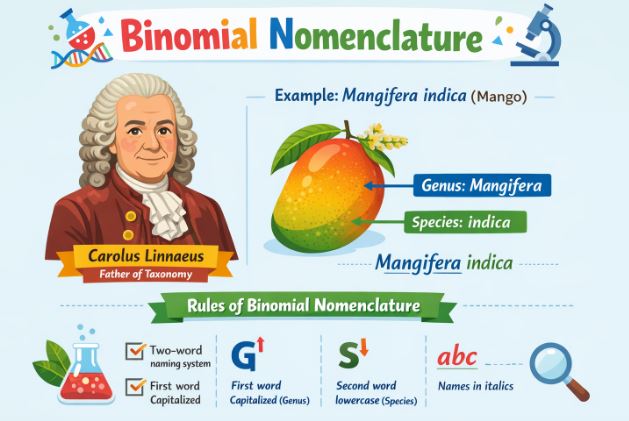
A brilliant scientist named Carolus Linnaeus gave us a highly effective, two-word naming system that the whole scientific community uses today. This is called Binomial Nomenclature (“Bi” means two, “nomial” means name).
Every scientific name has two components:
- Generic Name: Tells us which Genus the organism belongs to.
- Specific Epithet: Points to the exact species within that genus.
The Universal Rules of Naming (Memorize these!):
- Language: Biological names are generally taken from the Latin language, irrespective of where the organism was found. This is because Latin is a “dead language” and doesn’t change over time.
- Formatting in Print: They are always printed in italics to show their Latin origin.
- Formatting in Handwriting: When you write them with a pen in your exam, you MUST separately underline both words (e.g., Mangifera indica).
- Capitalization: The first letter of the Generic name is always CAPITALIZED. The specific epithet starts with a small letter.
- Author Citation: Sometimes, the name of the scientist who first described the species is written at the very end in an abbreviated form, not in italics. Example: Mangifera indica Linn. (Linn stands for Linnaeus).
4. Classification and Taxonomy
Now that we can name things, how do we study 1.8 million species without losing our minds? We group them!
Classification is the process of putting organisms into convenient categories based on traits we can easily observe. For example, if I say “Dog”, your brain immediately pictures a barking animal with fur and four legs. You don’t picture a leafy tree. These convenient mental groups—like Dogs, Cats, Mammals, Plants—are scientifically termed Taxa (singular: Taxon).
The scientific study of outlining these principles and procedures of classification is called Taxonomy. Modern taxonomy doesn’t just look at the outside appearance. It looks at internal structure, cell structure, how the organism develops, and how it interacts with its environment.
Systematics: Humans are curious. We don’t just want to group things; we want to know how they are related to each other in an evolutionary family tree. This broader field of study, which includes taxonomy plus evolutionary relationships, is called Systematics. The word comes from the Latin ‘systema’, meaning systematic arrangement.
5. Taxonomic Categories (The Biological Hierarchy)
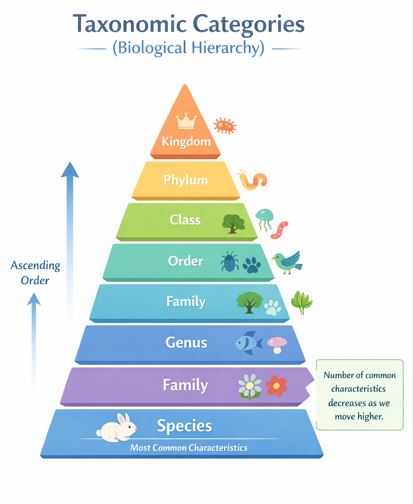
Classification is not a one-step jump. It is a ladder, a hierarchy of steps. Each step or rank in this ladder is a taxonomic category. When you put all the categories together from lowest to highest, you get the Taxonomic Hierarchy.
Let’s walk up the ladder, starting from the basic unit:
5.1 Species (The Foundation)
A species is a group of individual organisms with fundamental, core similarities. They look alike and, most importantly, can breed among themselves in nature. You should be able to tell one species apart from a closely related one based on distinct physical differences.
Example: In the name Panthera leo (Lion) and Panthera tigris (Tiger), leo and tigris are specific epithets representing distinct species.
5.2 Genus (The Close Cousins)
A genus is essentially a group of closely related species that share more common features with each other than with species in other genera.
Example: The potato (Solanum tuberosum) and the brinjal (Solanum melongena) are different species, but they are so fundamentally similar that they are grouped under the same genus, Solanum. Similarly, Lions, Tigers, and Leopards all belong to the genus Panthera.
5.3 Family (The Extended Family)
Now we zoom out a bit. A family groups together related genera. However, the number of similarities drops compared to the genus level. For plants, families are decided based on both how the plant grows (vegetative) and its flowers/fruits (reproductive).
Example: The genus Panthera (roaring big cats) and the genus Felis (purring small house cats) are grouped together into the cat family, Felidae. Dogs have their own separate family called Canidae.
5.4 Order
Higher categories like Order are identified based on the aggregate (collection) of characters. An order assembles related families together.
Example: The cat family (Felidae) and the dog family (Canidae) both eat meat and share certain teeth structures. So, they are placed together in the order Carnivora.
5.5 Class
A class contains related orders.
Example: The order Primata (monkeys, apes, humans) and the order Carnivora (dogs, cats) both have organisms that possess body hair and feed milk to their young. Thus, they are both placed in the class Mammalia.
5.6 Phylum (For Animals) or Division (For Plants)
We are looking at very broad strokes now. Classes of animals like fishes, amphibians, reptiles, birds, and mammals all share a couple of key features, like having a nerve cord down their back. They are bundled into the Phylum Chordata. Teacher’s Tip: Remember, we use the term “Phylum” for animals, but we use “Division” when grouping plant classes!
5.7 Kingdom (The Top Tier)
The highest and broadest category. All animals from various phyla are put into Kingdom Animalia. All plants from various divisions go into Kingdom Plantae.
Crucial Rule: As we go higher up the ladder from Species to Kingdom, the number of common characteristics shared by the organisms goes on decreasing. It is much easier to find similarities between two lions (same species) than between a lion and a fish (same phylum).
Real-Life Examples to Understand Classification
- The Supermarket Analogy: Think about how a supermarket is organized. You don’t find soap mixed with apples. You have a “Kingdom” of Food and a “Kingdom” of Non-Food. Under Food, you have a “Phylum” of Produce. Under Produce, a “Class” of Fruits. Under Fruits, a “Family” of Citrus. Finally, a specific “Species” of Oranges. This makes finding things easy!
- Your School Address: If someone wants to find you, they need your Country (Kingdom), State (Phylum), City (Class), School (Order), Grade (Family), Section (Genus), and your specific Name (Species). Classification works just like an address system for living beings.
Key Takeaways & Summary
- Biodiversity represents the immense variety of life on Earth (1.7-1.8 million known species).
- Nomenclature is necessary for universal scientific communication. ICBN and ICZN set the rules.
- Binomial nomenclature (Genus + species) was introduced by Carolus Linnaeus.
- Taxonomy involves Characterisation, Identification, Classification, and Nomenclature. Systematics adds evolutionary relationships to this mix.
- The hierarchy goes: Species → Genus → Family → Order → Class → Phylum/Division → Kingdom.
- Lower taxa share more common characteristics; higher taxa share fewer.
Common Student Misconceptions
Misconception 1: “Taxon” and “Category” are exactly the same thing.
Correction: A category is an abstract rank or level (like “Class” or “Family”). A taxon is the actual biological group placed in that rank (like “Mammalia” or “Felidae”). Think of “Category” as the empty jar, and “Taxon” as the specific cookies you put inside it.
Misconception 2: Plants and Animals use the exact same categories.
Correction: They are mostly the same, but remember the one major difference! Animals are grouped into a “Phylum”, whereas plants are grouped into a “Division”.
Practice Set: Test Your Knowledge (CBSE Pattern)
Very Short Answer Questions (1 Mark)
Q1. Why are biological names generally in Latin?
Answer: Latin is a dead language, meaning it no longer changes or evolves. This ensures that biological names remain uniform and stable globally over time.
Q2. Which taxonomic category is common to both monkeys and tigers but different from frogs?
Answer: Class Mammalia. Both monkeys (Order Primata) and tigers (Order Carnivora) belong to the class Mammalia, whereas frogs belong to the class Amphibia.
Short Answer Questions (2-3 Marks)
Q3. Explain the term ‘Systematics’. How is it different from basic taxonomy?
Answer: Taxonomy deals strictly with the characterization, identification, nomenclature, and classification of organisms based on observable traits. Systematics is a broader field. It includes all of taxonomy but also takes into account the evolutionary history and relationships between organisms.
Q4. Write down the correct format of the scientific name of humans and explain the rules applied.
Answer: The scientific name of humans is Homo sapiens.
Rules applied:
1. Consists of two words: Generic name (Homo) and specific epithet (sapiens).
2. The genus name starts with a capital letter (‘H’), and the species name starts with a small letter (‘s’).
3. When typed, it is in italics. (If handwritten, both words must be separately underlined).
Long Answer Questions (5 Marks)
Q5. Describe the taxonomic hierarchy with suitable examples. Show how the number of common characters changes as we move up the hierarchy.
Answer: Taxonomic hierarchy is the arrangement of various categories in successive levels for the biological classification of organisms. The sequence from lowest to highest is: Species → Genus → Family → Order → Class → Phylum/Division → Kingdom.
Example: Let’s trace a dog.
– Species: familiaris (specific type of dog).
– Genus: Canis (includes dogs, wolves, jackals).
– Family: Canidae (includes all dog-like mammals).
– Order: Carnivora (meat-eaters, brings in cats and bears too).
– Class: Mammalia (animals with hair and mammary glands).
– Phylum: Chordata (animals with a backbone/nerve cord).
– Kingdom: Animalia (all animals).
Trend: As we move upwards from species to kingdom, the organisms become less similar. Two members of the same species share maximum common characters. Two members of the same kingdom (like a dog and a sponge) share very few common characters.
Case-Based / Competency-Based Question (4 Marks)
Q6. Read the situation and answer the questions.
A student visits a botanical garden and observes two different plants. The informational board labels Plant A as Solanum nigrum and Plant B as Solanum tuberosum. The student is confused about their relationship.
(a) What do the terms ‘Solanum’, ‘nigrum’, and ‘tuberosum’ represent scientifically?
(b) Are these two plants capable of interbreeding in nature? Give a reason.
(c) To which higher taxonomic category (Family) do these plants likely belong based on their shared genus?
Answer:
(a) ‘Solanum’ represents the Genus. ‘nigrum’ and ‘tuberosum’ represent distinct specific epithets (species).
(b) No, they cannot interbreed. Even though they belong to the same genus, they are two different species. By definition, members of different species are reproductively isolated in nature.
(c) They belong to the family Solanaceae, which aggregates related genera based on vegetative and reproductive features.
Assertion-Reason Question
Q7. For the following question, two statements are given—one labeled Assertion (A) and the other labeled Reason (R). Select the correct answer from the codes (a), (b), (c), and (d) as given below.
(a) Both A and R are true, and R is the correct explanation of A.
(b) Both A and R are true, but R is not the correct explanation of A.
(c) A is true, but R is false.
(d) A is false, but R is true.
Assertion (A): As we go higher from species to kingdom, the problem of classification becomes more complex.
Reason (R): At higher categories, the number of common characteristics shared by the members within the taxon decreases, making it harder to determine relationships.
Answer: (a). The assertion is completely correct, and the reason perfectly explains why classification gets harder at the Kingdom or Phylum level compared to the Species level.
End of Notes.
Students, make sure you memorize the exact sequence of the taxonomic hierarchy and practice writing binomial names correctly. Happy studying!
Read Also:
Class-11 Physics All Chapters
For official syllabus and textbooks, visit the
NCERT Official Website.