
Introduction | The Journey from a Seed to a Giant Tree
Hello students! Welcome back to another exciting journey into the world of plants. Have you ever stood next to a massive, ancient banyan tree and tried to imagine that its entire existence started from a tiny, insignificant-looking seed? How does a single fertilised egg (zygote) transform into a complex body with roots, branches, vibrant flowers, and sweet fruits? This is not magic; it is the beautifully orchestrated science of growth and development!
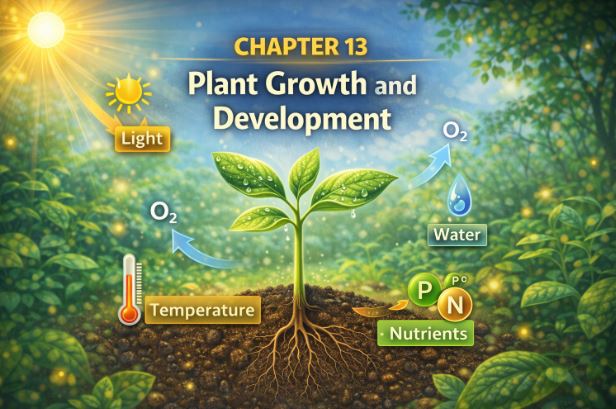
In our previous chapters, we looked at the anatomy and morphology of plants. Now, we are going to look at the “action” side of biology. We will uncover the “how” and “why” behind plant growth. We will explore how a seed wakes up from its slumber (germination) when it gets the right water, oxygen, and temperature. More importantly, we are going to dive deep into the fascinating world of internal chemical messengers—the plant hormones—that dictate whether a plant should grow tall, drop its leaves, or burst into bloom. Grab your notebooks, and let’s unravel the secrets of how plants grow!
1. Decoding “Growth”: What Does It Actually Mean?
1.1 The Definition of Growth
In biology, we can’t just say something “gets bigger.” We need a precise definition. Growth is defined as an irreversible, permanent increase in the size of an organ, its parts, or even an individual cell.
Let me ask you a question: If you take a dry wooden door and it swells up during the rainy season because it absorbs moisture, is that growth? No! When the dry season returns, the door will shrink back. True growth is permanent. Also, true biological growth requires energy and is accompanied by metabolic processes—both building up (anabolic) and breaking down (catabolic).
1.2 Plants Have “Unlimited” Growth Potential
Here is a superpower that plants have and we humans do not: indeterminate growth. A plant retains the capacity to grow infinitely throughout its entire lifespan. You stop growing taller after a certain age, but a tree keeps adding new branches and leaves year after year.
Why does this happen? The secret lies in special zones called meristems. Meristems are clusters of forever-young cells that have the extraordinary capacity to continuously divide and self-perpetuate. Because new cells are always being added to the plant body by these meristems, we call this the open form of growth.
- Primary Growth: Driven by root apical meristems and shoot apical meristems, which make the plant grow taller and deeper.
- Secondary Growth: Driven by lateral meristems (like vascular cambium and cork cambium) in dicots and gymnosperms, which increase the girth or thickness of the plant axis.
1.3 How Do We Measure Growth?
At the most fundamental cellular level, growth is simply an increase in the amount of protoplasm. But how do you measure protoplasm? It’s extremely difficult! So, scientists measure other parameters that are directly proportional to it. We can measure growth by checking the increase in fresh weight, dry weight, length, area, volume, or even the sheer number of cells.
Mind-blowing Facts from Nature:
- A single maize root apical meristem can crank out more than 17,500 new cells every single hour! Here, growth is measured by cell number.
- A cell in a watermelon can increase in size by up to 3,50,000 times! Here, growth is measured by cell size.
- For a flat leaf, growth is measured by its increase in surface area.
2. The Three Phases of Growth
If you look closely at a growing root tip, you can divide its growth journey into three distinct phases or zones. Think of this as the life cycle of a cell: birth, stretching, and getting a job.
- Meristematic Phase (The Nursery): Located right at the apex of the root and shoot. These cells are constantly dividing. They are packed with rich protoplasm and have large, highly visible nuclei. Their cell walls are primary, thin, and cellulosic, with plenty of plasmodesmatal connections to communicate with neighbors.
- Elongation Phase (The Stretching Zone): Found just behind (proximal to) the meristematic zone. Here, cells do not divide; instead, they stretch and expand like water balloons. You will see increased vacuolation (forming large central vacuoles), massive cell enlargement, and the deposition of new cell wall materials.
- Maturation Phase (The Graduation Zone): Located even further behind the elongation zone. Cells here have reached their maximum size. They undergo structural changes, thicken their walls, and transform to perform highly specific duties (like becoming a xylem vessel to carry water).
3. Growth Rates: Arithmetic vs. Geometric
This is a highly testable concept in your exams. We need to understand the mathematical pace at which cells multiply.
The increased growth per unit of time is called the growth rate. This rate can take two mathematical paths: Arithmetic or Geometric. Let’s break them down simply.
3.1 Arithmetic Growth
Imagine a factory where one worker trains a new worker, but immediately after training, the first worker retires. So, you always just add one active worker at a time. In arithmetic growth, after a cell divides into two daughter cells via mitosis, only one daughter cell continues to divide. The other one stops dividing, differentiates, and matures into a permanent tissue.
If you plot this growth (length against time) on a graph, you get a perfectly straight linear curve.
The mathematical formula is: $L_{t} = L_{0} + rt$
Where $L_{t}$ is length at time ‘t’, $L_{0}$ is the initial length, and ‘r’ is the growth rate.
3.2 Geometric (Exponential) Growth
Now imagine a factory where every trained worker trains two more, and all of them keep working and training others. The numbers explode! In geometric growth, both daughter cells retain the ability to divide and continue to do so.
However, trees don’t grow to touch the moon. Eventually, they run out of space and nutrients. Therefore, geometric growth in nature follows a classic Sigmoid (S-shaped) curve. It has three phases:
- Lag Phase: Initial growth is very slow as the machinery gets started.
- Log / Exponential Phase: Growth increases rapidly at an exponential rate.
- Stationary Phase: As nutrient supply becomes limited, growth slows down and levels off.
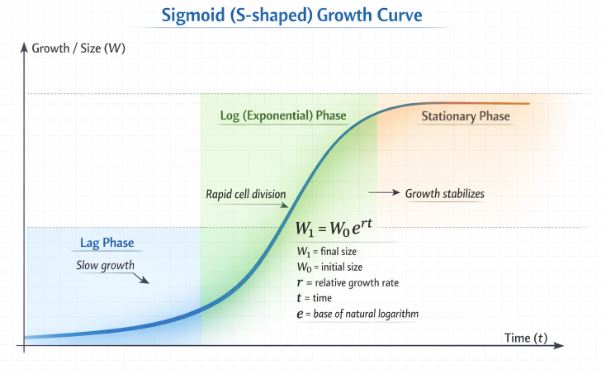
The mathematical formula for the exponential phase is: $W_{1} = W_{0}e^{rt}$
Where $W_{1}$ is final size, $W_{0}$ is initial size, ‘r’ is relative growth rate, ‘t’ is time, and ‘e’ is the base of natural logarithms. Here, ‘r’ acts as an efficiency index, showing how well the plant produces new material.
4. The Three D’s: Differentiation, Dedifferentiation, and Redifferentiation
Let’s understand how plant cells choose their careers.
4.1 Differentiation (Getting a Job)
When cells originating from the apical meristems or cambium mature to perform a specific function, this process is called differentiation. During this process, they undergo major structural modifications.
Teacher’s Example: To become a tracheary element (a water pipe), a plant cell will literally strip away and lose its living protoplasm! It then builds a super strong, elastic, lignocellulosic secondary cell wall so it can transport water under extreme tension without collapsing.
4.2 Dedifferentiation (Quitting the Job to Return to School)
Plants are incredibly flexible. Sometimes, living, fully mature, differentiated cells that have lost the capacity to divide can suddenly regain their dividing ability when the situation demands it. This remarkable phenomenon is called dedifferentiation.
Example: Fully mature parenchyma cells in the stem can dedifferentiate to form new meristems, such as the interfascicular cambium and cork cambium.
4.3 Redifferentiation (Getting a New Job)
Once those new meristems (created via dedifferentiation) divide and produce new cells, those new cells eventually lose their dividing capacity again and mature to perform specific functions. This final settling down is called redifferentiation.
4.4 Plasticity (Shape-shifting Plants)
Because differentiation in plants is “open” (meaning a single meristem can give rise to a variety of cell types based on location), plants show a phenomenal ability called plasticity. Plasticity means plants can follow different developmental pathways in response to their environment or life phase to form different structures.
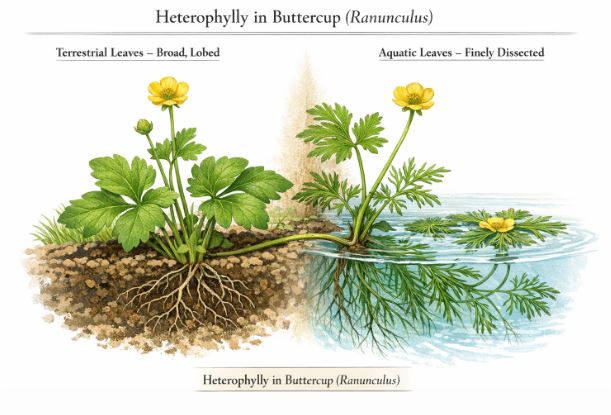
A classic example is Heterophylly. In plants like cotton, coriander, and larkspur, the leaves of a juvenile (young) plant look entirely different in shape from the leaves of a mature plant. In the buttercup plant, the leaves that grow underwater are highly dissected and feathery, while the leaves that grow up in the air are broad and flat! The environment directly changes their physical structure.
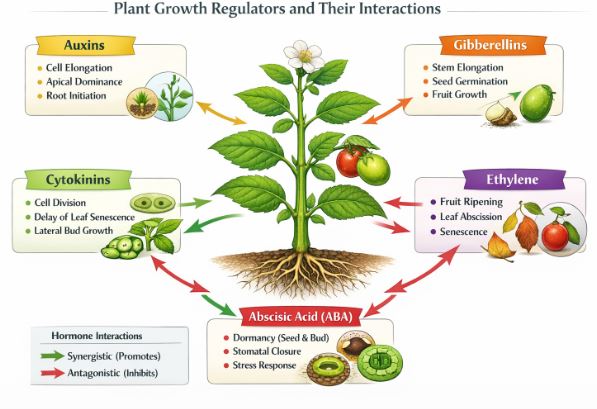
5. Plant Growth Regulators (PGRs): The Chemical Messengers
This is the heart of the chapter. Just as humans have hormones like adrenaline and insulin, plants have their own chemical messengers called Plant Growth Regulators (PGRs).
PGRs are small, simple molecules with diverse chemical compositions. They can be broadly divided into two warring factions based on their functions:
- The Promoters: These promote growth activities like cell division, flowering, seed formation, and fruit growth. Examples: Auxins, Gibberellins, and Cytokinins.
- The Inhibitors: These handle plant responses to stress, wounds, and severe weather. They inhibit growth and induce things like dormancy and leaf fall. Example: Abscisic Acid (ABA).
- Note: Ethylene is a gas that can fit into both groups but acts largely as an inhibitor.
5.1 Auxins (The Master Apical Regulators)
Discovery: Charles Darwin and his son Francis observed that the coleoptiles (protective sheaths) of canary grass always bent towards a light source (phototropism). They figured out that the tip of the plant was sensing the light and sending a signal downwards. Later, a scientist named F.W. Went successfully isolated this mysterious substance from oat seedlings and named it Auxin (from the Greek word ‘auxein’, meaning to grow).
Key Functions:
- Apical Dominance: Auxins are produced at the growing tips (apices) of stems. They travel down and strictly inhibit the growth of lateral (side) axillary buds. If you cut off the tip of a plant (decapitation), the auxin source is gone, and the side branches explode with growth! This is why gardeners regularly trim hedges to make them bushy, and why tea pluckers remove the top leaves of tea plants.
- Root Initiation: Gardeners dip stem cuttings in synthetic auxins to quickly generate roots for plant propagation.
- Weed Eradication: A synthetic auxin called 2,4-D is a selective weedkiller. It selectively kills broad-leaved dicot weeds but leaves narrow-leaved monocot crops (like your lawn grass or wheat) totally unharmed.
- Parthenocarpy: Auxins can be sprayed on flowers to induce fruit formation without fertilization, giving us seedless fruits like seedless tomatoes.
5.2 Gibberellins (The Stem Stretchers)
Discovery: In Japan, farmers noticed a “foolish seedling” disease (bakanae) where rice plants grew absurdly tall, became thin, and fell over. A scientist named E. Kurosawa discovered that this was caused by an infection from a fungal pathogen called Gibberella fujikuroi. The active chemical the fungus was pumping into the plants was identified as Gibberellic Acid ($GA_{3}$).
Key Functions:
- Internode Elongation: GAs are famous for stretching plant axes. For example, spraying gibberellins on grapes increases the length of the grape stalks, making the bunches larger.
- Sugarcane Yield Booster: Sugarcane stores precious sugar in its stem. If a farmer sprays gibberellins on the crop, the stems elongate dramatically, increasing the sugar yield by a whopping 20 tonnes per acre!
- Bolting: In plants that grow like a flat rosette on the ground (like cabbages and beetroots), applying GA causes the internodes to suddenly shoot up and elongate just before flowering. This is called bolting.
- Delaying Senescence: GAs delay the aging of fruits, meaning apples can be left on the tree longer to extend their market period.
5.3 Cytokinins (The Cell Dividers)
Discovery: F. Skoog and his team observed that plant tissue cultures (callus) would only multiply rapidly if the nutrient medium was supplemented with extracts like coconut milk or yeast. Later, Miller and his team crystallized the active substance from autoclaved herring sperm DNA and called it Kinetin. Later, natural versions like Zeatin were isolated from corn kernels.
Key Functions:
- Promoting Cytokinesis: As the name suggests, cytokinins are heavily involved in cell division. They are naturally synthesized in areas of rapid growth like root apices and developing shoot buds.
- Overcoming Apical Dominance: While auxins enforce apical dominance, cytokinins fight against it. They promote the growth of lateral shoots.
- Anti-Aging: Cytokinins help delay the senescence (aging) of leaves by actively mobilizing nutrients toward them.
5.4 Ethylene (The Ripening Gas)
Discovery: A scientist named H.H. Cousins observed a bizarre phenomenon: a batch of perfectly good, unripened bananas ripened incredibly fast when stored next to a batch of over-ripened, rotting oranges! He confirmed the oranges were releasing a volatile gas, later identified as Ethylene ($C_{2}H_{4}$).
Key Functions:
- Fruit Ripening: This is its most famous job. It greatly enhances the respiration rate of fruits during ripening, a sudden spike known as the respiratory climactic. The chemical ‘Ethephon’ is heavily used in agriculture to slowly release ethylene and hasten the ripening of tomatoes and apples.
- Abscission and Senescence: Ethylene accelerates the dropping (abscission) of older leaves and flowers.
- Breaking Dormancy: It wakes up seeds and buds from dormancy. It is the reason potato tubers start sprouting.
- Deep-Water Rice Survival: In flooded rice fields, ethylene promotes rapid petiole and internode elongation, keeping the upper leaves of the rice plant above the water surface to survive.
5.5 Abscisic Acid / ABA (The Stress Hormone)
Discovery: In the 1960s, independent researchers isolated three different growth inhibitors and named them inhibitor-B, abscission II, and dormin. Later, chemical analysis proved all three were the exact same molecule! It was officially named Abscisic Acid (ABA).
Key Functions:
- The Stress Protector: Why do we call it the stress hormone? When a plant faces severe drought, ABA rushes to the leaves and forces the stomata to close immediately, preventing water loss via transpiration. It drastically increases the plant’s tolerance to various environmental stresses.
- Seed Dormancy: While humans think of dormancy as a negative thing, for a seed, it is a survival mechanism. ABA induces seed dormancy, ensuring the seed does not germinate in the freezing winter or a severe drought, helping it withstand desiccation.
- The Great Antagonist: In almost every physiological situation, ABA acts as a direct antagonist (enemy) to Gibberellic Acid (GAs). Where GA promotes germination, ABA inhibits it.
Real-Life Examples to Connect the Dots
- The Gardener’s Secret: Have you ever seen a gardener snipping the very top tips off decorative bushes? They are physically removing the primary source of Auxin. Without Auxin pushing “apical dominance”, the side branches are free to grow thanks to Cytokinins. The result? A beautifully dense, bushy hedge.
- The Supermarket Banana Trick: If you buy hard, green avocados or bananas, place them in a brown paper bag with a fully ripe apple. The ripe apple acts like a miniature gas factory, pumping out Ethylene gas. Trapped in the bag, this ethylene will trigger the respiratory climactic in your green fruits, ripening them perfectly overnight!
Key Takeaways & Summary
- Growth is an irreversible, permanent increase in size, mostly driven by an increase in protoplasm.
- Plant growth is unique because it is open and indeterminate, thanks to the continuous division capability of meristems.
- The three phases of growth are meristematic (division), elongation (expansion), and maturation (differentiation).
- Growth curves can be Arithmetic (linear progression) or Geometric (the classic Sigmoid S-curve).
- Plants exhibit plasticity, adapting their physical development based on the environment (e.g., heterophylly in buttercup).
- Auxins rule apical dominance and root initiation. Gibberellins cause stem elongation and bolting. Cytokinins promote cell division and delay leaf aging.
- Ethylene is the gaseous fruit ripener. Abscisic Acid (ABA) is the stress hormone that protects plants via stomatal closure and seed dormancy.
Common Student Misconceptions
Misconception 1: “Abscisic Acid (ABA) is a ‘bad’ hormone because it inhibits growth.”
Teacher’s Correction: It’s easy to view inhibitors as negative, but ABA is a lifesaver! If a plant didn’t have ABA to force its stomata shut during a severe drought, it would rapidly dehydrate and die. If ABA didn’t cause seed dormancy, a seed might germinate in the middle of a freezing winter and perish immediately. Inhibition is often a defense mechanism.
Misconception 2: “Growth and Development are the exact same thing.”
Teacher’s Correction: No, they are mathematical cousins! Growth is purely quantitative (getting physically bigger/more cells). Development is the overall umbrella term that is the SUM of two things: Growth + Differentiation. You can grow bigger without developing complex new functional tissues, but development requires that maturation step.
Practice Set: Test Your Knowledge (CBSE Pattern)
Very Short Answer Questions (1 Mark)
Q1. A gardener wants a weed-free lawn. Which specific synthetic Plant Growth Regulator should he spray, and why won’t it kill his lawn grass?
Answer: He should spray 2,4-D (a synthetic auxin). It is used because it selectively kills dicotyledonous weeds but does not affect mature monocotyledonous plants, like lawn grass.
Q2. Name the three phases of the sigmoid growth curve.
Answer: The lag phase, the exponential (or log) phase, and the stationary phase.
Short Answer Questions (2-3 Marks)
Q3. Explain the phenomenon of plasticity with the help of a suitable example.
Answer: Plasticity is the ability of plants to follow different developmental pathways in response to their environment or phases of life, resulting in different physical structures. An excellent example is heterophylly in the buttercup plant. The leaves produced by the plant in a terrestrial (air) habitat are broad, whereas the leaves produced by the same plant in a water habitat are highly dissected and feathery.
Q4. Differentiate between absolute growth rate and relative growth rate.
Answer:
– Absolute growth rate: It is the measurement and comparison of total growth per unit of time.
– Relative growth rate: It is the growth of the given system per unit of time expressed on a common basis, such as per unit initial parameter (e.g., initial size or area). It acts as an efficiency index.
Long Answer Questions (5 Marks)
Q5. Describe the sequence of events from differentiation to redifferentiation in plants. Give examples.
Answer:
1. Differentiation: Cells derived from meristems mature and undergo structural changes to perform specific functions. They lose their capacity to divide. Example: Cells losing protoplasm to become rigid tracheary elements.
2. Dedifferentiation: Sometimes, these living, differentiated cells regain their capacity to divide under certain conditions. Example: Fully mature parenchyma cells dedifferentiate to form the interfascicular cambium or cork cambium.
3. Redifferentiation: The new cells produced by these newly formed meristems once again lose their capacity to divide and mature to perform specific new functions. Example: The secondary xylem and phloem formed from the vascular cambium are products of redifferentiation.
Q6. Match the following Plant Growth Regulators with their key physiological roles and briefly explain one application for each: Auxin, Gibberellin, Cytokinin, Ethylene, Abscisic Acid.
Answer:
1. Auxin: Controls apical dominance. Application: Used in hedge-making by decapitating shoot tips to promote lateral branching.
2. Gibberellin: Causes internode elongation. Application: Sprayed on sugarcane crops to increase stem length, thereby drastically increasing the sugar yield.
3. Cytokinin: Promotes cell division and delays leaf senescence. Application: Helps overcome apical dominance and promotes lateral shoot growth.
4. Ethylene: A gaseous hormone that hastens fruit ripening. Application: Ethephon is used to quickly and uniformly ripen tomatoes and apples for the market.
5. Abscisic Acid (ABA): The stress hormone. Application: It stimulates the closure of stomata during severe drought to prevent massive water loss via transpiration.
Case-Based / Competency-Based Question (4 Marks)
Q7. Read the situation and answer the questions.
A farmer has a large orchard of apple trees and a nearby field of cabbages. He notices that his apples are taking too long to ripen, risking a delay for the local market. Furthermore, he wishes to obtain seeds from his cabbage plants, but cabbages naturally grow as short rosettes close to the ground, taking a long time to flower.
(a) Which specific PGR should the farmer spray to ensure his apples ripen quickly and uniformly?
(b) What is the chemical nature of the PGR mentioned in (a)?
(c) To help his cabbage plants flower and produce seeds faster, what process should he induce, and which PGR is responsible for it?
Answer:
(a) The farmer should use Ethylene (commercially available as aqueous Ethephon).
(b) Ethylene is unique because it is a simple gaseous PGR.
(c) He should induce a process called “bolting”, which is the rapid elongation of internodes just prior to flowering. This is achieved by spraying the cabbages with Gibberellins.
Assertion-Reason Question
Q8. For the following question, two statements are given—one labeled Assertion (A) and the other labeled Reason (R). Select the correct answer from the codes (a), (b), (c), and (d) as given below.
(a) Both A and R are true, and R is the correct explanation of A.
(b) Both A and R are true, but R is not the correct explanation of A.
(c) A is true, but R is false.
(d) A is false, but R is true.
Assertion (A): Decapitation (removal of shoot tips) is widely applied in tea plantations and hedge-making to make plants bushier.
Reason (R): The removal of the shoot tip removes the source of Auxins, thus breaking apical dominance and allowing lateral (axillary) buds to grow freely.
Answer: (a). Both A and R are absolutely true. Auxins produced at the apex normally inhibit lateral buds. Removing the apex removes the auxin, which directly explains why decapitation leads to bushy growth.
End of Notes.
Students, make sure you memorize the graphical curves for growth and the specific commercial applications of the five major PGRs. Happy studying!
Read Also:
Chapter 12- Respiration in Plants
For official syllabus and textbooks, visit the
NCERT Official Website.