
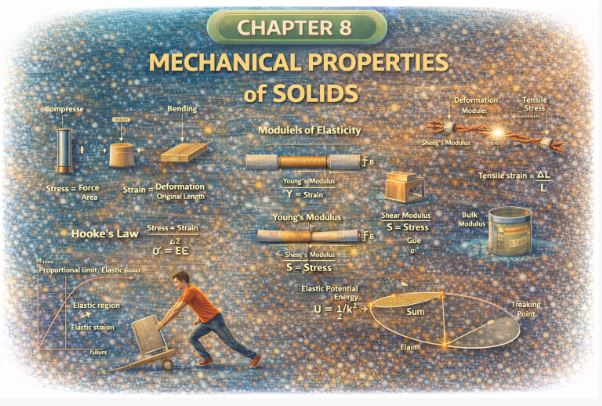
Chapter 8- Mechanical Properties of Solids

Class 11 Physics | Chapter 8 | Class 11 Physics Chapter 8 Mechanical Properties of Solids notes

1. Introduction: The Reality of “Solid” Objects | Class 11 Physics Chapter 8 Mechanical Properties of Solids notes

Hello students! Welcome to a new unit. Up until now, in our study of mechanics (like rotation and motion), we assumed something very convenient. We assumed that objects were Rigid Bodies. We pretended that when you hit a cricket ball or rotate a wheel, its shape never changes. The distance between any two atoms inside it stays fixed forever.

But looking around the real world, we know this is a lie. Nothing is perfectly rigid.

If you sit on a sofa, the cushion sinks. If you stretch a rubber band, it elongates. Even a steel bridge bends slightly when a heavy truck drives over it. Even the hardest diamond can be deformed if you apply enough force.

In this chapter, we are going to study the Mechanical Properties of Solids. We will explore why things change shape, how they return to their original shape, and when they break. This science is the foundation of Civil Engineering and Mechanical Engineering. Without it, every building we build would collapse!

1.1 Elasticity and Plasticity

Imagine you have a piece of rubber and a piece of chewing gum. You stretch both of them.

  • The Rubber: When you let go, it snaps back to its original length.
  • The Chewing Gum: When you let go, it stays stretched and messy.

This difference is the core of this chapter.

1. Elasticity:

This is the “memory” of a material. It is the property by virtue of which a body tends to regain its original size and shape after the applied force is removed.

Examples: Steel, Rubber, Quartz, Human Skin.

2. Plasticity:

This is the “forgetfulness” of a material. It is the property by which a body does not regain its original shape and gets permanently deformed.

Examples: Putty, Mud, Chewing Gum, Paraffin Wax.

1.2 The Microscopic View: Atoms as Springs

Why do solids behave like this? Let’s zoom in to the atomic level.

Solids are made of atoms arranged in a lattice. Imagine these atoms are small balls connected to their neighbors by invisible Springs.

– When you pull the object, you are stretching these inter-atomic springs. They want to pull back (Restoring Force).

– When you squash the object, you are compressing the springs. They want to push back.

This internal “springiness” of chemical bonds is the origin of Elasticity.
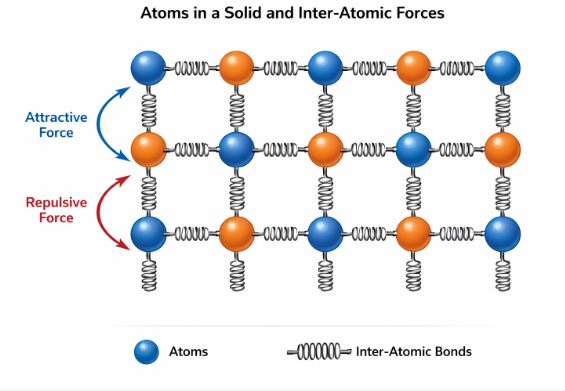
Inter-atomic forces.

Figure 1: The Spring-Ball Model of Solids. Stretching the solid stretches the bonds between atoms.

2. Stress: The Internal Fighter

When you pull a rubber band, you apply an External Deforming Force.

But the rubber band doesn’t just give up. It fights back! Inside the rubber, millions of molecular bonds are pulling back, trying to restore the original shape.

Definition: Stress is the Internal Restoring Force developed per unit area of the body.

In equilibrium, the internal restoring force is equal in magnitude to the external applied force. So, for calculation purposes, we use the applied force.

Formula: Stress (σ) = Force (F) / Area (A)

SI Unit: N/m² or Pascal (Pa).

Dimensional Formula: [ML⁻¹T⁻²] (Same as Pressure).

2.1 Types of Stress

Depending on how the force is applied, stress comes in three flavors:
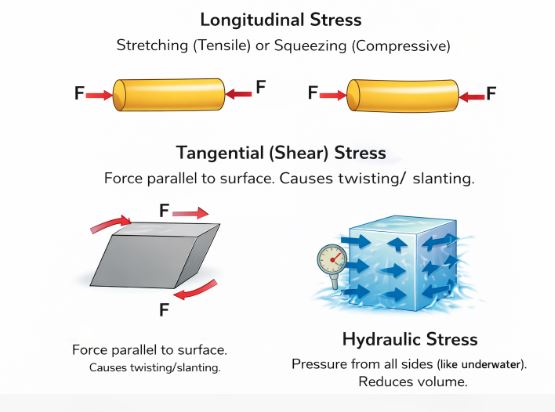
Type of stress

Figure 2: The three ways to stress a body.

A. Longitudinal Stress

This happens when the force acts along the length of a cylinder or wire.

Tensile Stress: When the force pulls the object to elongate it.

Compressive Stress: When the force pushes the object to shorten it.

B. Tangential (Shearing) Stress

Imagine a thick book on a table. If you push the top cover sideways while keeping the bottom fixed, the book slants. The pages slide over each other.

Here, the force is applied Parallel to the surface area.

C. Hydraulic Stress

This happens to a ball thrown deep into the ocean. The water pressure pushes it from every single direction perpendicular to the surface. The ball shrinks in volume but keeps its shape.

3. Strain: The Measure of Deformation

Stress is the cause; Strain is the effect.

When you stress an object, it changes dimensions. Strain tells us “how much” it changed relative to its original size.

Formula: Strain (ε) = Change in Dimension / Original Dimension

Unit: Strain is a ratio of two similar quantities (like length/length). Therefore, it has NO UNIT and NO DIMENSIONS.

3.1 Types of Strain

Just like stress, strain has three corresponding types:

  • Longitudinal Strain: Change in Length per unit Original Length.

    ε_l = ΔL / L
  • Shearing Strain: The angle by which a vertical face gets tilted.

    ε_s = tan θ ≈ θ = Δx / L (Relative displacement / Length).
  • Volume Strain: Change in Volume per unit Original Volume.

    ε_v = ΔV / V

4. Hooke’s Law

Robert Hooke, a contemporary of Newton, did many experiments with springs and wires. He found a very simple relationship.

Statement: “For small deformations, Stress is directly proportional to Strain.”

Stress ∝ Strain

Stress = k × Strain

This constant of proportionality ‘k’ is called the Modulus of Elasticity.

This law is valid only up to a certain limit called the Elastic Limit.

5. The Stress-Strain Curve: A Material’s Biography

If we take a metal wire and stretch it more and more while measuring the stress and strain, we get a graph. This graph tells us the complete life story of that material—from being elastic to breaking apart.
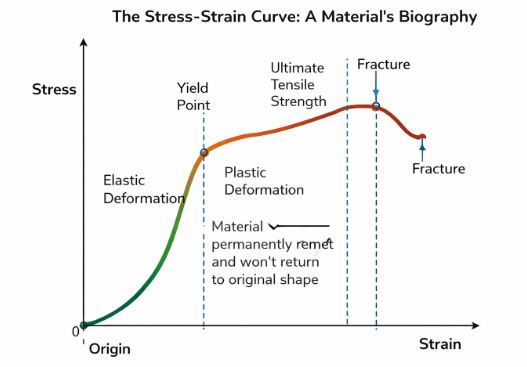
Stress stran curve

Figure 3: The Stress-Strain Curve for a ductile metal.
Decoding the Curve:

  1. Region O to A (Proportional Limit): The graph is a straight line. Stress is directly proportional to Strain. Hooke’s Law works perfectly here.
  2. Region A to B (Elastic Limit / Yield Point): The graph curves slightly. It is no longer linear, BUT if you remove the load, the wire still returns to its original length. Point B is the maximum stress the material can handle without permanent damage.
  3. Region B to D (Plastic Region): If you stretch beyond B, the material gets Permanently Deformed. Even if you remove the force, the wire will not go back to zero length; it will always remain a bit longer (Permanent Set). The material starts flowing like plastic. Point D is the Ultimate Tensile Strength—the maximum load the wire can bear.
  4. Region D to E (Fracture Point): After point D, the wire thins down (necking) and finally snaps at point E.

Material Classifications based on the Curve

  • Ductile Materials: The gap between point B (Elastic Limit) and point E (Fracture) is very large. These materials can be stretched into long wires before breaking.

    Examples: Copper, Steel, Gold, Aluminum.
  • Brittle Materials: The gap between B and E is very small. They break almost immediately after crossing the elastic limit. They cannot be stretched.

    Examples: Glass, Ceramics, Cast Iron.
  • Elastomers: These materials don’t follow Hooke’s law (no straight line), but they can be stretched to huge strains (like 500%) and still return to original shape.

    Examples: Rubber, Aorta (tissue carrying blood from heart).

6. Elastic Moduli: Measuring Stiffness

The Modulus of Elasticity is essentially a measure of Stiffness. A material with a higher modulus is harder to deform.

6.1 Young’s Modulus (Y)

This relates to Longitudinal Stress and Strain (Stretching).

Y = Longitudinal Stress / Longitudinal Strain

Y = (F/A) / (ΔL/L) = (F L) / (A ΔL)

The Great Debate: Steel vs. Rubber

Common sense says rubber is more elastic because it stretches more.

Physics says NO! In physics, “Elasticity” means resistance to deformation.

If you apply the same force to a steel wire and a rubber band:

– Rubber stretches a lot (Large ΔL) -> Small Y.

– Steel stretches very little (Tiny ΔL) -> Huge Y.

Since Steel has a larger Young’s Modulus, Steel is more elastic than Rubber.

6.2 Shear Modulus (G)

This relates to Shearing Stress and Strain (Twisting/Shape change).

G = Shearing Stress / Shearing Strain

G = (F/A) / θ

Generally, G is about 1/3rd of Young’s Modulus. Solids are easier to twist than to stretch.

6.3 Bulk Modulus (B)

This relates to Hydraulic Stress and Volume Strain (Compression).

B = Hydraulic Stress / Volume Strain

B = - P / (ΔV/V)

Why the Negative Sign?

Because pressure (P) increase leads to a volume (V) decrease (ΔV is negative). The minus sign ensures B is a positive number.

Compressibility (k): The reciprocal of Bulk Modulus (1/B).

– Solids have high B (Hard to compress).

– Gases have very low B (Easy to compress).

6.4 Poisson’s Ratio (σ)

Imagine stretching a piece of chewing gum. As it gets longer, it also gets thinner.

When you stretch a wire, it elongates (Longitudinal Strain) but also shrinks laterally (Lateral Strain).

Poisson’s Ratio is the ratio of these two effects.

σ = Lateral Strain / Longitudinal Strain

σ = - (Δd/d) / (ΔL/L)

Since it is a ratio of two strains, it has no unit.

7. Applications of Elasticity in Engineering

Why do we study all this? To build things that don’t break!

7.1 Designing Bridges (The I-Beam)

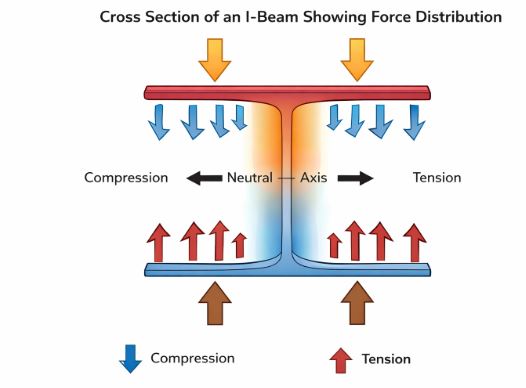
When a heavy load is placed on a beam (like a bridge), the beam bends. The top surface gets compressed, and the bottom surface gets stretched.

The middle part of the beam experiences very little stress (Neutral Axis).

So, engineers realized: Why waste material in the middle? They removed the material from the sides, leaving an ‘I’ shape cross-section.

Advantages of I-Beams:

1. They are lighter (less material used).

2. They are cheaper.

3. They are incredibly strong against bending because the mass is concentrated at the top and bottom flanges where stress is maximum.

Cross section of an I-beam showing how forces are distributed.

Figure 4: An I-Beam. Efficient and Strong.

7.2 Maximum Height of Mountains

Why isn’t Mount Everest 20 km high? Why are mountains roughly capped at 8-10 km?

The rock at the bottom of a mountain has to support the weight of everything above it. If the mountain gets too high, the pressure at the base exceeds the Shearing Strength of the rock. The rock would start to flow like plastic, and the mountain would sink.

Calculations using the elastic limits of rocks show that the maximum height on Earth is roughly 10 km. Everest fits right in!

7.3 Cranes and Metallic Ropes

Cranes lift tons of weight. The ropes used are not single thick rods. They are made of thin steel wires braided together.

Why braided?

1. Flexibility: It can roll over pulleys.

2. Strength: If one strand breaks, the others hold.

Engineers calculate the required thickness (Area) using the Elastic Limit of steel to ensure the stress never crosses the safety limit.

8. Elastic Potential Energy

When you stretch a wire, you do work against the inter-atomic forces. This work is not lost; it is stored in the wire as Elastic Potential Energy (U).

Derivation Logic:

Force required to stretch is not constant; it increases as length increases (F = kx).

Work Done = Average Force × Extension

W = ½ F × l (where l is elongation).

So, U = ½ F l.

We can rewrite this in terms of Stress and Strain:

U = ½ (Stress × Area) × (Strain × Length)

U = ½ × Stress × Strain × Volume

Energy Density (u): Energy stored per unit volume.

u = ½ × Stress × Strain

u = ½ × Y × (Strain)²

9. Practice Questions & Detailed Solutions

Physics is best learned by solving problems. Let’s tackle some exam-favorites.

Part A: Multiple Choice Questions (MCQ)

  1. Which of the following has no units?
    (a) Stress (b) Strain (c) Young’s Modulus (d) Force

    Solution: (b) Strain.

    Reasoning: Strain is the ratio of change in dimension to original dimension (L/L). Units cancel out. Stress and Modulus have units of Pressure (Pa).

  2. A material that can be drawn into a wire is called:
    (a) Brittle (b) Ductile (c) Elastic (d) Plastic

    Solution: (b) Ductile.

    Reasoning: Ductile materials have a large plastic region, allowing them to deform permanently into wires without breaking. Brittle materials snap immediately.

  3. Why is steel preferred over copper for springs?
    (a) Steel is cheaper. (b) Steel is harder. (c) Steel has a higher Young’s Modulus. (d) Steel is less plastic.

    Solution: (c).

    Reasoning: A higher Young’s modulus means steel is more elastic. It returns to its original shape with more force and resists deformation better than copper.

Part B: Short Answer Questions

  1. Q: A rubber band stretches easily, while a steel wire does not. Which material is considered more elastic in physics and why?

    Answer: Steel is more elastic.

    In physics, elasticity is defined as the resistance to deformation. A material that requires more force to produce the same extension is more elastic.

    Since Young’s Modulus Y = Stress/Strain, and Steel requires huge stress for tiny strain, its Y is much larger than Rubber. Therefore, Steel is elastically stronger.

  2. Q: Explain the difference between tensile stress and hydraulic stress.

    Answer:

    Tensile Stress: It is a restoring force developed when an object is elongated (stretched) by forces acting outwards along its length. It leads to a change in shape (length).

    Hydraulic Stress: It is the restoring force developed when an object is subjected to uniform fluid pressure from all sides. It leads to a change in volume (compression) without changing the geometrical shape.

Part C: Long Answer Questions (Numerical Solving)

  1. Q: A steel elevator cable is 30 m long and has a diameter of 2 cm. It lifts a 1500 kg elevator. How much does the cable elongate? (Y_steel = 200 GPa, g = 9.8 m/s²)

    Answer:

    Given:

    Length (L) = 30 m

    Diameter = 2 cm = 0.02 m -> Radius (r) = 0.01 m

    Mass (m) = 1500 kg

    Young’s Modulus (Y) = 200 × 10⁹ Pa

    Step 1: Calculate Applied Force (F).

    F = mg = 1500 × 9.8 = 14,700 N.

    Step 2: Calculate Area of Cross-section (A).

    A = π r² = 3.1415 × (0.01)²

    A = 3.1415 × 10⁻⁴ m².

    Step 3: Calculate Stress (σ).

    Stress = F / A = 14700 / (3.1415 × 10⁻⁴)

    Stress ≈ 4.68 × 10⁷ Pa.

    Step 4: Calculate Elongation (ΔL).

    Formula: Y = Stress / Strain = Stress / (ΔL/L)

    So, ΔL = (Stress × L) / Y

    ΔL = (4.68 × 10⁷ × 30) / (200 × 10⁹)

    ΔL = (140.4 × 10⁷) / (2 × 10¹¹)

    ΔL ≈ 70.2 × 10⁻⁴ m

    ΔL ≈ 7.02 × 10⁻³ m = 7.02 mm.

    Conclusion: The 30-meter steel cable stretches by about 7 millimeters under the weight of the elevator.

Read Also: 

Class-11 Physics Part-1

For more check official website of
NCERT

Scroll to Top