
1. Introduction: The Biological Blueprint
Hello students! Welcome to one of the most fascinating chapters in Biology. Have you ever wondered why you look like your parents? Maybe you have your father’s nose or your mother’s eye color. Or perhaps you have seen a litter of puppies where some look exactly like the mother, but others have a completely different fur pattern. How does nature decide which features get passed down and which ones don’t?
This “decision-making” process of nature is what we call Heredity. It is the transmission of traits (characteristics) from one generation to the next. Basically, it is the reason why humans give birth to humans and not monkeys! When you are looking for Class 10 Heredity Chapter 8 Notes, the first thing you need to understand is this fundamental link between parents and offspring.
1.1 Variation: The Spice of Life
Now, look around your classroom. Everyone has two eyes, a nose, and a mouth. We are all humans. But do we all look identical? No! Unless you have an identical twin, no two people in the room are exactly the same. This difference is called Variation.
Why does variation happen?
It depends on how organisms reproduce:
1. Asexual Reproduction: Think of bacteria or amoeba. They essentially clone themselves. The parent splits into two. The offspring are almost exact carbon copies. Variation here is very low—it only happens if there is a tiny error when copying the DNA (like a typo in a document).
2. Sexual Reproduction: This is what humans, animals, and flowering plants do. Here, we mix the genetic material from two parents (Father and Mother). Because we are mixing two different sets of blueprints, the offspring gets a unique combination. This creates huge variation.
Why is Variation good?
Imagine a population of beetles living in a forest. They can all survive up to 30°C. Suddenly, due to global warming, the temperature jumps to 35°C. If all beetles were identical, they would all die, and the species would go extinct. But, thanks to variation, maybe a few beetles naturally have a “heat-resistant” trait. These few will survive, reproduce, and repopulate the forest. So, variation is nature’s insurance policy against extinction!
2. Important Terms: The Vocabulary of Genetics
Before we dive into the experiments, let’s learn the language of genetics. Imagine DNA is a cookbook.
- Chromosome: Think of this as the entire cookbook containing thousands of recipes. Humans have 23 pairs of these.
- Gene: This is a single recipe in that book. For example, a recipe for “Eye Color” or “Height”. Genes are the functional units of heredity.
- Allele: These are the different versions of the same recipe. For the “Ice Cream” gene, you might have a “Chocolate” allele or a “Vanilla” allele. In plants, for the “Height” gene, we have a Tall (T) allele and a Short (t) allele.
- Dominant Allele: The bossy one! If this allele is present, it expresses itself no matter what. We write it with a Capital Letter (e.g., T).
- Recessive Allele: The shy one. It only expresses itself if the bossy dominant allele is NOT there. We write it with a small letter (e.g., t).
- Genotype: The genetic code inside the cells (e.g., TT, Tt, or tt). You can’t see this with your eyes.
- Phenotype: The physical appearance we can see (e.g., Tall plant, Short plant).
- Homozygous: When both alleles are the same (Purebred). Examples: TT (Pure Tall) or tt (Pure Short).
- Heterozygous: When the alleles are different (Hybrid). Example: Tt (Hybrid Tall).
Understanding these terms is crucial when writing answers for heredity class 10 NCERT solutions.
3. Gregor Mendel: The Father of Genetics
Long before we knew about DNA or microscopes, a monk named Gregor Mendel worked out the rules of inheritance. He was a math and science teacher who loved gardening. He performed experiments on garden pea plants (Pisum sativum) for seven years!
Why did he choose Pea Plants?
He was smart in his choice because:
1. They grow very fast (he didn’t have to wait years for results).
2. They have clear, visible differences (Tall vs Short, Purple vs White flowers). There were no “medium” confusion.
3. They can self-pollinate or be cross-pollinated easily.
3.1 Mendel’s Experiment 1: The Monohybrid Cross
“Mono” means one. Here, Mendel studied the inheritance of just one trait: Height.
Step 1: The Parents (P Generation)
He took a purebred Tall plant (TT) and a purebred Short plant (tt) and crossed them.
Step 2: The First Generation (F1)
He collected the seeds and grew them. What do you think happened? Were they medium height?
NO! Every single plant was Tall. The shortness seemed to vanish completely.
Genotype of F1: Tt (Heterozygous).
Why Tall? Because the T (Tall) allele is dominant over the t (Short) allele.
Step 3: The Second Generation (F2)
Mendel didn’t stop. He let these F1 tall plants self-pollinate (Tt × Tt).
The result was shocking. In the next generation, for every 3 tall plants, there was 1 short plant! The “shortness” trait had been hiding in the genes all along and reappeared.
Let’s visualize this using a Punnett Square (A tool used to predict genetic outcomes):
| T (Male Gamete) | t (Male Gamete) | |
|---|---|---|
| T (Female) | TT (Tall) |
Tt (Tall) |
| t (Female) | Tt (Tall) |
tt (Short) |
Important Ratios for Exams:
1. Phenotypic Ratio (Appearance): 3 Tall : 1 Short (3:1)
2. Genotypic Ratio (Genetic Makeup): 1 TT : 2 Tt : 1 tt (1:2:1)
This experiment proved the Law of Dominance (one trait masks the other) and the Law of Segregation (alleles separate during gamete formation). This is a frequent question in heredity class 10 NCERT solutions.
3.2 Mendel’s Experiment 2: The Dihybrid Cross
Now Mendel got ambitious. He wanted to see if two traits influenced each other. Did being “Tall” force a plant to have “Green seeds”?
He crossed plants varying in two traits:
1. Seed Shape: Round (R) vs Wrinkled (r)
2. Seed Color: Yellow (Y) vs Green (y)
The Cross: Round-Yellow Seeds (RRYY) × Wrinkled-Green Seeds (rryy).
F1 Generation: All plants had Round-Yellow seeds (RrYy). This tells us Round and Yellow are dominant.
F2 Generation: He self-pollinated the F1 plants. He got a mix of four types of seeds:
1. Round Yellow (9) – Parental type
2. Round Green (3) – New Combination!
3. Wrinkled Yellow (3) – New Combination!
4. Wrinkled Green (1) – Parental type
The Phenotypic Ratio is 9:3:3:1.
Conclusion (Law of Independent Assortment): The fact that we got “Round Green” and “Wrinkled Yellow” seeds proves that the gene for seed shape separated independently from the gene for seed color. Just because a seed is Round doesn’t mean it has to be Yellow. It can pick either color. The inheritance of one trait does not influence the inheritance of another.
4. How Do Genes Control Traits? (The Central Dogma)
We keep saying “genes control traits,” but how? It’s not magic; it’s chemistry. Let’s look at the mechanism.
Your cells are like little factories.
1. DNA is the Manager. It sits in the nucleus and has the blueprints.
2. Proteins (specifically Enzymes) are the Workers. They actually build structures or catalyze reactions.
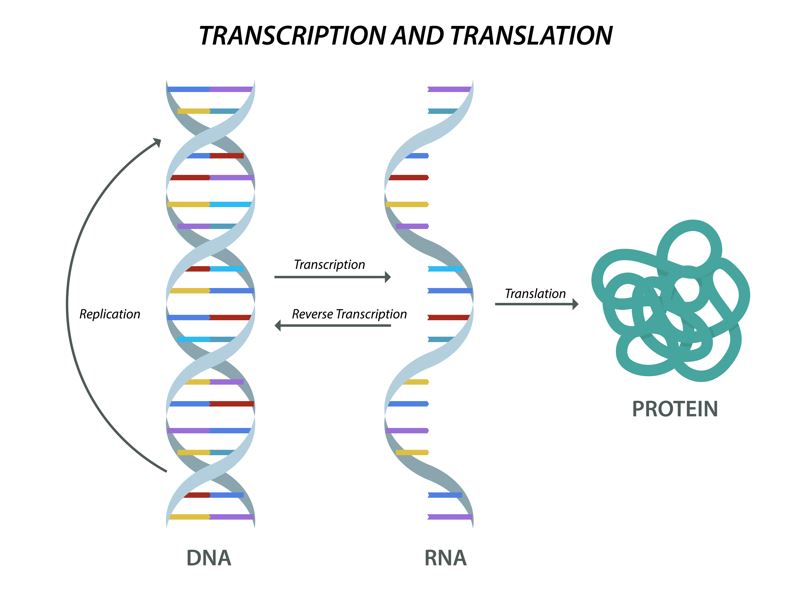
Figure 1: The Central Dogma. DNA creates Proteins, and Proteins result in characteristics (Traits).
Let’s take Plant Height as an example:
– The plant needs a specific Growth Hormone to grow tall.
– This hormone is made by a specific Enzyme.
– The gene has the instructions to build this Enzyme.
- Scenario A (Dominant T): The gene works perfectly. It makes a very efficient enzyme. The enzyme makes a LOT of growth hormone. Result: The plant grows Tall.
- Scenario B (Recessive t): The gene has a slight variation. It makes a less efficient enzyme (or none at all). Very little growth hormone is produced. Result: The plant stays Short.
This biochemical explanation is often asked in advanced questions for heredity class 10 NCERT solutions.
5. Sex Determination: Boy or Girl?
In our society, people often (wrongly) blamed mothers for giving birth to daughters. Science proves that this is biologically incorrect. Let’s see why.
Humans have 23 pairs of chromosomes.
– 22 pairs are called Autosomes (they determine body traits like eye color, height, etc.).
– The 23rd pair is the Sex Chromosome.
The Chromosome Code:
Females: Have a perfect pair of X chromosomes (XX).
Males: Have one normal X and one short Y chromosome (XY).
The Mechanism of Inheritance:
When a mother makes egg cells (gametes), she splits her XX pair. Since both are X, 100% of her eggs carry an X chromosome.
When a father makes sperm cells, he splits his XY pair. 50% of sperm carry X, and 50% carry Y.
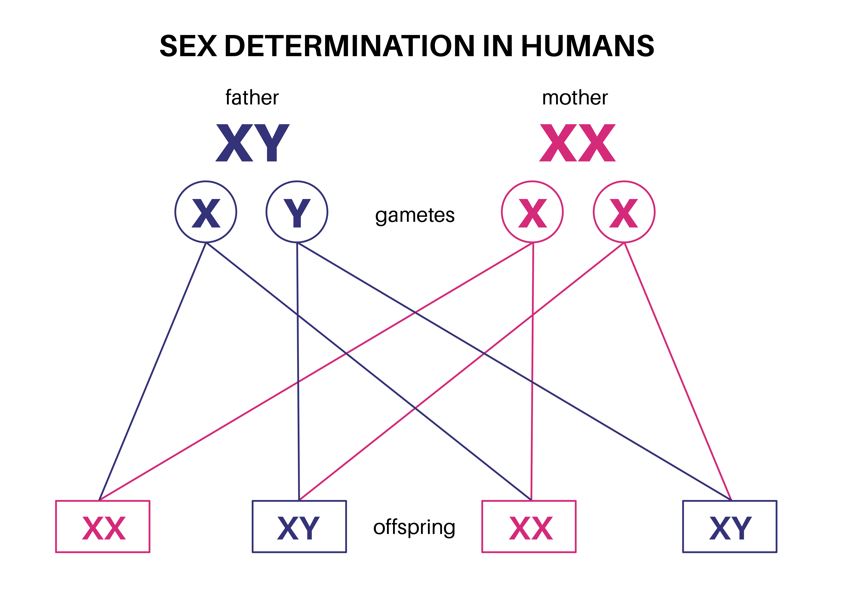
Figure 2: Sex Determination Flowchart. It shows that the father’s sperm decides the sex of the baby.
The Moment of Fertilization:
It is a game of chance!
1. If a Sperm carrying X meets the Egg (X) -> Result: XX (Girl).
2. If a Sperm carrying Y meets the Egg (X) -> Result: XY (Boy).
Since there is a 50-50 chance of the father passing on X or Y, there is always a 50% probability of having a boy or a girl. Therefore, the sex of the child is determined by the Father, not the Mother. This is a crucial concept to remember for your heredity class 10 NCERT solutions.
6. Extensive Practice Questions & Solutions
To master this chapter, you need to practice applying these concepts. Here is a curated list of important questions.
Part A: Multiple Choice Questions (MCQs)
- Exchange of genetic material takes place in:
(a) Vegetative reproduction
(b) Asexual reproduction
(c) Sexual reproduction
(d) BuddingAnswer: (c) Sexual reproduction.
Reason: Sexual reproduction involves the fusion of gametes from two parents, leading to the mixing of DNA. - A cross between a tall plant (TT) and short pea plant (tt) resulted in progeny that were all tall plants because:
(a) Tallness is the recessive trait
(b) Shortness is the dominant trait
(c) Height of pea plant is not governed by gene ‘T’ or ‘t’
(d) Tallness is the dominant traitAnswer: (d) Tallness is the dominant trait.
Reason: In the F1 generation, the dominant allele (T) masks the expression of the recessive allele (t). - Which of the following statements is incorrect?
(a) For every hormone there is a gene.
(b) For every protein there is a gene.
(c) For production of every enzyme there is a gene.
(d) For every molecule of fat there is a gene.Answer: (d) For every molecule of fat there is a gene.
Reason: Genes code for proteins (enzymes). Fats are not proteins; they are synthesized by enzymes, but there isn’t a “fat gene” directly coding for the fat molecule itself. - In human males, all the chromosomes are paired perfectly except one. This/these unpaired chromosome is/are:
(i) Large chromosome (ii) Small chromosome (iii) Y-chromosome (iv) X-chromosome
(a) (i) and (ii)
(b) (iii) only
(c) (iii) and (iv)
(d) (ii) and (iv)Answer: (c) (iii) and (iv).
Reason: Males have an XY pair. The X and Y chromosomes are different sizes and shapes, so they don’t form a perfect matching pair like autosomes.
Part B: Short Answer Questions
- “The sex of the children is determined by what they inherit from their father and not their mother.” Justify.Answer:
A human female has two X chromosomes (XX) and produces only one type of gamete (egg) with an X chromosome. A human male has one X and one Y chromosome (XY) and produces two types of gametes (sperm): 50% with X and 50% with Y.
– If X-sperm fertilizes the egg -> XX (Girl).
– If Y-sperm fertilizes the egg -> XY (Boy).
Since the mother always contributes an X, the variable that determines the outcome comes solely from the father. This is a standard question in heredity class 10 NCERT solutions.
- A man with blood group A marries a woman with blood group O and their daughter has blood group O. Is this information enough to tell you which of the traits – blood group A or O – is dominant? Why or why not?Answer:
Yes, this information is enough.
– The daughter has blood group O. The genotype for O is always recessive (let’s say oo). This means she received one ‘o’ allele from the father and one ‘o’ allele from the mother.
– The mother is group O, so her genotype is oo.
– The father is group A, but he must have given an ‘o’ allele to the daughter. This means his genotype must be Ao.
– Since the father has both ‘A’ and ‘o’ alleles but his blood group is A, it proves that A is dominant over O. If O were dominant, his blood group would have been O.
- Why are acquired traits not inherited?Answer: Acquired traits (like building muscles, learning a language, or losing a finger) only affect the Somatic Cells (body cells) of an organism. They do not change the DNA of the Germ Cells (sperm and egg). Since heredity works by passing DNA through germ cells to the offspring, changes in body cells cannot be passed down. For example, a mouse whose tail is cut off will still give birth to mice with tails.
Part C: Long Answer Questions
- How do Mendel’s experiments show that traits may be dominant or recessive? Describe with a flowchart.Answer:
Mendel crossed a pure tall pea plant (TT) with a pure short pea plant (tt).
1. In the F1 generation, he observed that all plants were tall. There were no short plants. This showed that the Tall trait expressed itself while the Short trait was hidden. This proved that Tallness is Dominant and Shortness is Recessive.
2. When he self-pollinated the F1 plants, the short trait reappeared in the F2 generation (in 25% of plants). This confirmed that the recessive trait was present but masked.
- How do Mendel’s experiments show that traits are inherited independently?Answer:
Mendel performed a Dihybrid Cross using two traits: Seed Shape (Round/Wrinkled) and Seed Color (Yellow/Green).
– Parents: Round-Yellow (RRYY) × Wrinkled-Green (rryy).
– F1 Generation: All Round-Yellow.
– F2 Generation: He observed new combinations that were not present in the parents, specifically Round-Green and Wrinkled-Yellow seeds.
– This appearance of new combinations proves that the factors controlling seed shape and seed color move independently of each other during gamete formation. This is the Law of Independent Assortment.
- A study found that children with light-colored eyes are likely to have parents with light-colored eyes. On this basis, can we say anything about whether the light eye color trait is dominant or recessive? Why or why not?Answer:
No, this information alone is not sufficient to determine dominance.
Let’s assume “Light” is the trait in question.
Case 1: If Light is Recessive (ll). Two parents with light eyes (ll x ll) can only have children with light eyes (ll). This fits the statement.
Case 2: If Light is Dominant (LL). Two parents with light eyes (LL x LL) would also have children with light eyes (LL). Even if they were hybrids (Ll x Ll), 75% would still have light eyes.
Since the statement holds true in both scenarios (whether light is dominant or recessive), we cannot pinpoint the nature of the trait without more data (like at least one dark-eyed parent or child in the mix). This type of critical thinking is key for heredity class 10 NCERT solutions.
Read Also:
Class 10 Chapter 7- How do organisms reproduce
For more check official website of
NCERT