
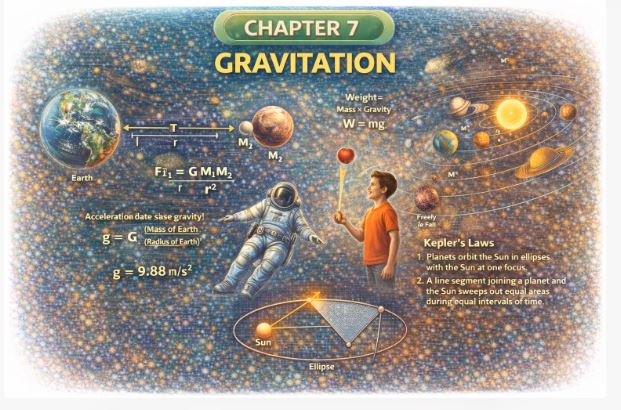
1. Introduction: The Universal Glue | Class 11 Physics Chapter 7 Gravitation Notes
Hello students! Welcome to Chapter 7. Today we are going to talk about the force that literally holds the universe together. Have you ever wondered why you don’t float away into space when you jump? Or why the Moon keeps circling the Earth without an engine? Or why the tides in the ocean rise and fall every day?
The answer to all these questions is Gravitation. It is the invisible glue of the cosmos. For a long time, people thought the laws of the heavens (stars, planets) were different from the laws of Earth (apples falling). It was Isaac Newton who unified them. He realized that the force pulling an apple to the ground is the exact same force keeping the Moon in orbit.
2. Kepler’s Laws of Planetary Motion
Before Newton could explain why planets move, a brilliant mathematician named Johannes Kepler described how they move. He spent years analyzing data collected by his mentor, Tycho Brahe, and formulated three famous laws.
2.1 First Law: The Law of Orbits
Statement: “All planets move in elliptical orbits with the Sun situated at one of the foci of the ellipse.”
This was a shocker! Everyone before him, including Copernicus, thought orbits were perfect circles. Kepler said, “No, they are stretched circles called ellipses.”
What is an Ellipse?
Imagine a circle that someone sat on. It has two center points called Foci (plural of Focus). The Sun is at one focus, and the other focus is empty.
This means the distance between the Earth and the Sun is constantly changing.
– Perihelion: The closest point to the Sun.
– Aphelion: The farthest point from the Sun.
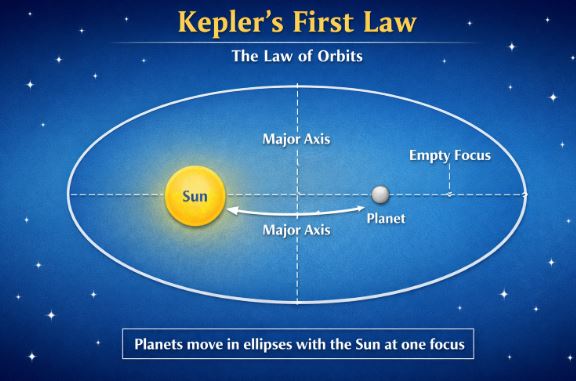
Figure 1: An elliptical orbit. The Sun is not in the center, but off to the side at a Focus.
2.2 Second Law: The Law of Areas
Statement: “The line that joins any planet to the Sun sweeps out equal areas in equal intervals of time.”
This sounds complicated, but it’s simple. It basically says: Planets change their speed.
– When a planet is closer to the Sun (Perihelion), it moves faster.
– When it is farther away (Aphelion), it moves slower.
This happens to conserve Angular Momentum. Just like an ice skater spins faster when she pulls her arms in, a planet moves faster when it gets closer to the Sun.
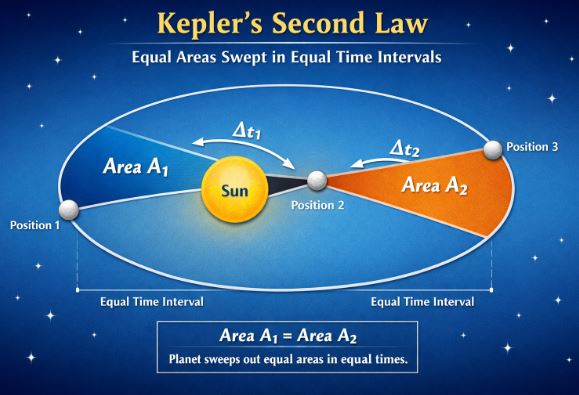
Figure 2: The Law of Areas. The wide, short slice (near Sun) has the same area as the long, thin slice (far away). To cover the wide slice in the same time, the planet must travel faster.
2.3 Third Law: The Law of Periods
Statement: “The square of the time period of revolution of a planet is proportional to the cube of the semi-major axis of the ellipse traced out by the planet.”
T² ∝ a³
Where T is the time to complete one orbit (Year), and a is the average distance from the Sun.
Meaning: Planets farther away from the Sun take much longer to orbit. Not just because the path is longer, but because they move slower!
3. Newton’s Universal Law of Gravitation
Newton took Kepler’s observations and found the physics behind them.
The Law: “Every particle of matter in the universe attracts every other particle with a force. This force is directly proportional to the product of their masses and inversely proportional to the square of the distance between them.”
The Formula
F = G (m₁ m₂) / r²
- F: Gravitational Force.
- m₁, m₂: Masses of the two objects.
- r: Distance between their centers.
- G: Universal Gravitational Constant.
Value of G: 6.67 × 10⁻¹¹ N m² kg⁻².
This ‘G’ is a tiny number. That is why you don’t feel attracted to your textbook or your friend sitting next to you. The force exists, but it is too weak to notice. It only becomes huge when one object is massive, like the Earth!
Vector Form: Since Force is a vector, we write it as:
F₁₂ = -G (m₁m₂/r²) r̂
The negative sign shows that the force is Attractive. Gravity never pushes; it only pulls.
4. The Gravitational Constant (G) vs. Gravity (g)
Students often confuse Big G and small g. Let’s clear this up.
| Property | Universal Constant (G) | Acceleration due to Gravity (g) |
|---|---|---|
| What is it? | A fundamental constant of nature. | The acceleration produced by Earth’s pull. |
| Value | 6.67 × 10⁻¹¹ (Fixed everywhere). | 9.8 m/s² (On Earth’s surface). |
| Does it change? | No. It’s the same on the Moon, Mars, or deep space. | Yes. It changes with height, depth, and planet. |
4.1 Calculating ‘g’
Let’s calculate the acceleration of an object falling on Earth.
Force of Gravity F = G M m / R² (where M is Earth’s mass, R is Earth’s radius, m is object mass).
From Newton’s 2nd Law, F = m g.
Equating them: mg = G M m / R².
The small ‘m’ cancels out!
Formula: g = GM / R²
Key Insight: ‘g’ does not depend on the mass of the falling object. This proves Galileo right—a feather and a hammer will fall at the same speed in a vacuum!
5. Variation of Acceleration due to Gravity (g)
The value 9.8 m/s² is only true at sea level. If you move around, ‘g’ changes.
5.1 Variation with Altitude (Height h)
As you go up a mountain or fly in a plane, you are moving further away from the Earth’s center.
Distance increases -> Attraction decreases -> ‘g’ decreases.
Formula: g_h = g (1 - 2h/R) (for small heights).
If you go infinitely high, gravity becomes zero.
5.2 Variation with Depth (Depth d)
What if you dig a deep tunnel towards the center of the Earth? You might think gravity increases because you are getting closer to the center. But NO!
As you go down, the part of the Earth “above” you starts pulling you upwards, cancelling out some of the downward pull.
Formula: g_d = g (1 - d/R).
At the Center of Earth: Depth d = R. So, g = g(1 - 1) = 0.
You would feel weightless at the center of the Earth!
5.3 Variation with Shape
The Earth is not a perfect sphere; it’s an oblate spheroid (squashed at poles).
Radius at Equator > Radius at Poles.
Since g ∝ 1/R², gravity is stronger at the Poles and weaker at the Equator. You actually weigh slightly more at the North Pole!
6. Gravitational Potential Energy (V)
In the previous chapter on Energy, we used U = mgh. That formula is valid only near the surface where ‘g’ is constant. But for satellites and rockets, ‘g’ changes. We need a general formula.
Definition: Gravitational Potential Energy is the work done in bringing a mass ‘m’ from Infinity to a point ‘r’.
Why Infinity? Because at infinity, the force is zero, so potential energy is defined as Zero there.
Formula: V = - (G M m) / r
Why Negative?
Gravity is an attractive force. To move away to infinity (where energy is 0), you have to add energy. This means your current energy must be less than zero (Negative). It represents a “bound” state—the object is trapped in the Earth’s gravitational well.
7. Escape Speed (v_e)
Imagine throwing a stone up. It comes back. Throw it harder. It goes higher, but still comes back. Is there a speed at which you throw it so hard that it never comes back?
Yes! This is called Escape Speed. It is the minimum speed required to break free from a planet’s gravitational pull.
Derivation Logic:
Total Energy at surface = Kinetic Energy + Potential Energy
E = ½ m v² - (GMm / R)
To escape to infinity, the Total Energy must be at least Zero.
½ m v² - (GMm / R) = 0
½ v² = GM / R
v = √(2GM / R)
For Earth:
v_escape = 11.2 km/s (approx 40,000 km/h).
Fun Fact: It does not depend on the mass of the object. A rocket and a tennis ball need the same speed to escape Earth!
8. Earth Satellites
A satellite is an object that orbits a planet. The Moon is a natural satellite. The GPS satellites are artificial.
8.1 Orbital Speed (v_o)
Why doesn’t a satellite fall down? Because it is moving sideways so fast that as it falls, it misses the Earth!
The Gravitational Force provides the necessary Centripetal Force to keep it in a circle.
GMm / r² = m v² / r
v_orbital = √(GM / r)
Note: The closer the satellite is to Earth (small r), the faster it must move to stay in orbit.
8.2 Time Period (T)
How long does it take to complete one circle?
T = Circumference / Speed = 2πr / v
Squaring this leads us back to Kepler’s 3rd Law: T² ∝ r³.
8.3 Geostationary Satellites
These are special satellites used for TV and Communication (like Tata Sky). They appear stationary (fixed) from the Earth.
Conditions:
1. Time Period must be exactly 24 Hours (Same as Earth).
2. It must orbit in the equatorial plane.
3. Height must be approx 35,800 km.
Since it rotates at the same speed as Earth, it hovers over the same country always.
8.4 Polar Satellites
These orbit closer to Earth (500-800 km) and go over the North and South Poles. As the Earth spins below them, they scan the entire globe strip by strip. They are used for Google Maps, weather forecasting, and spying!
9. Weightlessness
We see astronauts floating in the International Space Station (ISS). Are they in zero gravity?
NO! At the height of the ISS, gravity is almost 90% as strong as on Earth.
Then why do they float?
Because they are in a state of Free Fall. The ISS is constantly falling towards Earth (but moving sideways fast enough to orbit).
Imagine being in an elevator whose cable just snapped. You and the elevator would fall together. If you stood on a weighing scale inside, it would read Zero. You would float inside the elevator.
This phenomenon where the reaction force (Normal) becomes zero is called Weightlessness.
10. Practice Questions & Detailed Solutions
Let’s test your understanding with some conceptual and numerical problems.
Part A: Multiple Choice Questions (MCQ)
- Planet Z has half the mass of Earth and half the radius. What is ‘g’ on Planet Z’s surface compared to Earth’s (g)?
(a) g/4 (b) g/2 (c) g (d) 2gSolution: (d) 2g.
Reasoning: Formula
g = GM / R².
For Planet Z:g' = G(M/2) / (R/2)²
g' = G(M/2) / (R²/4)
g' = (4/2) (GM/R²) = 2g.
Gravity is double! You would feel twice as heavy. - According to Kepler’s second law, a planet moves fastest when it is:
(a) Farthest from the sun.
(b) Closest to the sun.
(c) At the midpoint of its orbit.
(d) Its speed is constant.Solution: (b) Closest to the sun.
Reasoning: To sweep equal areas in equal time, the planet must cover a longer arc when it is closer (Perihelion). Also, conservation of angular momentum (mvr = constant) implies if ‘r’ is small, ‘v’ must be large.
- The total energy of a satellite in a stable circular orbit is -8 x 10⁹ J. What is its kinetic energy?
(a) -8 x 10⁹ J (b) +8 x 10⁹ J (c) -4 x 10⁹ J (d) +4 x 10⁹ JSolution: (b) +8 x 10⁹ J.
Reasoning: For a satellite:
Potential Energy (U) = -2K
Total Energy (E) = K + U = K – 2K = -K.
So,K = -E.
Since E = -8 x 10⁹, Kinetic Energy K = -(-8 x 10⁹) = +8 x 10⁹ J.
Part B: Short Answer Questions
- Q: A person weighs 800 N on Earth. What would they weigh on a planet with the same mass but twice the radius?
Answer:
WeightW = mg = m (GM/R²). SoW ∝ 1/R².
If Radius doubles (2R), the denominator becomes (2R)² = 4R².
The new weight will be 1/4th of the original weight.
New Weight = 800 / 4 = 200 N. - Q: What is a geostationary satellite? Why is it parked at a specific height?
Answer:
A geostationary satellite appears fixed in the sky relative to an observer on Earth.
To achieve this, its Time Period must match Earth’s rotation exactly (24 Hours).
According to Kepler’s 3rd Law (T² ∝ r³), a specific time period (24h) corresponds to a specific orbital radius. This calculation gives a fixed height of approximately 35,800 km. If it were lower, it would move faster than Earth; if higher, slower.
Part C: Long Answer Questions (Numerical Solving)
- Q: A space probe of mass 5000 kg needs to escape Mars. What is the minimum escape speed? (Mass of Mars Mₘ = 6.4×10²³ kg, Radius Rₘ = 3.4×10⁶ m).
Answer:
Given:
Mass M = 6.4 × 10²³ kg
Radius R = 3.4 × 10⁶ m
G = 6.67 × 10⁻¹¹ N m²/kg²Formula:
v_escape = √(2GM / R)Calculation:
v = √ [ 2 × (6.67 × 10⁻¹¹) × (6.4 × 10²³) / (3.4 × 10⁶) ]
v = √ [ (85.376 × 10¹²) / (3.4 × 10⁶) ]
v = √ [ 25.11 × 10⁶ ]
v = √25.11 × 10³
v ≈ 5.01 × 10³ m/s
v ≈ 5.01 km/s.
So, to leave Mars, you need a speed of about 5 km/s (compared to Earth’s 11.2 km/s).
Read Also:
Class-11 Chapter 6- Systems of Particles and Rotational Motion
For more check official website of
NCERT