
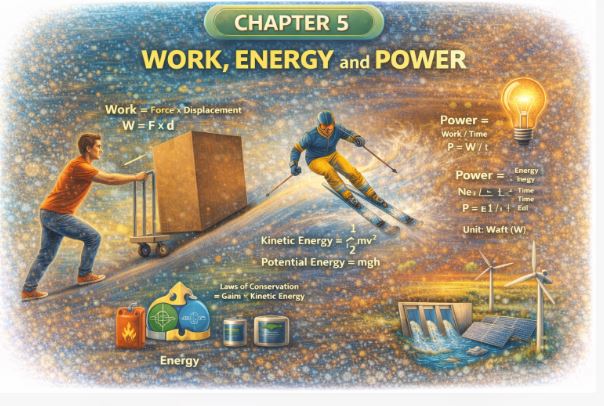
1. Introduction: Physics vs. Real Life | Class 11 Physics Chapter 5 Work energy and power notes
Hello students! Welcome to Chapter 5. Today, we are going to redefine some words you use every day. In daily life, if you study for 5 hours sitting on a chair, you say “I did a lot of work.” If you hold a heavy bucket and wait for a bus, you say “I am working hard.”
But in Physics? No! In both these cases, your work done is ZERO. Why? Because Physics has a very strict definition of work. It involves motion. If you don’t move anything, you haven’t done any work, no matter how much you sweat! Let’s dive in and see why.
2. What is Work in Physics?
In physics, Work is said to be done only when a Force applied on a body produces a Displacement in it.
2.1 The General Formula for Constant Force
Imagine pushing a block.
1. If you push harder (more Force F), you do more work.
2. If you push it further (more Displacement d), you do more work.
3. But what if you push at an angle?
Imagine pulling a toy car with a string. The string is at an angle θ to the ground. Your force is pulling up and forward. But the car is only moving forward.
Only the part of the force acting in the direction of motion actually does work. That part is F cos θ.
Formula: W = F d cos θ
or in vector form: W = F · d (Dot Product)
SI Unit: Joule (J).
1 Joule is defined as the work done when a force of 1 Newton moves an object by 1 Meter in the direction of the force.
2.2 Types of Work
Depending on the angle θ between Force and Displacement vectors, work can be positive, negative, or zero.
Case A: Positive Work (θ < 90°)
When the force helps the motion.
Example: An apple falling down. Gravity pulls down, apple moves down. Angle is 0°. Work is Positive.
Case B: Negative Work (θ > 90°)
When the force opposes the motion.
Example: Friction. When you slide a book on a table, friction pushes backward while the book moves forward. Angle is 180°. Work done by friction is Negative. This usually means energy is being taken away from the object (often turning into heat).
Case C: Zero Work (θ = 90°)
When force is perpendicular to motion.
Example 1: The Waiter. A waiter holding a tray moves horizontally. His force (lifting) is Vertical. Motion is Horizontal. Angle is 90°. Work done by waiter = 0.
Example 2: The Moon. Gravity pulls the moon towards Earth (Center). Moon moves in a circle (Tangent). Angle is 90°. Work done by Gravity = 0. This is why the moon doesn’t speed up or slow down due to gravity!
2.3 Work Done by a Variable Force
In real life, forces are rarely constant. When you stretch a spring, the force needed increases as you pull. How do we calculate work then?
We cannot use W = F × d simply.
Instead, we use Calculus. We sum up tiny bits of work done over tiny displacements.
W = ∫ F(x) dx (Integral from initial position to final position).
Graphically: Work done is equal to the Area under the Force-Displacement Graph.
3. Energy: The Capacity to Do Work
Energy and Work are inseparable. They are like two sides of the same coin.
– Energy is the “money” you have in your bank account.
– Work is “spending” that money.
If you have energy, you can do work. When you do work, you lose energy.
Unit: Joule (J) – exactly same as Work!
3.1 Kinetic Energy (K)
This is the energy possessed by a body due to its Motion. Anything that moves has K.E.
A fast bullet has huge K.E., which is why it can penetrate a wall (do work on the wall).
K = ½ m v²
Notice: Since ‘v’ is squared, K is always positive. Also, doubling the speed (v becomes 2v) quadruples the energy (4K)! That’s why high-speed driving is exponentially more dangerous.
3.2 The Work-Energy Theorem
This is arguably the most important theorem in this chapter. It connects Work (Dynamics) and Speed (Kinematics).
Statement: “The work done by the net force on an object is equal to the change in its kinetic energy.”
W_net = K_final - K_initial
W = ΔK
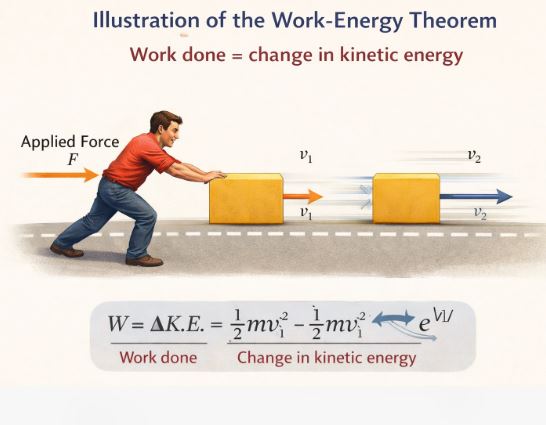
Figure 1: If you push a block (do Work), it speeds up (gains Kinetic Energy). If friction pushes back (Negative Work), it slows down.
Example: Stopping a Car
A car moving at speed ‘v’ has K.E. To stop it, the brakes must do Negative Work equal to that K.E.
Work done by friction = Change in K.E.
-F × d = 0 - ½mv²
Stopping distance d ∝ v². So if you go 2x faster, you need 4x distance to stop! This physics fact is crucial for road safety.
4. Potential Energy: The Hidden Energy
Kinetic Energy is visible (motion). Potential Energy (U or V) is invisible. It is Stored Energy due to an object’s position or configuration.
4.1 Gravitational Potential Energy
When you lift a book from the floor to a table, you do work against gravity. This work isn’t lost; it is stored in the book. If you drop it, that energy turns back into motion (K.E.).
Formula: U = mgh
(m = mass, g = gravity, h = height above reference level).
Note: Potential energy is relative. You can choose the floor, the table, or the ground as h=0. Only the change in potential energy matters.
4.2 Potential Energy of a Spring
Springs are magical. If you stretch or compress them, they fight back. This restoring force is given by Hooke’s Law: F = -kx, where ‘k’ is the spring constant (stiffness) and ‘x’ is displacement from mean position.
The work you do to stretch the spring gets stored as Elastic Potential Energy.
U = ½ k x²
Graph: If you plot U vs x, you get a Parabola (U-shape). Energy is zero at the center (x=0) and maximum at the ends (maximum stretch/compression).
5. Conservation of Mechanical Energy
The universe loves to save energy. It never wastes it. This leads to the Law of Conservation of Energy.
Statement: “Energy can neither be created nor destroyed, only transformed from one form to another.”
In mechanics, if only Conservative Forces (like gravity or spring force) are acting, then the total Mechanical Energy (E) is conserved.
E = K + U = Constant
ΔK + ΔU = 0 (Gain in K = Loss in U)
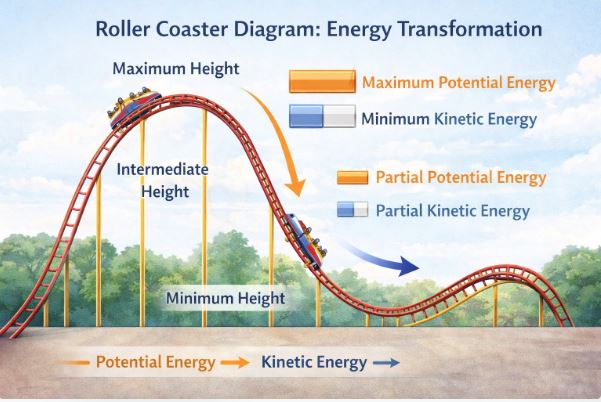
Figure 2: The Roller Coaster. At the top, Potential Energy is max, Kinetic is min. As it falls, U converts to K. At the bottom, Potential is min, Kinetic is max. Total Energy is constant everywhere (ignoring friction).
Conservative vs. Non-Conservative Forces
- Conservative Force: Work done depends ONLY on initial and final points, not the path taken.
Examples: Gravity, Spring Force, Electrostatic Force.
Feature: Work done in a closed loop (round trip) is Zero. (Gravity does zero total work on a roller coaster loop). - Non-Conservative Force: Work done depends on the path. Longer path = More work lost.
Examples: Friction, Air Resistance, Viscosity.
Feature: Energy is dissipated as Heat/Sound. It cannot be recovered fully. (This is why perpetual motion machines don’t work!).
6. Power: The Speed of Work
Imagine two students, Ram and Shyam. Both lift a 20kg bag to the 3rd floor. Both do the same amount of Work (mgh).
But Ram runs up in 1 minute. Shyam walks up in 5 minutes.
Who is stronger? Ram. Why? Because he has more Power.
Definition: Power is the rate of doing work. It tells us how fast energy is being consumed or transferred.
P = Work / Time
Also, since Work = Force × Distance:
P = (F × d) / t = F × (d/t) = F × v
Power = Force × Velocity
Unit: Watt (W).
1 Watt = 1 Joule/second.
Car Engines: Measured in Horsepower (hp).
1 hp = 746 Watts.
7. Collisions: The Crash Course
A collision is a short, strong interaction between two bodies. Think of billiard balls or car crashes.
Golden Rule: In ANY collision (where external force = 0), Linear Momentum is ALWAYS Conserved.
7.1 Types of Collisions
We classify collisions based on what happens to Kinetic Energy (K). Momentum is conserved in all types, but Energy is picky.
1. Elastic Collision
Like hardened steel balls or atoms bouncing perfectly.
– Momentum is Conserved.
– Kinetic Energy is Conserved. (No loss to heat/sound).
2. Inelastic Collision
Like car crashes or a ball dropping on sand.
– Momentum is Conserved.
– Kinetic Energy is NOT Conserved. Some is lost as heat, sound, or deformation.
3. Perfectly Inelastic Collision
The sticky crash. Example: A bullet hitting a wooden block and embedding in it.
– The two bodies stick together and move with a common velocity.
– Maximum loss of Kinetic Energy happens here.
7.2 Elastic Collision in 1D (The Derivation Logic)
Consider two balls m1 and m2 moving with velocities u1 and u2. They hit and move with v1 and v2.
We have two equations:
1. Momentum: m1u1 + m2u2 = m1v1 + m2v2
2. Energy: ½m1u1² + ½m2u2² = ½m1v1² + ½m2v2²
Solving these is long, but leads to an interesting result:
Relative velocity of approach = Relative velocity of separation
u1 - u2 = v2 - v1
Special Case: If masses are equal (m1=m2), the balls simply exchange velocities! If Ball A hits stationary Ball B, A stops dead and B moves off with A’s exact speed.
8. Practice Questions & Detailed Solutions
Physics is best learned by solving problems. Let’s tackle some interesting ones!
Part A: Multiple Choice Questions (MCQ)
- A waiter carries a 50 N tray of food horizontally for 10 m. How much work does he do on the tray?
(a) 500 J (b) 50 J (c) 5 J (d) 0 JSolution: (d) 0 J.
Reasoning: Work W = F d cos θ.
Force applied by waiter is Upwards (Vertical) to balance weight.
Displacement of tray is Horizontal.
Angle θ = 90°. Since cos 90° = 0, Work Done = 0. - A 1000 kg car accelerates from 10 m/s to 20 m/s. What is the net work done on the car?
(a) 5,000 J (b) 15,000 J (c) 50,000 J (d) 150,000 JSolution: (d) 150,000 J.
Reasoning: Use the Work-Energy Theorem: W = Change in K.E.
Initial K = ½ (1000) (10)² = 50,000 J.
Final K = ½ (1000) (20)² = 200,000 J.
Work = 200,000 – 50,000 = 150,000 J. - In a completely inelastic collision, which of the following is true?
(a) Both momentum and kinetic energy are conserved.
(b) Momentum is conserved, but kinetic energy is not.
(c) Kinetic energy is conserved, but momentum is not.
(d) Neither is conserved.Solution: (b).
Reasoning: Momentum is conserved in ALL isolated collisions. Inelastic means energy is lost (deformation, heat). So K.E. is not conserved.
Part B: Short Answer Questions
- Q: A bowling ball and a volleyball have the same kinetic energy. Which has greater momentum?
Answer: The Bowling Ball.
Reasoning: We know the relation:K = p² / 2m.
Rearranging for momentum:p = √(2mK).
Since K is the same for both,p ∝ √m.
The bowling ball has much greater mass (m) than the volleyball. Therefore, it must have greater momentum (p). - Q: Why is the work done by gravity on a satellite in a circular orbit zero?
Answer:
1. The gravitational force acts towards the center of the Earth (Centripetal Force).
2. The displacement of the satellite is along the tangent to the circular orbit.
3. The angle between the Radius (Force) and Tangent (Displacement) is always 90°.
Since W = Fd cos 90°, and cos 90° = 0, the Work Done is Zero.
Part C: Long Answer Questions (Numerical Solving)
- Q: A 50 kg crate is pushed 15 m up a 30° ramp by a 400 N force (parallel to the ramp). The coefficient of kinetic friction is 0.2. Find the work done by friction and the crate’s final speed if it starts from rest. (Take g=10 m/s²).
Answer: This is a classic “Sum of all Work” problem.
Given: m = 50kg, d = 15m, θ = 30°, F_app = 400N, μk = 0.2.Step 1: Find Normal Force (N).
On a ramp, N balances the perpendicular component of weight.
N = mg cos θ.
N = 50 × 10 × cos 30° = 500 × 0.866 = 433 N.Step 2: Find Friction Force (f).
f = μk N = 0.2 × 433 = 86.6 N.Step 3: Calculate Work Done by Friction (W_f).
Friction opposes motion (angle 180°).
W_f = – f × d = – 86.6 × 15 = -1299 J.Step 4: Calculate Net Work Done.
We have three forces doing work along the ramp:
1. Applied Force (Positive): W_app = 400 × 15 = 6000 J.
2. Gravity (Negative component):
Force down ramp = mg sin 30° = 500 × 0.5 = 250 N.
W_g = – 250 × 15 = -3750 J.
3. Friction (Negative): W_f = -1299 J.
Net Work = 6000 – 3750 – 1299 = 951 J.Step 5: Find Final Speed using W-E Theorem.
W_net = ΔK = ½mv² – 0
951 = ½ × 50 × v²
951 = 25 v²
v² = 951 / 25 = 38.04
v = √38.04 ≈ 6.17 m/s.
Read Also:
Class-11 Chapter 4- Laws of Motion
For more check official website of
NCERT