1. Introduction
Hello students! Welcome to Chapter 4 of your Class 9 Political Science journey. We often hear that democracy is about people electing their rulers, but the story does not end there. The rulers cannot just do whatever they want. They have to follow certain rules and procedures. They have to work with and within institutions to run the country properly.
In this chapter, we will learn about the working of these institutions. We will see how major decisions are taken and implemented in India. Step by step, we will break down the roles of the three key institutions: the Legislature, the Executive, and the Judiciary. By the end of these notes, you will understand exactly who holds the power to do what in our democratic setup. Let’s dive in!
2. How is a Major Policy Decision Taken?
To understand how the government works, let’s look at a real example. On August 13, 1990, the Government of India issued a very important order called an Office Memorandum. It announced a massive policy decision regarding government jobs. But who actually made this decision?
This decision was not taken by just one person. It involved a long chain of events. The President announced the intention, the Prime Minister and the Cabinet made the formal decision, the Parliament debated it, and finally, civil servants drafted the actual order. When people protested against the reservations, the Supreme Court stepped in to resolve the dispute, proving how different institutions interact to govern the country peacefully.
3. Parliament and its Key Functions
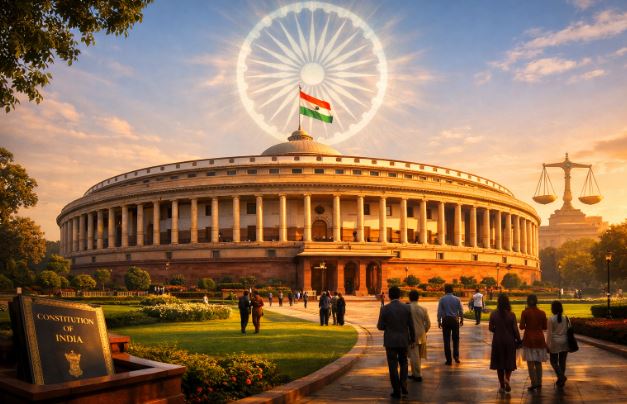
In all democracies, an assembly of elected representatives exercises supreme political authority on behalf of the people. In India, this national assembly is called the Parliament. Let’s look at its major functions.
Feature 1: Making Laws
The Parliament is the final authority for making laws in our country. It can make new laws, change existing ones, or completely abolish old laws and put new ones in their place. This task is so crucial that these assemblies are called legislatures.
Feature 2: Controlling the Government
The Parliament exercises direct control over those who run the government. In India, the Prime Minister and the Council of Ministers can only take decisions as long as they enjoy the support of a majority of members in the Parliament.
Feature 3: Controlling Finance
The Parliament controls all the money that the government has. The public money collected through taxes can only be spent when the Parliament sanctions and approves the national budget.
Feature 4: Highest Forum for Debate
It is the highest forum of discussion and debate on public issues and national policy. The Parliament can seek information about any matter and hold the leaders accountable for their actions.
4. The Two Houses of Parliament
Since the Parliament plays such a central role, its powers are divided into two parts, known as Chambers or Houses. Let’s understand how they differ from each other.
- Lok Sabha (House of the People): Members are directly elected by the public. It exercises real power and has the final say in money matters. If it passes a ‘no confidence’ motion, the entire ministry must quit.
- Rajya Sabha (Council of States): Members are elected indirectly. It performs special functions looking after the interests of various states and regions. It cannot reject a money bill, only delay it by 14 days.
- Joint Session: If there is a disagreement between the two Houses on an ordinary bill, a joint session is held. Because Lok Sabha has more members, its view usually prevails.
- The President’s Role: The President of India is a part of the Parliament, even though they are not a member of either House. No bill can become a law without the President’s signature.
5. The Executive: Political and Permanent
When we talk about ‘the government’, we usually mean the executive. They are called the executive because they are in charge of executing the policies of the government. This is divided into two categories.
The Political Executive
- Elected by People: This consists of political leaders elected by the people for a specific period, like the Prime Minister and Cabinet Ministers.
- Ultimate Power: They take the biggest decisions because they are answerable to the people. In a democracy, the will of the people is supreme.
- The Big Picture: Ministers might not be experts in technical fields, but they decide the overall framework and destination of policies.
- Council of Ministers: This is the official body of 60 to 80 ministers. The Cabinet is the inner ring of top-level leaders who meet to take major decisions.
- Prime Ministerial Power: The PM is the most powerful person in the Cabinet. He distributes work, chairs meetings, and if he quits, the entire ministry quits.
The Permanent Executive (Civil Services)
While politicians come and go, the daily administration needs stability. This brings us to the second category.
- Long-term Appointment: People here are appointed on a long-term basis through tough exams. They remain in office even when the ruling party changes.
- Expert Knowledge: Civil servants like secretaries are often more educated and have better technical expertise than the ministers they work for.
- Advisory Role: They provide the necessary background information, lay out the options, and assist the political executive in running the administration.
- Implementing Policies: Once a minister takes a decision, it is the duty of the civil servants to figure out the exact steps to implement it properly.
- Working Under Politicians: Despite their expertise, civil servants work under the political executive because elected leaders represent the will of the citizens.
6. The President and the Judiciary
While the Prime Minister heads the government, the President is the head of the State. The President is not elected directly by the people but by elected MLAs and MPs. All laws and major appointments are made in the name of the President. However, the President only exercises these formal powers on the advice of the Prime Minister and the Council of Ministers.
Now, what happens if there is a dispute over a government decision? This is where the Judiciary comes in. The Indian judiciary is an independent institution consisting of the Supreme Court, High Courts, and local courts. It is not under the control of the legislature or the executive. Judges are appointed by the President but are incredibly difficult to remove.
The Supreme Court has the power of judicial review, meaning it can declare any law or government action invalid if it goes against the Constitution. The courts act as guardians of fundamental rights. Anyone can approach the court if the public interest is hurt by the government, which is known as Public Interest Litigation (PIL). This independence ensures fairness and trust in the system.
7. Key Takeaways
- A democracy requires institutions like the Legislature, Executive, and Judiciary to function smoothly.
- The Parliament makes laws, controls government finances, and acts as the highest forum for national debate.
- The Lok Sabha is more powerful than the Rajya Sabha, especially concerning money bills and controlling the Cabinet.
- The Political Executive takes major decisions, while the Permanent Executive (civil servants) implements them.
- The Indian Judiciary is independent and has the power of judicial review to check unconstitutional laws and protect citizen rights.
8. Practice Section: Master the Chapter!
Test your knowledge with these carefully crafted questions based on the notes above.
Part A: True or False (10 Questions)
- The President of India is directly elected by the citizens.
- The Lok Sabha has the final say in money matters.
- The Rajya Sabha can reject a money bill completely.
- The Prime Minister is a part of the permanent executive.
- The Mandal Commission was set up to identify socially and educationally backward classes.
- A joint session is held if there is a difference between the two Houses on a money bill.
- The Cabinet is the inner ring of the Council of Ministers.
- Civil servants generally have more expert knowledge than the ministers they work under.
- The Supreme Court of India is completely controlled by the Prime Minister.
- Judicial review means the courts can declare a law unconstitutional.
Click to view True/False Answers
- False (The President is indirectly elected by elected MPs and MLAs)
- True
- False (Rajya Sabha can only delay a money bill by 14 days)
- False (The PM is part of the political executive)
- True
- False (Joint sessions are for ordinary bills, not money bills)
- True
- True
- False (The Judiciary is independent of the Executive)
- True
Part B: Multiple Choice Questions (10 Questions)
- Which institution has the final authority for making laws in India?
A) The Judiciary
B) The Parliament
C) The Prime Minister
D) The Civil Servants
- Who appoints the Prime Minister of India?
A) Chief Justice of India
B) Members of Rajya Sabha
C) The President
D) Election Commission
- Which body resolves disputes between citizens and the government?
A) Lok Sabha
B) Supreme Court
C) Cabinet Secretariat
D) The President
- What is the permanent executive also known as?
A) Council of Ministers
B) Members of Parliament
C) Civil Services
D) Supreme Court Judges
- Who is the supreme commander of the defence forces of India?
A) Prime Minister
B) Defence Minister
C) Chief of Army Staff
D) The President
- How long can the Rajya Sabha delay a money bill passed by Lok Sabha?
A) 14 days
B) 1 month
C) 6 months
D) It cannot delay it at all
- What does SEBC stand for in the context of the Mandal Commission?
A) Socially and Economically Backward Citizens
B) Socially and Educationally Backward Classes
C) Scheduled and Economically Backward Castes
D) State Education Board Committee
- Who is considered the most powerful person within the Cabinet?
A) The President
B) The Home Minister
C) The Prime Minister
D) The Chief Justice
- A person who is not a Member of Parliament can become a minister, provided they get elected within:
A) 1 month
B) 3 months
C) 6 months
D) 1 year
- Which House is also known as the ‘Council of States’?
A) Lok Sabha
B) Vidhan Sabha
C) Rajya Sabha
D) Parliament
Click to view MCQ Answers
- B) The Parliament
- C) The President
- B) Supreme Court
- C) Civil Services
- D) The President
- A) 14 days
- B) Socially and Educationally Backward Classes
- C) The Prime Minister
- C) 6 months
- C) Rajya Sabha
Part C: Short Answer Questions (5 Questions)
- What is an Office Memorandum?
- Why do we need political institutions in a democracy?
- Name the two Houses of the Indian Parliament.
- Who is more powerful: the political executive or the permanent executive? Why?
- What is Public Interest Litigation (PIL)?
Click to view Short Answers
- An Office Memorandum is a formal communication issued by an appropriate government authority stating the policy or a major decision of the government.
- We need political institutions to ensure rules and regulations are followed, to assign responsibilities for running the country smoothly, and to provide a system to resolve disputes fairly.
- The two Houses of the Indian Parliament are the Lok Sabha (House of the People) and the Rajya Sabha (Council of States).
- The political executive (ministers) is more powerful than the permanent executive (civil servants) because ministers are elected by the people. In a democracy, the will of the people is supreme, so the elected representatives take the final decisions.
- Public Interest Litigation (PIL) is a process where anyone can approach the courts if the public interest is being hurt by the actions of the government or public officials.
Part D: Long Answer Questions (5 Questions)
- Explain why the Lok Sabha is considered more powerful than the Rajya Sabha.
- Distinguish between the political executive and the permanent executive.
- Describe the key powers of the Prime Minister in India.
- What are the major powers and functions of the Parliament?
- How does the Constitution ensure the independence of the Indian Judiciary?
Click to view Long Answers
- The Lok Sabha is more powerful for three main reasons: First, any ordinary law needs to be passed by both Houses, but in a joint session, the Lok Sabha’s view prevails because it has more members. Second, it holds absolute power in money matters; the Rajya Sabha cannot reject a money bill and can only delay it by 14 days. Third, the Lok Sabha controls the Council of Ministers. If the majority of Lok Sabha members pass a ‘no confidence’ motion, all ministers, including the Prime Minister, must quit.
- The political executive consists of leaders elected by the people for a specific period (e.g., Prime Minister, Cabinet Ministers). They are answerable to the public, represent the people’s will, and take final policy decisions. The permanent executive consists of civil servants (like IAS officers) who are appointed on a long-term basis through exams. They hold expert knowledge, assist the politicians with background information, and remain in office to implement policies even when governments change.
- The Prime Minister has wide-ranging powers as the head of the government. He chairs Cabinet meetings, coordinates the work of different departments, and his decisions are final in case of disagreements. He exercises general supervision over all ministries, distributes work to ministers, and has the power to dismiss them. Ultimately, if the Prime Minister quits, the entire ministry is forced to quit.
- The Parliament has four major functions: First, it is the highest law-making body, capable of making new laws or abolishing old ones. Second, it controls the government, meaning the executive can only function as long as it has parliamentary support. Third, it controls public finance; the government cannot spend any money without the Parliament’s approval. Fourth, it acts as the supreme forum for debating national issues and policies, holding leaders accountable.
- The Indian Judiciary’s independence is ensured through multiple ways. Judges of the Supreme Court and High Courts are appointed by the President on the advice of the Prime Minister and the Chief Justice, leaving little room for political interference. Once appointed, it is nearly impossible to remove a judge; it requires an impeachment motion passed by two-thirds of both Houses of Parliament. Furthermore, judges do not act on the direction of the government or the ruling party, allowing them to freely strike down unconstitutional laws through judicial review.
Read Also:Class 9 Social Science All Chapters
Previous Chapter:Electoral Politics
For official syllabus and textbooks, visit theNCERT Official Website.