
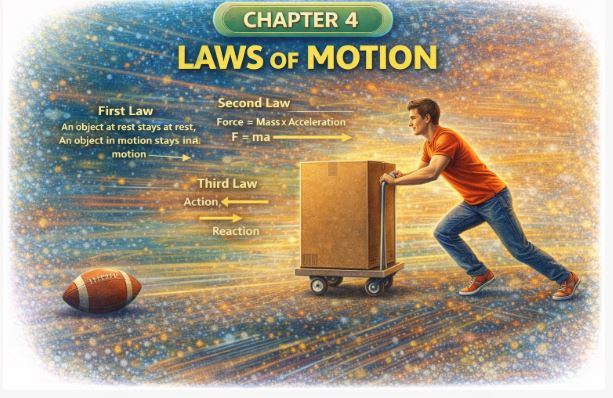
1. Introduction: The Why Behind the Move | Class 11 Physics Chapter 4 Laws of Motion Notes
Hello students! Welcome to one of the most fundamental chapters in all of physics. In the previous chapters (Kinematics), we learned how to describe motion. We talked about velocity, acceleration, and displacement. We could predict where a ball would land or how fast a car was going. But we never asked the most important question: WHY?
Why does a ball start moving when you kick it? Why does it eventually stop rolling on the grass? Why do you fall forward when a bus brakes suddenly? The answer to all these “whys” lies in the concept of Force. The branch of physics that deals with the causes of motion is called Dynamics.
In this chapter, we are going to explore the rules that govern the universe’s motion—Isaac Newton’s Laws of Motion. These three laws are so powerful that they can explain everything from the walk you take to school to the orbit of the moon around the Earth.
2. The Idea of Force and Inertia
Before Newton, people had some very wrong ideas about how the world worked. Let’s travel back in time to Ancient Greece.
2.1 Aristotle’s Fallacy (The Big Mistake)
Aristotle, a great philosopher, observed the world around him. He saw that if you stop pushing a cart, it stops moving. If you stop shooting arrows, they fall. So, he concluded: “An external force is required to keep a body in uniform motion.”
This sounds logical, right? It matches our daily experience. But it is WRONG! Aristotle didn’t realize there was a hidden force acting against every motion he saw. That hidden force is Friction. If you slide a book on a table, it stops because friction stops it, not because it “wants” to stop.
2.2 Galileo’s Experiment (The Correction)
Galileo Galilei came along and corrected this. He did experiments with inclined planes. He noticed that a ball rolling down a smooth plane speeds up. A ball rolling up slows down. He reasoned, what if the plane is perfectly horizontal and perfectly smooth (no friction)?
Conclusion: The ball would neither speed up nor slow down. It would keep moving forever at a constant velocity.
So, Galileo gave us a new truth: “If the net external force is zero, a body at rest stays at rest, and a body in motion stays in uniform motion.” We call this property Inertia.
2.3 Inertia: The Laziness of Matter
Think of inertia as “laziness.” Matter resists change. If it is sitting still, it wants to stay sitting still. If it is moving, it wants to keep moving. It hates changes in velocity.
Mass is the measure of Inertia.
Imagine kicking a football. It flies away. Now imagine kicking a bowling ball of the same size. You might break your toe! The bowling ball has more mass, so it has more inertia (resistance to change). It is harder to start moving, and once moving, it is harder to stop.
- Inertia of Rest: A book on a table won’t move until you push it.
- Inertia of Motion: A fan keeps spinning for a while after you switch it off.
- Inertia of Direction: When a car turns a sharp corner, you feel pushed to the side because your body wants to keep going straight.
3. Newton’s First Law of Motion
Newton took Galileo’s idea and formalized it as the First Law.
“Every body continues to be in its state of rest or of uniform motion in a straight line unless compelled by some external force to act otherwise.”
What does this mean?
1. No Force = No Acceleration. If the net force on an object is zero, its acceleration is zero.
2. Definition of Force: This law actually defines what force is. Force is that external agency which overcomes inertia.
Real-Life Example: The Bus Ride
Imagine you are standing in a stationary bus.
Scenario 1: The bus starts suddenly.
The floor of the bus moves forward. Friction pulls your feet forward along with the bus. But your upper body has Inertia of Rest. It wants to stay where it was. So, while your feet go forward, your body is left behind. You fall backwards.
Scenario 2: The moving bus brakes suddenly.
You and the bus are moving at 40 km/h. The driver hits the brakes. The bus (and your feet) stop. But your upper body has Inertia of Motion. It wants to keep moving at 40 km/h. So, you fall forwards.
4. Newton’s Second Law of Motion
The First Law tells us what happens when there is no force. The Second Law tells us what happens when there IS a force. It gives us a formula to calculate it.
4.1 Momentum: The Quantity of Motion
Before we state the law, we need a new concept: Momentum (p).
Imagine a tennis ball thrown at you gently. You can catch it easily. Now imagine a cricket ball thrown at the same speed. It hurts more to catch. Why? Because the cricket ball has more Mass.
Now imagine a bullet. It has very little mass, but it is fired at a super-high speed. It can kill you. Why? Because it has high Velocity.
So, the “impact” or “quantity of motion” depends on both Mass (m) and Velocity (v). We define this product as Momentum.
p = m × v
Momentum is a vector quantity. Its direction is the same as velocity.
4.2 The Law Statement
“The rate of change of momentum of a body is directly proportional to the applied force and takes place in the direction in which the force acts.”
Mathematically:
F ∝ dp/dt
Or F = k (dp/dt). In SI units, we choose k=1.
So, F = dp/dt = d(mv)/dt.
For most objects (like cars, balls, people), mass ‘m’ stays constant. We can take ‘m’ out of the derivative.
F = m (dv/dt)
Since acceleration a = dv/dt, we arrive at the most famous equation in physics:
F = m a
Force = Mass × Acceleration
4.3 Impulse: A Force for a Short Time
Sometimes, a very large force acts for a very short duration. Think of a bat hitting a cricket ball or a hammer hitting a nail. This is called an Impulsive Force.
Impulse (I) is the total effect of this force. It is defined as Force multiplied by Time.
Impulse = Force × Duration
I = F × Δt
From Newton’s Second Law (F = Δp/Δt), we can see that:
F × Δt = Δp
So, Impulse = Change in Momentum.

Figure 1: Why do cricketers pull their hands back? By increasing the time (Δt) of the catch, they reduce the Force (F) on their hands (since F = Δp/Δt).
5. Newton’s Third Law of Motion
This law is often quoted but frequently misunderstood.
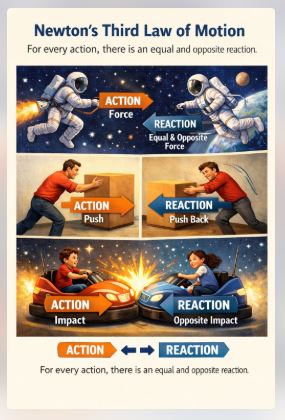
“To every action, there is always an equal and opposite reaction.”
If Object A exerts a force on Object B, then Object B simultaneously exerts a force on Object A.
F_AB = - F_BA
Important Points to Remember
- Forces come in Pairs: There is no such thing as a single isolated force in the universe. Forces always exist in Action-Reaction pairs.
- Different Bodies: This is the most crucial point. Action and Reaction forces act on two different bodies.
– Example: When you kick a football. Action is force on the Ball. Reaction is force on your Foot. Since they act on different objects, they do not cancel each other out. If they acted on the same object, the net force would be zero, and nothing would ever move! - Simultaneous: Action and Reaction happen at the exact same instant. It’s not like the ball waits for a microsecond before pushing back.
How does a Rocket fly?
Many people think a rocket pushes against the ground or the air to fly. But rockets work in space where there is no air! How?
Explanation: The rocket engine burns fuel and shoots hot gas downwards at high speed. This is the Action (Force on Gas). According to Newton’s 3rd Law, the gas exerts an equal and opposite force upwards on the rocket. This is the Reaction (Force on Rocket). The rocket pushes the gas; the gas pushes the rocket.
6. Conservation of Momentum
This is a fundamental law of nature derived from Newton’s Second and Third Laws.
Statement: “The total momentum of an isolated system (a system with no external force) remains constant.”
This means momentum can neither be created nor destroyed; it can only be transferred from one object to another.
The Recoil of a Gun
Imagine a soldier holding a rifle. Before firing, both the gun and the bullet are at rest.
Total Momentum = 0.
When he fires, the bullet shoots forward with momentum p = m × v.
Since the total momentum must stay zero, the gun must gain an equal momentum in the backward direction.
Momentum of Gun = - Momentum of Bullet
M × V = - (m × v)
So, V = - (mv)/M.
This backward velocity ‘V’ is called the Recoil Velocity. Since the gun is much heavier (M is large), the recoil speed is small, but it’s strong enough to bruise your shoulder!
7. Equilibrium of a Particle
In mechanics, a particle is in equilibrium if the net external force on it is zero. This means it is either at rest or moving with a constant velocity.
If multiple forces F1, F2, and F3 act on a particle, equilibrium implies:
F1 + F2 + F3 = 0 (Vector Sum)
This means the vector triangle formed by these forces must form a closed loop (head of the last vector touches the tail of the first).
8. Common Forces in Mechanics
When solving physics problems, you will encounter several “standard” forces repeatedly. Let’s get to know them.
8.1 Weight (Gravitational Force)
This is the force with which the Earth pulls an object.
Formula: W = mg
Direction: Always Vertically Downwards (towards the center of Earth).
8.2 Normal Reaction (N)
When you place a book on a table, gravity pulls it down. Why doesn’t it crash through the table? Because the table pushes back!
This contact force is called the Normal Force.
Direction: Always Perpendicular (Normal) to the surface of contact.
Note: ‘Normal’ doesn’t mean ‘Ordinary’; it is a mathematical term for ‘Perpendicular’.
8.3 Tension (T)
This is the force transmitted through a string, rope, or cable when it is pulled tight.
Direction: Always pulls Away from the body. You can pull with a rope, but you can’t push with it!
8.4 Friction (f)
Friction is a contact force that opposes the relative motion between two surfaces. It acts parallel to the surfaces. It arises due to electromagnetic interactions between the atoms of the two surfaces.
- Static Friction (fs): This acts when the body is at rest but trying to move. It is a “smart” force—it adjusts itself to exactly match the applied force, up to a maximum limit called Limiting Friction.
Formula:fs ≤ μs N(where μs is the coefficient of static friction). - Kinetic Friction (fk): This acts when the body is actually sliding. Once an object starts moving, the friction drops slightly and becomes constant.
Formula:fk = μk N(where μk is the coefficient of kinetic friction).
Fact: It is usually harder to start pushing a heavy box (overcoming static friction) than to keep it moving (overcoming kinetic friction). So, μs > μk.
9. Circular Motion
We often think Newton’s First Law means “no force = constant speed”. But remember, velocity is a vector. Changing direction also requires force.
When an object moves in a circle at a constant speed, its direction is changing at every instant. Therefore, it is accelerating.
This acceleration points towards the center and is called Centripetal Acceleration (a = v²/R).
According to Newton’s 2nd Law, there must be a force causing this acceleration. This force is called Centripetal Force.
Fc = m v² / R
Note: Centripetal force is not a “new” type of force like gravity or friction. It is just a job title. Any force can act as a centripetal force.
– For a planet orbiting the Sun, Gravity is the centripetal force.
– For a stone tied to a string, Tension is the centripetal force.
– For a car turning a corner, Friction is the centripetal force.
9.1 Motion of a Car on a Level Road
When a car turns on a flat road, the only force pushing it towards the center of the turn is the friction between the tires and the road.
If you go too fast, the required centripetal force (mv²/R) becomes larger than the maximum friction available. Result? The car skids off the road.
9.2 Motion of a Car on a Banked Road
To make turns safer, engineers tilt the road slightly, raising the outer edge. This is called Banking.
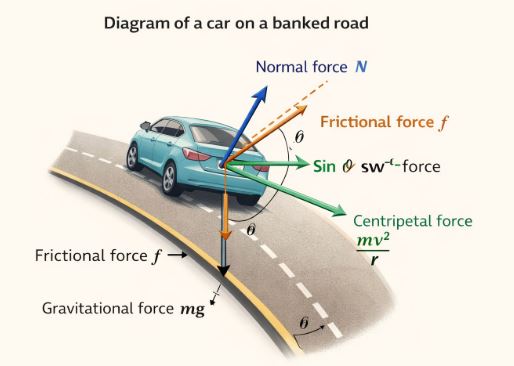
Figure 2: On a banked road, the Normal Force (N) helps you turn. The component N sin θ pushes the car towards the center.
By banking the road, we reduce the reliance on friction. There is a specific speed where you don’t need any friction at all to make the turn!
Optimum Speed: v = √(Rg tan θ)
This allows cars to turn safely at much higher speeds on highways and racetracks.
10. Solving Problems in Mechanics
Physics problems can seem scary, but there is a recipe to solve them. It’s called the Free Body Diagram (FBD) method.
Step 1: Identify the object you are studying (the system).
Step 2: Draw a simple dot or box to represent that object.
Step 3: Draw arrows representing ALL the external forces acting ON that object. Do not draw forces the object exerts on others.
Step 4: Resolve forces into X and Y components.
Step 5: Apply Newton’s Second Law:
Σ Fx = m ax
Σ Fy = m ay
Example: Block sliding down a ramp
Forces:
1. Weight (mg): Straight down. We split this into mg cos θ (pushing into ramp) and mg sin θ (sliding down).
2. Normal (N): Perpendicular to ramp. Balances mg cos θ.
3. Friction (f): Up the ramp, opposing motion.
Equation: Net force down = mg sin θ - f = ma.
11. Extensive Practice Set (Detailed Solutions)
Let’s apply these laws to solve some interesting problems. I have provided step-by-step logic.
Part A: Multiple Choice Questions (MCQs)
- A book is resting on a table. The reaction force to the Earth’s gravitational pull on the book is:
(a) The force of the table on the book.
(b) The force of the book on the table.
(c) The gravitational force of the book on the Earth.
(d) Zero.Solution: (c).
Reasoning: This is a common trap! Many students choose (a). But remember, Action-Reaction pairs act between the same two bodies.
Action: Earth pulls Book (Gravity).
Reaction: Book pulls Earth (Gravity).
The Normal force from the table is a separate interaction (contact force), not the reaction to gravity. - A 2 kg object is moving at 10 m/s. A net force of 4 N acts on it for 5 seconds in the direction of motion. What is the final momentum?
(a) 20 kg m/s (b) 40 kg m/s (c) 60 kg m/s (d) 100 kg m/sSolution: (b) 40 kg m/s.
Reasoning:
Initial Momentum (pi) = mass × velocity = 2 × 10 = 20 kg m/s.
Impulse = Force × Time = 4 N × 5 s = 20 Ns.
Impulse is the Change in Momentum (Δp). So, momentum increased by 20.
Final Momentum = Initial + Change = 20 + 20 = 40 kg m/s. - A car doubles its speed on a circular track of constant radius. By what factor does the required centripetal force increase?
(a) 1/2 (b) 1 (c) 2 (d) 4Solution: (d) 4.
Reasoning:
Formula for Centripetal Force:F = mv² / R.
If speed ‘v’ becomes ‘2v’, then square of speed becomes (2v)² = 4v².
So, new Force F’ = m(4v²) / R = 4 × (mv²/R) = 4F.
Doubling speed quadruples the danger of skidding!
Part B: Short Answer Questions
- Q: Why can you not lift yourself up by pulling on your own bootstraps (or shoelaces)?
Answer: This is a classic application of Newton’s Third Law.
When you pull upward on your shoelaces, your hands exert an upward force (Action). However, the shoelaces exert an equal and opposite downward force on your hands (Reaction).
Since your hands are attached to your body, these forces are Internal Forces within the system (You). They cancel each other out perfectly. To accelerate your body mass upward, you need an External Force (like pushing against the ground to jump). - Q: A 1000 kg car traveling at 20 m/s collides with a 2000 kg truck at rest. They stick together. What is their combined velocity?
Answer:
This is an inelastic collision. We use Conservation of Momentum.
Before Collision:
– Momentum of Car = 1000 kg × 20 m/s = 20,000 kg m/s.
– Momentum of Truck = 2000 kg × 0 m/s = 0.
– Total Initial Momentum = 20,000.
After Collision:
– They stick together, so Total Mass = 1000 + 2000 = 3000 kg.
– Let final velocity be ‘v’.
– Final Momentum = 3000 × v.
Calculation:
Initial = Final
20,000 = 3000 v
v = 20,000 / 3,000 = 20/3 ≈ 6.67 m/s.
Part C: Long Answer Questions
- Q: A 1200 kg race car is on a road banked at 20°. The turn radius is 80 m. What is the ideal speed (optimum speed) for the car so that no friction is needed to keep it on the track? (Take g = 9.8 m/s²).
Answer:
On a banked road, the optimum speed is the speed at which the horizontal component of the Normal Force exactly provides the necessary centripetal force. In this case, friction is zero (or not needed).
Formula:v = √(Rg tan θ)
Given:
Radius (R) = 80 m
Gravity (g) = 9.8 m/s²
Angle (θ) = 20° (tan 20° ≈ 0.364)Calculation:
v² = R × g × tan θ
v² = 80 × 9.8 × 0.364
v² = 784 × 0.364
v² ≈ 285.37
v = √285.37
v ≈ 16.9 m/s.
So, if the driver maintains a speed of approx 16.9 m/s (about 61 km/h), the car will turn smoothly without relying on tire grip at all.
Read Also:
Class-11 Chapter 3- Motion in a Plane
For more check official website of
NCERT