Class 11 Physics | Chapter 3 | In-Depth Analysis
1. Introduction: Escaping the Straight Line
Hello students! Welcome to Chapter 3. In the last chapter, we were like trains—stuck on a straight track. We could only go forward or backward. But look around you. Does a bird fly in a straight line? Does a football player run only in one direction? No! The real world is multidimensional.
In this chapter, we are going to break free from the straight line and enter the world of 2D Motion, or Motion in a Plane. Imagine an ant crawling on a table. It can go left, right, forward, backward, or any diagonal direction. To describe its motion, we need more than just a single number; we need a new mathematical tool called Vectors.
2. Scalars and Vectors: The Language of Physics
Physics is all about measuring things. But not all measurements are created equal. Some are simple, and some are a bit more complex. We divide all physical quantities into two big families: Scalars and Vectors.
2.1 Scalars: The Simple Quantities
Scalars are the easy ones. These quantities have only magnitude (which is just a fancy word for “size” or “value”). They don’t care about direction at all. They are specified completely by a number and a unit.
- Examples:
- Mass: If you buy 5 kg of potatoes, you don’t ask “5 kg towards North?” It’s just 5 kg.
- Time: “3 hours” is just a duration. It has no direction.
- Temperature: “30°C” is just how hot it is.
- Distance, Speed, Work, Energy, Power: All scalars.
- How to do Math with them: Simple! You use ordinary algebra. 5 kg + 2 kg = 7 kg. That’s it.
2.2 Vectors: The Direction Matters
Vectors are the quantities that have both magnitude AND direction. If you ignore the direction, you lose essential information.
- Examples:
- Displacement: If I tell you “Walk 5 km,” you will ask “Which way?” Walking 5 km East puts you in a totally different spot than walking 5 km West.
- Velocity: “50 km/h North” is a vector. Just “50 km/h” is speed (scalar).
- Force: If you push a car, the direction you push matters. Pushing it from behind helps it move; pushing it from the side might just dent it.
- Acceleration, Momentum, Torque: All vectors.
- Representation: We draw vectors as arrows.
- The Length of the arrow represents the magnitude (how much?).
- The Arrowhead points in the direction (which way?).
- In books, we usually print vectors in bold (like A) or with a tiny arrow on top (like \(\vec{A}\)).
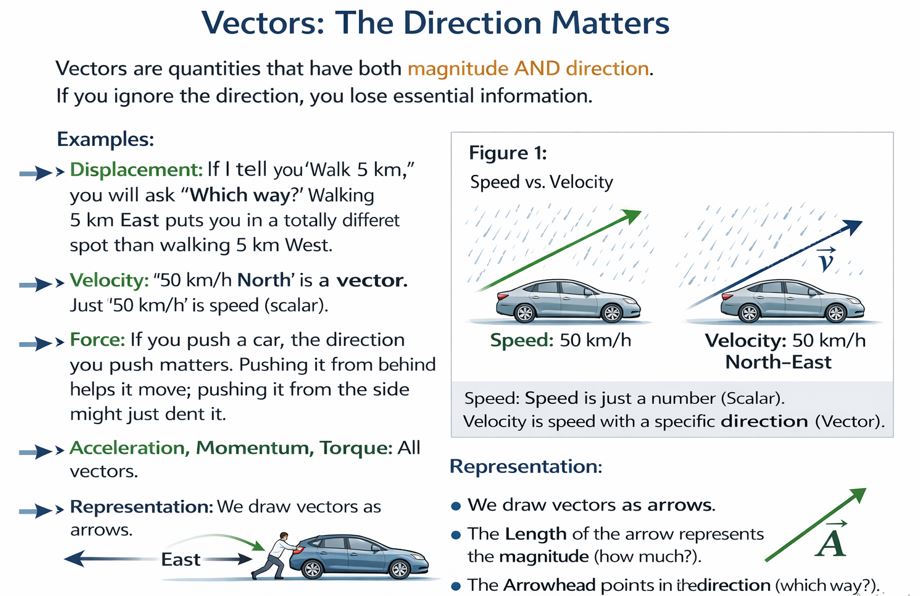
Figure 1: Speed is just a number (Scalar). Velocity is speed with a specific direction (Vector).
2.3 Types of Vectors
Before we start adding them, let’s meet the family members:
- Equal Vectors: Two vectors are equal if they have the same magnitude AND the same direction. It doesn’t matter where they are located.
- Negative Vector: A vector with the same magnitude but pointing in the opposite direction. If A is 5 units East, then -A is 5 units West.
- Zero Vector (Null Vector): A vector with zero magnitude. It has an arbitrary direction. Example: The velocity of a stationary car is a zero vector.
- Unit Vector: This is a very special VIP vector. It has a magnitude of exactly 1. Its only job is to point in a direction. We put a “hat” or “cap” on it (like \(\hat{i}\), \(\hat{j}\), \(\hat{k}\)) to show it’s a unit vector.
3. Vector Algebra: How to Add Arrows
You can’t just add vectors like numbers (3 + 4 is not always 7 in vector world!). Imagine walking 3 meters East, then 4 meters North. You haven’t walked 7 meters away from home; you are actually 5 meters away (thanks to Pythagoras). This is why we need special rules.
3.1 Graphical Method: Head-to-Tail Rule
Imagine vectors as instructions for a treasure hunt. Vector A says “Walk this way,” and Vector B says “Then walk that way.”
- Triangle Law:
Draw vector A. Then, starting from the head (arrow tip) of A, draw vector B.
The Resultant Vector (R) is the shortcut straight from the tail of A to the head of B.
Formula: R = A + B.
- Parallelogram Law:
If two vectors start from the same point (like two people pulling a heavy box), imagine them as two adjacent sides of a parallelogram. Complete the parallelogram. The diagonal starting from that common point is the Resultant.
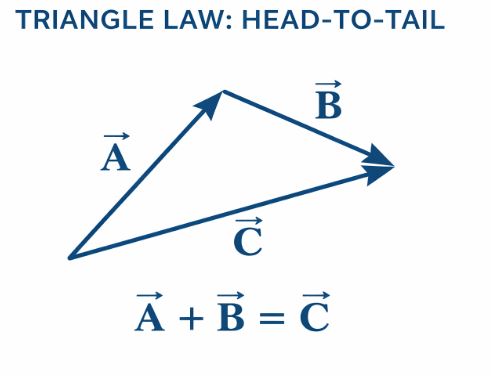
Triangle Law: Head-to-Tail connection.
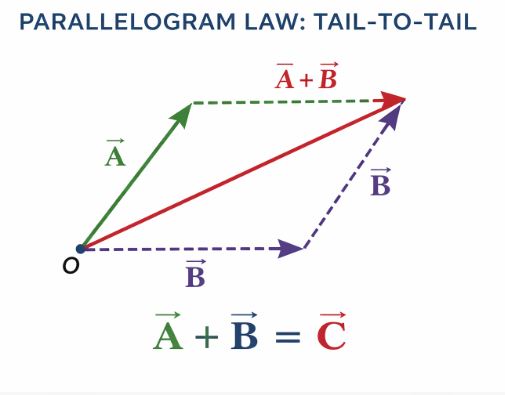
Parallelogram Law: Tail-to-Tail connection.
3.2 Analytical Method: The Formulas
Drawing is fun, but we need precise numbers. If two vectors A and B have an angle θ between them, the magnitude of the resultant R is given by the cosine law formula:
R = √(A² + B² + 2AB cos θ)
- If θ = 0° (Same direction): R = A + B (Maximum)
- If θ = 180° (Opposite direction): R = A – B (Minimum)
- If θ = 90° (Perpendicular): R = √(A² + B²)
4. Resolving Vectors: Breaking Them Down
Usually, a vector points in a weird diagonal direction. To make calculations easier, we “break” it into two perpendicular parts: a horizontal part (x-component) and a vertical part (y-component). This process is called Resolution of Vectors.
Imagine you pull a suitcase with a strap at an angle. Part of your force pulls it forward (horizontal component), and part of your force lifts it up (vertical component).
If a vector A makes an angle θ with the x-axis:
- Horizontal Component (Ax): A cos θ
- Vertical Component (Ay): A sin θ
We can write the full vector using unit vectors: A = (A cos θ)î + (A sin θ)ĵ.
This is super useful because you can add x-parts to x-parts and y-parts to y-parts independently!
5. Motion in a Plane: Combining X and Y
Now that we understand vectors, describing motion in 2D is easy. The secret is simple: Treat the X motion and Y motion as two separate problems happening at the same time.
Imagine a boat crossing a river. The motor pushes it North (y-axis), and the river current pushes it East (x-axis). The boat actually moves diagonally Northeast. But we can analyze the North speed and East speed separately.
5.1 Position, Velocity, and Acceleration Vectors
- Position Vector (r): Tells us the coordinates (x, y).
r = xî + yĵ
- Velocity Vector (v): Tells us the speed in x and y directions.
v = vxî + vyĵ
The direction of velocity is always tangent to the path.
- Acceleration Vector (a): Tells us how velocity changes in x and y.
a = axî + ayĵ
If the acceleration is constant, we can apply our favorite kinematic equations separately for the x-axis and y-axis. It’s like solving two simple Class 9 problems at once!
6. Projectile Motion: The Angry Birds Physics
This is the most famous example of 2D motion. Imagine kicking a football, throwing a stone, or firing a cannonball. The object flies into the air, curves, and hits the ground. This curved path is called a Parabola, and the object is a Projectile.
6.1 The Assumption
We assume air resistance is zero (to keep math simple). So, only one force acts on the projectile: Gravity acting downwards.
6.2 Breaking it Down
Remember the rule? Treat X and Y separately.
| Feature |
Horizontal Motion (X-axis) |
Vertical Motion (Y-axis) |
| Force |
No Force (Air resistance is 0) |
Gravity (pulls down) |
| Acceleration |
Zero (ax = 0) |
Constant downward (ay = -g) |
| Velocity |
Constant! (Never changes) |
Changes (Slows down going up, speeds up going down) |
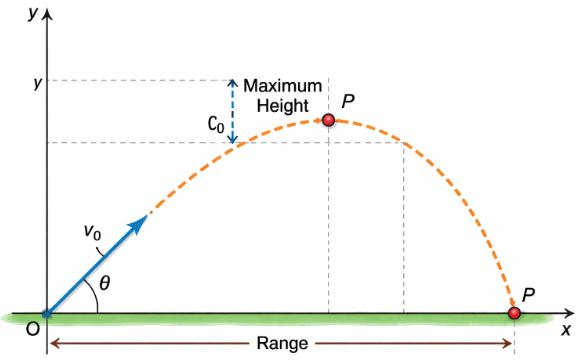
Figure 2: The path of a projectile. Notice that the horizontal arrow (vx) stays the same length the whole time, but the vertical arrow (vy) changes.
6.3 Key Formulas (The Cheat Sheet)
Suppose you launch a ball with speed u at an angle θ.
- Initial Components:
Horizontal: ux = u cos θ
Vertical: uy = u sin θ
- Time of Flight (T): How long does it stay in the air?
T = (2u sin θ) / g
Concept: Depends only on the vertical speed. Gravity kills the vertical speed and brings it back down.
- Maximum Height (H): How high does it go?
H = (u² sin² θ) / 2g
Concept: At the very top, the vertical velocity is momentarily zero (vy = 0).
- Horizontal Range (R): How far does it land?
R = (u² sin 2θ) / g
Concept: This depends on both how fast it moves sideways and how long it stays in the air.
Fun Fact for Cricketers:
To hit a “Six” the farthest distance, you should hit the ball at 45°. This is because sin(2×45°) = sin(90°) = 1, which is the maximum possible value. So, 45° gives the Maximum Range.
7. Uniform Circular Motion: Going in Circles
Imagine tying a stone to a string and whirling it in a circle at a constant speed. This is Uniform Circular Motion.
The Big Question: If the speed is constant, is the object accelerating?
Answer: YES!
Why? Because velocity is a vector (Speed + Direction). Even if speed (magnitude) is constant, the direction is changing at every single moment. Since velocity is changing, there must be acceleration.
7.1 Centripetal Acceleration
This acceleration is special. It doesn’t speed you up or slow you down; it just turns you. It always points towards the center of the circle.
We call it Centripetal Acceleration (ac).
Formula: ac = v² / R
Where v is speed and R is the radius.
Real Life Example: When your car takes a sharp turn, you feel pushed sideways. That’s your body trying to go straight while the car accelerates inward (Centripetal force provided by friction).
8. Relative Velocity in 2D: Rain-Man Problems
Remember relative velocity from the last chapter? (Velocity of A – Velocity of B). In 2D, we just do this with vectors.
The Rain-Man Problem:
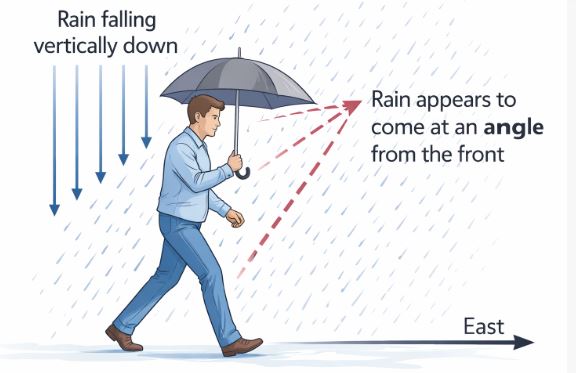
Imagine rain is falling vertically down. You start walking East holding an umbrella.
To you, the rain doesn’t seem to fall straight down anymore; it feels like it’s coming at an angle from the front. Why?
Because relative to you, the rain has a backward horizontal velocity component.
The Logic:
v_rain_relative = v_rain - v_man (Vector Subtraction).
To not get wet, you must point your umbrella into the relative velocity vector (tilt it forward).
Practice Questions & Solutions
Physics is best learned by solving problems. Here are some carefully selected questions to test your understanding.
Multiple Choice Questions (MCQ)
- Which of the following is a scalar quantity?
(a) Displacement (b) Electric Field (c) Work (d) Acceleration
Solution: (c) Work.
Reasoning: Work is the dot product of Force and Displacement. The dot product of two vectors results in a scalar. Displacement, Field, and Acceleration clearly have directions.
- A projectile is fired at an angle of 30° to the horizontal. If the vertical component of its initial velocity is 10 m/s, what is its time of flight? (g=10 m/s²)
(a) 1 s (b) 2 s (c) 3 s (d) 4 s
Solution: (b) 2 s.
Reasoning: Time of flight depends only on vertical velocity (uy).
Formula: T = 2uy / g.
Given uy = 10.
T = (2 × 10) / 10 = 2 seconds. Simple!
- A particle moves in a circle of radius R with constant speed v. The magnitude of average acceleration in half a revolution is:
(a) 0 (b) v²/R (c) 2v²/πR (d) v²/2R
Solution: (c) 2v²/πR.
Reasoning:
In half a circle, direction reverses. Change in velocity = v – (-v) = 2v.
Time taken = Distance/Speed = (πR)/v.
Avg Acc = Change in Vel / Time = (2v) / (πR/v) = 2v²/πR.
Note: Instantaneous acceleration is v²/R, but Average is different!
- Two bullets are fired simultaneously, horizontally and with different speeds from the same place. Which bullet will hit the ground first?
(a) The faster one (b) The slower one (c) Both simultaneously (d) Depends on mass
Solution: (c) Both simultaneously.
Reasoning: Vertical motion is independent of horizontal motion. Both have initial vertical velocity uy = 0. Both fall the same height ‘h’ under the same gravity ‘g’. So, time t = √(2h/g) is the same for both.
Short Answer Questions
- Q5: Can the sum of two vectors of unequal magnitude be zero? Explain.
Answer: No.
To get a zero resultant (cancel out completely), two vectors must have equal magnitude and act in exactly opposite directions (180°). If their magnitudes are different (e.g., 5 N and 3 N), they can never cancel each other to zero. The minimum resultant would be 5 – 3 = 2 N.
- Q6: A river flows east at 3 m/s. A swimmer can swim at 4 m/s in still water. If he wants to cross the river along the shortest path (straight across), in which direction should he swim?
Answer:
This is a relative velocity logic puzzle.
The river tries to push him downstream (East). To counteract this, he must aim partially upstream (West).
Imagine a right-angled triangle.
– Hypotenuse = Swimmer’s speed = 4 m/s.
– Perpendicular side (drift) = River speed = 3 m/s.
– Angle with vertical (upstream) = θ.
sin θ = Opposite/Hypotenuse = River Speed / Swimmer Speed = 3/4.
θ = sin⁻¹(0.75).
So, he should swim at an angle of sin⁻¹(0.75) West of North.
Long Answer Questions (Numerical Solving)
- Q7: A cricketer hits a ball with a velocity of 28 m/s at an angle of 30° above the horizontal. Calculate: (a) Maximum height, (b) Time of flight, (c) The distance from the thrower to where the ball returns to the same level. (g = 9.8 m/s²)
Solution:
Given: u = 28 m/s, θ = 30°, g = 9.8 m/s².
(a) Maximum Height (H):
Formula: H = (u² sin² θ) / 2g
sin 30° = 0.5. So sin² 30° = 0.25.
H = (28² × 0.25) / (2 × 9.8)
H = (784 × 0.25) / 19.6
H = 196 / 19.6 = 10.0 meters.
(b) Time of Flight (T):
Formula: T = (2u sin θ) / g
T = (2 × 28 × 0.5) / 9.8
T = 28 / 9.8 = 2.86 seconds.
(c) Horizontal Range (R):
Formula: R = (u² sin 2θ) / g
2θ = 60°. sin 60° ≈ 0.866.
R = (28² × 0.866) / 9.8
R = (784 × 0.866) / 9.8
R = 678.9 / 9.8 = 69.28 meters.
Conclusion: The ball goes 10m high, stays in air for nearly 3s, and lands 69m away. That’s a good shot!
- Q8: Rain is falling vertically with a speed of 30 m/s. A woman rides a bicycle with a speed of 10 m/s in the North to South direction. What is the direction in which she should hold her umbrella?
Solution:
This is a classic Vector Relative Velocity problem.
Velocity of Rain (Vr) = 30 m/s (Downwards).
Velocity of Woman (Vw) = 10 m/s (South).
We need the Velocity of Rain with respect to the Woman (Vrw).
Vrw = Vr – Vw.
Vector-wise: This means we add Vr (Down) + Negative Vw (North).
Drawing the Triangle:
Imagine a triangle where the vertical side is 30 (Rain) and the horizontal side is 10 (Woman’s reversed speed).
The resultant vector is the diagonal. The angle θ is with the vertical.
tan θ = Opposite / Adjacent = Speed of Woman / Speed of Rain
tan θ = 10 / 30 = 1/3 ≈ 0.333.
θ = tan⁻¹(0.333) ≈ 18.4°.
Direction:
The relative rain comes from the front. Since she is moving South, “front” means South.
So, she must hold the umbrella tilted 18.4° towards the South (direction of motion) with the vertical to block the rain.