
1. Pure Substances vs. Mixtures
In everyday language, “pure” might mean something is not adulterated, like “pure ghee” or “pure milk.” But in science, it has a very specific meaning.
- 🧪 Pure Substance: A substance made up of only one type of particle. All the particles have the same chemical nature.
- Examples: Salt (sodium chloride), sugar, and iron are pure substances because they are made of only one type of particle.
- 🤝 Mixture: A substance made up of two or more different types of pure substances mixed together.
- Examples: Milk is a mixture of water, fats, and proteins. The air we breathe is a mixture of gases like oxygen, nitrogen, etc.
2. Types of Mixtures
Mixtures can be divided into two main types based on how their components are distributed.
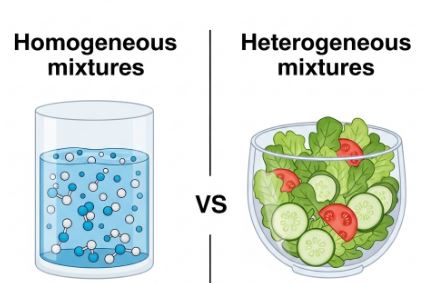
Homogeneous mixtures have a uniform composition, while heterogeneous mixtures do not.
- Homogeneous Mixture: A mixture that has a uniform composition throughout. You can’t see the different components separately.
- Another name for a homogeneous mixture is a solution.
- Examples: Salt dissolved in water, sugar dissolved in water, or lemonade.
- Heterogeneous Mixture: A mixture that has a non-uniform composition. You can often see the different parts.
- Examples: A mix of sand and water, oil and water, or a salad.
3. What is a Solution?
A solution is a homogeneous mixture of two or more substances. It has two parts:
- Solute: The substance that is dissolved (usually in a smaller amount).
- Solvent: The substance that does the dissolving (usually in a larger amount).
Example: In saltwater, salt is the solute and water is the solvent.
3.1 Properties of a Solution
- It’s a homogeneous mixture.
- The particles are extremely small (less than 1 nanometer) and can’t be seen with the naked eye.
- It is stable, meaning the solute particles don’t settle down.
- It does not scatter a beam of light, so the path of light is not visible through it.
4. What is a Suspension?
A suspension is a heterogeneous mixture where the solute particles do not dissolve but remain suspended in the solvent.
4.1 Properties of a Suspension
- It’s a heterogeneous mixture.
- The particles are large enough to be seen with the naked eye.
- It is unstable; the particles settle down if left undisturbed.
- It scatters a beam of light, making the path of light visible (this is called the Tyndall effect).
Example: Muddy water or chalk powder in water.
5. What is a Colloid?
A colloid is a mixture that appears homogeneous but is actually heterogeneous. The particle size is between that of a solution and a suspension.

Colloids and suspensions exhibit the Tyndall effect, while true solutions do not.
5.1 Properties of a Colloid
- It appears to be homogeneous.
- The particles are too small to be seen with the naked eye.
- It is stable; the particles do not settle down.
- It shows the Tyndall effect (scatters light).
Examples: Milk, fog, and shaving cream.
6. Physical vs. Chemical Changes
- 🏃♀️ Physical Change: A change where only the physical properties (like color, hardness, or state) of a substance change. No new substance is formed.
- Examples: Melting ice, boiling water, or cutting a piece of paper.
- 🔥 Chemical Change: A change where a new substance with completely new properties is formed. This is also called a chemical reaction.
- Examples: Burning wood, rusting of iron, or cooking an egg.
7. Types of Pure Substances
Pure substances are classified into two categories: elements and compounds.
- Elements: The most basic form of matter that cannot be broken down into simpler substances by chemical reactions.
- Elements can be metals (like iron, gold), non-metals (like oxygen, hydrogen), or metalloids (which have properties of both, like silicon).
- Example: Iron is an element. You can’t break it down into anything simpler.
- Compounds: A substance formed when two or more elements are chemically combined in a fixed proportion.
- The properties of a compound are completely different from its constituent elements.
- Example: Water (H₂O) is a compound made of hydrogen and oxygen. Its properties are very different from hydrogen (a combustible gas) and oxygen (a gas that supports combustion).
8. Extensive Practice Set
Here is a set of original questions to test your understanding of the chapter.
Part A: Multiple-Choice Questions (MCQs)
- Which of the following is considered a pure substance in science?
a) Milk
b) Air
c) Iron
d) Lemonade - A mixture of oil and water is an example of:
a) A homogeneous mixture
b) A heterogeneous mixture
c) A solution
d) A colloid - The scattering of a beam of light by colloidal particles is known as:
a) The Reflection Effect
b) The Tyndall Effect
c) The Dissolving Effect
d) The Suspension Effect - Which of the following is a chemical change?
a) Melting of wax
b) Tearing a piece of paper
c) Burning of a candle
d) Dissolving sugar in water - Which of the following best describes an element?
a) A substance made of two or more elements chemically combined.
b) A substance that cannot be broken down into simpler substances by chemical means.
c) A uniform mixture of two or more substances.
d) A non-uniform mixture of two or more substances.
Part B: Short Answer Questions
- Differentiate between a solute and a solvent, using the example of a sugar solution.
- Give two properties of a suspension that make it different from a solution.
- Why is milk considered a colloid and not a solution?
- Classify the following into physical or chemical changes:
- Rusting of an almirah
- Boiling water to make steam
- Making a fruit salad
- Digestion of food
- What is the difference between a mixture and a compound? Give one example of each.
Part C: Long Answer Questions
- Explain the difference between homogeneous and heterogeneous mixtures with at least two examples for each.
- Pragya wants to separate a mixture of sand, salt, and water. Describe the steps she should follow to separate all three components.
- Describe the properties of a colloid with suitable examples. Why is a colloid considered a stable mixture?
- You are given a colorless liquid. How would you determine if it is a pure substance (like distilled water) or a solution (like saltwater)?
- What are elements and compounds? Explain how they are different from each other, focusing on their composition and properties. Give two examples of each.
Also read: Class 9 Science Chapter 1 – Matter in Our Surroundings