
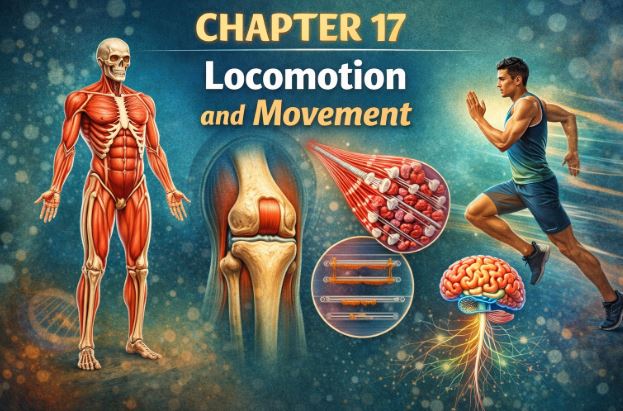
Introduction | Class 11 Biology Chapter 17 Locomotion and Movement notes
Hello students! Welcome back to another exciting journey into human physiology. Today, we are going to explore something you do every single second of your life without even realizing it—movement. Take a moment to blink your eyes, take a deep breath, or shift in your chair. All of these actions require a complex, beautiful coordination within your body.
Movement is one of the most significant and defining features of all living beings. Both animals and plants exhibit a wide range of movements. Think about a simple unicellular organism like an Amoeba; even it shows movement by the streaming of its internal fluid, the protoplasm. Other organisms might use tiny hair-like structures called cilia, whip-like flagella, or long tentacles to move around.
As human beings, we can move our limbs, talk using our jaws and tongue, and blink our eyelids. But sometimes, our movements result in us physically changing our location or place. When a voluntary movement causes you to change your location—like walking to the kitchen, running on a track, climbing stairs, or swimming—we call it locomotion.
An important golden rule to remember in biology is that the structures you use for locomotion don’t necessarily have to be entirely different from the ones you use for other movements. For example, in a microscopic organism called Paramoecium, the same cilia that help it swim (locomotion) also help sweep food into its cytopharynx (feeding). Similarly, a Hydra uses its tentacles to capture prey, but it can also use those same tentacles to walk around. We humans use our limbs to shift our body posture while sitting, and we use those exact same limbs to walk.
Because of this incredible overlap, we cannot study movements and locomotion as entirely separate topics. I want you to memorize this statement: All locomotions are movements, but all movements are not locomotions. Why do animals bother moving from place to place? They generally do it because of the demands of their situation and habitat. They move in search of food, a safe shelter, a mate, suitable breeding grounds, to find a more favourable climate, or to escape from predators and enemies. Let’s dive deeper and look at the cellular level!
1. Types of Movement in the Human Body
Even while you are sitting still reading these notes, millions of cells inside your body are constantly moving. The cells of the human body exhibit three main types of movements: amoeboid, ciliary, and muscular. Let’s break them down clearly.
1.1 Amoeboid Movement
Imagine a tiny, shape-shifting blob. Some highly specialised cells in our immune system, specifically macrophages and leucocytes (white blood cells) travelling in our blood, exhibit amoeboid movement. How do they do this without legs? They stream their protoplasm in a specific direction to form false feet called pseudopodia, exactly like an Amoeba does. To help maintain their shape during this shape-shifting process, they rely on internal cytoskeletal elements like microfilaments.
1.2 Ciliary Movement
Have you ever wondered how your lungs stay clean when you breathe in dusty air? Ciliary movement occurs inside most of our internal tubular organs that are lined with a special tissue called ciliated epithelium. Imagine millions of tiny brooms sweeping in a highly coordinated rhythm. In your windpipe (trachea), this coordinated movement of cilia helps sweep away dust particles and foreign inhaled substances away from the lungs. Another beautiful example is in the female reproductive system, where the passage of the ova (egg) through the reproductive tract is facilitated by these sweeping ciliary movements.
1.3 Muscular Movement
This is the big one! Every time you move your limbs, jaws, or tongue, you are relying on muscular movement. The core secret of muscles is their contractile property—their ability to shorten and generate pulling force. This property is effectively used for locomotion and other major body movements by humans and the majority of multicellular organisms. For perfect locomotion, you need a beautifully coordinated effort from three major bodily systems: the muscular system, the skeletal system, and the neural (nervous) system.
2. The Fascinating World of Muscles
Muscles are truly the biological engines of your body. Let’s understand where they come from and how they are classified.
During embryonic development, muscles arise from a specialised embryonic layer. Hence, muscle is a specialised tissue of mesodermal origin. They are so abundant that about 40 to 50 per cent of an adult human’s body weight is contributed purely by muscles.
Muscles are unique because they possess four special properties: excitability (they can respond to nervous signals), contractility (they can shorten and pull), extensibility (they can stretch), and elasticity (they return to their original shape after stretching).
Biologists classify muscles using different criteria: where they are located, what they look like under a microscope (appearance), and how their activities are regulated (voluntary or involuntary). Based on their location in the body, we identify three distinct types of muscles: Skeletal, Visceral, and Cardiac.
)
2.1 Skeletal Muscles
As the name suggests, skeletal muscles are physically attached and closely associated with the skeletal components (bones) of your body. If you look at them under a microscope, they have a striped or banded appearance, which is why they are called striated muscles. Are you in control of these? Yes! Their activities are directly under the voluntary control of your central nervous system, so we also call them voluntary muscles. They are primarily responsible for locomotory actions (like walking) and changing body postures.
2.2 Visceral (Smooth) Muscles
These are the hidden workers of your body. Visceral muscles are located in the inner walls of your hollow visceral organs, such as your alimentary canal (digestive tract) and reproductive tract. When viewed under a microscope, they do not exhibit any stripes or striations; they appear completely smooth. Hence, they are famously called smooth muscles or nonstriated muscles. You cannot consciously command your stomach to digest faster; therefore, their activities are not under voluntary nervous control, making them involuntary muscles. They assist in crucial internal movements, like pushing food through the digestive tract or transporting gametes through the genital tract.
2.3 Cardiac Muscles
Cardiac muscles are exclusively the muscles of the heart. They are unique because many cardiac muscle cells assemble and connect in a branching pattern to form the overall cardiac muscle structure. Based on their microscopic appearance, cardiac muscles are striated (striped). However, just like smooth muscles, they are involuntary in nature because your conscious nervous system does not directly control their continuous beating activities.
3. Anatomy of a Skeletal Muscle
To truly understand how we move, we need to zoom in and examine a skeletal muscle in detail. Imagine a skeletal muscle as a large cable made up of smaller wires, which are made of even smaller threads.
Every organised skeletal muscle in your body (like your biceps) is made up of numerous muscle bundles called fascicles. These fascicles are held tightly together by a common layer of collagenous connective tissue called fascia.
Now, if you pull out one single muscle bundle (fascicle), you will see it contains a number of individual muscle fibres (which are the actual muscle cells). Each of these muscle fibres is lined by an outer plasma membrane called the sarcolemma, which encloses the inner cellular fluid known as the sarcoplasm.
A very interesting feature of a muscle fibre is that it is a syncitium. This means the cell isn’t just controlled by one nucleus; its sarcoplasm contains many nuclei. The endoplasmic reticulum of these muscle fibres is specially modified and is called the sarcoplasmic reticulum, acting as a massive storehouse for calcium ions. Remember these calcium ions; they are the key to movement!
3.1 The Microscopic Threads: Myofibrils
Inside the sarcoplasm of the muscle fibre, there are a large number of parallelly arranged filaments known as myofilaments or myofibrils. When scientists studied these myofibrils under powerful microscopes, they noticed alternate dark and light bands. This striped, striated appearance is entirely due to the highly organized distribution pattern of two vital contractile proteins: Actin and Myosin.
)
Let’s map out this microscopic geography clearly:
- I-band (Light Band): The lighter bands contain the protein actin and are called Isotropic or I-bands. Actin filaments are relatively thinner, so they are commonly called thin filaments.
- A-band (Dark Band): The darker bands contain the protein myosin and are called Anisotropic or A-bands. Myosin filaments are thicker, hence they are called thick filaments.
- Z-line: Right in the centre of each light I-band is an elastic fibre called the ‘Z’ line, which bisects it completely. The thin actin filaments are firmly attached to this Z line.
- M-line: Similarly, the thick myosin filaments in the A-band are held together right in the middle by a thin fibrous membrane called the ‘M’ line.
- The Sarcomere: These A and I bands are arranged alternately throughout the entire length of the myofibrils. The specific portion of a myofibril located between two successive Z lines is considered the fundamental, functional unit of muscle contraction and is called a sarcomere.
- The H-zone: When the muscle is in a resting state, the edges of the thin actin filaments on either side partially overlap the free ends of the thick myosin filaments. However, the central part of the thick filaments is left un-overlapped. This specific central region of the thick filament, not overlapped by thin filaments, is called the ‘H’ zone.
4. Structure of the Contractile Proteins
To understand the magic of muscle contraction, we must look at the structural design of Actin and Myosin.
The Actin (Thin) Filament: Each thin actin filament is actually made of two filamentous actins, known as ‘F’ actins, which are helically wound around each other like a twisted pearl necklace. Each of these ‘F’ actins is a long polymer made up of many small monomeric globular units called ‘G’ actins. Running very closely alongside these ‘F’ actins throughout their entire length are two filaments of another regulatory protein called tropomyosin. Furthermore, a complex protein named Troponin is distributed at regular intervals sitting on top of the tropomyosin. Here is the critical part: during a resting state, a subunit of this troponin protein physically masks (covers up) the active binding sites for myosin located on the actin filaments. It’s like putting a lock on a door!
The Myosin (Thick) Filament: The thick myosin filament is also a complex polymerised protein. It is made up of many individual monomeric proteins called Meromyosins. Every single meromyosin molecule has two important parts: a globular head equipped with a short arm (collectively called Heavy Meromyosin or HMM), and a tail (called Light Meromyosin or LMM). The HMM components (head and short arm) project outwards at regular distances and angles from the surface of the polymerised myosin filament, forming what is known as a cross arm. The globular head is incredible because it functions as an active ATPase enzyme, containing specialized binding sites for ATP energy molecules, as well as active binding sites for actin.
5. Mechanism of Muscle Contraction: The Sliding Filament Theory
How do we actually lift a heavy bag or take a step forward? The entire mechanism of muscle contraction is beautifully explained by the Sliding Filament Theory. This theory states that the contraction of a muscle fibre occurs by the physical sliding of the thin actin filaments directly over the thick myosin filaments.
)
Let’s look at this complex dance step-by-step:
- The Command: It all begins with a thought. Muscle contraction is initiated by a neural signal sent by your central nervous system (CNS) traveling down via a motor neuron. A motor neuron, combined with all the specific muscle fibres it connects to, constitutes what we call a motor unit.
- The Junction: The exact meeting point between the motor neuron and the sarcolemma of the muscle fibre is called the neuromuscular junction, or the motor-end plate.
- The Chemical Messenger: When the electrical neural signal finally reaches this junction, it triggers the release of a chemical neurotransmitter known as Acetyl choline. This chemical generates an electrical action potential right on the sarcolemma of the muscle.
- The Key (Calcium): This action potential rapidly spreads all throughout the muscle fibre, causing the sarcoplasmic reticulum to release its stored calcium ions ($Ca^{++}$) deep into the sarcoplasm.
- Unlocking the Door: The sudden increase in calcium levels causes these $Ca^{++}$ ions to bind tightly with a specific subunit of the troponin protein located on the actin filaments. This binding forces a shape change, thereby completely removing the masking of the active sites for myosin. The door is now unlocked!
- The Cross Bridge Formation: Now, utilizing energy obtained from the hydrolysis of ATP, the eager myosin heads quickly bind to these newly exposed active sites on the actin filaments, physically forming a connection called a cross bridge.
- The Power Stroke: Once attached, the myosin head pivots. This action pulls the attached thin actin filaments directly towards the centre of the ‘A’ band. Because the ‘Z’ lines are firmly attached to these actin filaments, they are also pulled inwards from both sides. This inward pulling causes a literal shortening of the entire sarcomere—this is contraction!. During this shortening phase, the light ‘I’ bands get significantly reduced in size, whereas the dark ‘A’ bands retain their original length.
- Breaking the Bridge: After the pull, the myosin head releases its ADP and inorganic phosphate ($P_{1}$) and goes back to a relaxed state. To detach and prepare for another pull, a completely new ATP molecule must bind to the myosin head, causing the cross-bridge to break.
- Repeat: The new ATP is again hydrolysed by the myosin head, and this entire cycle of cross bridge formation, sliding, and breakage is continuously repeated, causing further and further sliding contraction.
When does it stop? The process continues relentlessly until the calcium ($Ca^{++}$) ions are actively pumped back into the sarcoplasmic cisternae. Without calcium, the troponin once again masks the actin filaments. The lack of connection causes the ‘Z’ lines to gently slide back to their original resting positions, resulting in muscle relaxation.
5.1 Red vs. White Muscle Fibres
If you do repeated, heavy activation of your muscles, they may rely on the anaerobic (without oxygen) breakdown of stored glycogen, leading to an accumulation of lactic acid, which causes that burning feeling of fatigue. However, muscles vary. They contain a red-coloured, oxygen-storing pigment called myoglobin.
Some muscles have incredibly high myoglobin content, giving them a dark reddish appearance. We call these Red fibres. Because they also pack plenty of mitochondria, they can constantly utilise the large amounts of stored oxygen to produce massive amounts of ATP energy; hence, they are considered aerobic muscles (great for endurance, like marathon running).
On the other hand, some muscles possess very low quantities of myoglobin and appear pale or whitish. These are the White fibres. They have fewer mitochondria but possess a high amount of sarcoplasmic reticulum. Because they lack oxygen storage, they depend heavily on fast, anaerobic processes for quick bursts of energy (great for sprinting or heavy lifting).
6. The Skeletal System: The Body’s Scaffolding
Imagine trying to chew your food without jaw bones, or trying to walk around without the sturdy long bones in your legs. You would be a puddle on the floor! The skeletal system provides the necessary framework of bones and a few cartilages that play a significant role in every movement shown by the body.
Both bone and cartilage are specialised connective tissues. Bone has a very hard, rigid matrix primarily due to the presence of calcium salts, while cartilage has a slightly more pliable (flexible) matrix due to chondroitin salts. In a normal adult human being, this entire skeletal system is made up of exactly 206 bones, supplemented by a few cartilages. We group this massive structure into two principal, easy-to-study divisions: the axial skeleton and the appendicular skeleton.
)
6.1 The Axial Skeleton (The Core Axis)
The axial skeleton forms the main longitudinal axis of the body and comprises exactly 80 bones. It includes four main structures: the skull, the vertebral column, the sternum, and the ribs. Let’s examine them:
The Skull: Your brain’s helmet. The skull is composed of two distinct sets of bones—the cranial and the facial—which together total 22 bones. There are 8 cranial bones that form the hard protective outer covering (the cranium) shielding your delicate brain. The front facial region is made up of 14 skeletal elements. Additionally, a single, independent U-shaped bone called the hyoid is present right at the base of the buccal cavity. Deep inside each middle ear, there are three tiny bones—the Malleus, Incus, and Stapes—collectively known as the Ear Ossicles. The skull physically articulates (connects) with the top superior region of the vertebral column using two structures called occipital condyles, which is why humans are said to have a dicondylic skull.
The Vertebral Column (Spine): Placed dorsally (on your back), it is formed by 26 serially arranged, individual units called vertebrae. It extends downwards from the base of the skull, forming the main structural framework of the trunk. Each individual vertebra has a hollow central portion known as the neural canal, acting as a safe tunnel through which the delicate spinal cord passes. The very first vertebra at the top is called the atlas, and it articulates directly with the occipital condyles of the skull. Starting from the skull down, the column is differentiated into specific regions: cervical (7 vertebrae), thoracic (12), lumbar (5), sacral (1-fused), and coccygeal (1-fused). An interesting fact: the number of cervical vertebrae is seven in almost all mammals, including human beings and even long-necked giraffes!. The vertebral column protects the spinal cord, firmly supports the head, and serves as a crucial point of attachment for the ribs and the strong musculature of your back.
The Sternum and Ribs: On the ventral (front) midline of your thorax lies a flat bone called the sternum (breastbone). Protecting your heart and lungs are 12 pairs of ribs. Each rib is a thin, flat bone connected dorsally to the vertebral column and ventrally toward the sternum. Because it has two articulation surfaces on its dorsal end, a rib is known as bicephalic. Let’s categorize these 12 pairs:
- True Ribs (1st to 7th pairs): These are attached dorsally to the thoracic vertebrae and are ventrally connected directly to the sternum with the help of flexible hyaline cartilage.
- False Ribs / Vertebrochondral Ribs (8th, 9th, and 10th pairs): These do not articulate directly with the sternum. Instead, they join the cartilage of the seventh rib below it, using hyaline cartilage.
- Floating Ribs (11th and 12th pairs): These last two pairs are not connected ventrally at all; they literally float in the front muscle tissue, protecting the kidneys.
Together, the thoracic vertebrae at the back, the ribs wrapping around, and the sternum in the front form the protective rib cage.
6.2 The Appendicular Skeleton (Limbs and Girdles)
The bones of your limbs, along with the specific girdles that attach them to the axial skeleton, constitute the appendicular skeleton. Each individual limb (arm or leg) is composed of exactly 30 bones.
The Forelimb (Arm/Hand): The bones comprise the humerus (upper arm), the radius and ulna (forearm), the carpals (8 wrist bones), the metacarpals (5 palm bones), and the phalanges (14 digits/finger bones).
The Hindlimb (Leg/Foot): The leg consists of the femur (the thigh bone, which is the longest and heaviest bone in the body), the tibia and fibula (lower leg), the tarsals (7 ankle bones), the metatarsals (5 foot bones), and the phalanges (14 digits/toe bones). Additionally, a special cup-shaped bone called the patella (knee cap) covers the knee ventrally.
The Girdles: How do your arms and legs attach to your spine? Through girdles! The Pectoral (shoulder) and Pelvic (hip) girdle bones help in the structural articulation of the upper and lower limbs respectively with the main axial skeleton.
– The pectoral girdle consists of two halves, each containing a clavicle (the long, slender collar bone with two curvatures) and a scapula (a large, triangular flat bone located in the dorsal part of the thorax between the second and seventh ribs). The scapula has an elevated ridge called the spine projecting as a flat process called the acromion, below which lies a depression called the glenoid cavity where the head of the humerus fits to form your shoulder joint.
– The pelvic girdle consists of two massive coxal bones. Each coxal bone is formed by the fusion of three distinct bones: the ilium, ischium, and pubis. At the exact point where these three bones fuse is a deep cavity called the acetabulum, into which the spherical head of the thigh bone (femur) tightly articulates. The two halves of the pelvic girdle meet in the front (ventrally) to form a joint called the pubic symphysis, which contains tough fibrous cartilage.
7. Joints: The Biological Hinges
Without joints, your skeleton would be a stiff, immovable statue. Joints are absolutely essential for all types of movements involving the bony parts of the body. Naturally, locomotory movements are no exception. Joints function as critical points of physical contact between two bones, or even between bones and cartilages. In physics terms, the force generated by muscle contraction is used to carry out movement through these joints, where the joint itself acts as a fulcrum (pivot point). The degree of movability at these different joints varies wildly depending on several factors.
)
Scientifically, joints have been classified into three major structural forms: fibrous, cartilaginous, and synovial. Let’s explore how they differ:
- Fibrous Joints (No Movement): These joints do not allow any movement whatsoever. A perfect example is the flat skull bones, which fuse end-to-end to form the protective cranium using dense fibrous connective tissues in the form of zig-zag lines called sutures.
- Cartilaginous Joints (Limited Movement): In these joints, the specific bones involved are firmly joined together with the help of dense cartilages. The vital joint between adjacent vertebrae in your vertebral column follows this pattern, permitting limited, shock-absorbing movements so you can bend and twist.
- Synovial Joints (Considerable Movement): These are the true movers! Synovial joints are uniquely characterised by the presence of a fluid-filled cavity (synovial cavity) located perfectly between the articulating surfaces of the two connecting bones. This fluid acts like lubricating oil, allowing considerable, smooth movement, which is essential for locomotion and daily activities.
Some key examples of Synovial joints include:
- Ball and socket joint (provides rotational movement; found between the humerus and the pectoral girdle in the shoulder).
- Hinge joint (moves in one plane like a door; your knee joint and elbow).
- Pivot joint (allows rotational nodding/shaking of the head; found between the atlas and axis vertebrae).
- Gliding joint (bones slide flatly over one another; found between the carpals in your wrist).
- Saddle joint (gives high flexibility; found between the carpal and metacarpal of your thumb, allowing you to grip objects).
8. Disorders of the Muscular and Skeletal System
When such a complex mechanical system breaks down, it leads to specific disorders. As biology students, you must be familiar with the common ones affecting humans:
- Myasthenia gravis: This is a dangerous auto-immune disorder that specifically attacks the neuromuscular junction, leading to extreme fatigue, weakening, and eventually paralysis of the affected skeletal muscles.
- Muscular dystrophy: Unlike an infection, this is mostly a genetic disorder resulting in the progressive, unstoppable degeneration of skeletal muscle tissues over time.
- Tetany: Have you ever had a sudden, uncontrollable muscle twitch? Tetany involves rapid spasms or wild contractions in the muscle directly caused by dangerously low calcium ($Ca^{++}$) ion levels in the body fluid.
- Arthritis: Simply put, this refers to the painful inflammation of one or more joints, causing swelling and restricted movement.
- Osteoporosis: An incredibly common age-related disorder heavily characterised by significantly decreased bone mass, leading to highly increased chances of bone fractures. In women, dramatically decreased levels of the hormone estrogen (often post-menopause) is a major common cause.
- Gout: This is a specific type of extremely painful arthritis characterized by the inflammation of joints directly due to the unwanted accumulation of sharp, needle-like uric acid crystals.
Key Takeaways & Summary
- Movement is universal, but locomotion involves changing one’s actual location. All locomotions are movements, but the reverse is not always true.
- The human body exhibits amoeboid, ciliary, and muscular movements.
- There are three muscle types: Skeletal (striated/voluntary), Visceral (smooth/involuntary), and Cardiac (striated/involuntary/branched).
- The functional unit of muscle contraction is the sarcomere, defined as the region between two successive Z-lines.
- Muscle contraction follows the sliding filament theory, where thin actin filaments are pulled over thick myosin filaments using energy from ATP, triggered by Calcium release.
- The skeletal system has 206 bones split into the Axial skeleton (80 bones: skull, spine, ribs, sternum) and Appendicular skeleton (126 bones: limbs and girdles).
- Joints are classified structurally into fibrous (immovable), cartilaginous (limited), and synovial (free-moving).
Common Student Misconceptions
Misconception 1: “During muscle contraction, the thick myosin filaments get shorter.”
Correction: Remember the Sliding Filament Theory! The filaments themselves NEVER change length. They simply slide past one another. The light I-band gets reduced, but the dark A-band (myosin) completely retains its original length. The overall sarcomere shortens due to the sliding.
Misconception 2: “All 12 pairs of ribs attach to the breastbone (sternum).”
Correction: Only the first 7 pairs (true ribs) connect directly to the sternum. Pairs 8, 9, and 10 attach indirectly via the 7th rib’s cartilage. Pairs 11 and 12 (floating ribs) do not connect ventrally at all.
Practice Set: Test Your Knowledge (CBSE Pattern)
Very Short Answer Questions (1 Mark)
Q1. Which cells in the human body exhibit amoeboid movement?
Answer: Specialised immune cells in our blood, specifically macrophages and leucocytes, exhibit amoeboid movement using pseudopodia.
Q2. Name the ion responsible for unmasking active sites for myosin on actin filaments.
Answer: Calcium ions ($Ca^{++}$). They bind to troponin, removing the masking of active sites.
Short Answer Questions (2-3 Marks)
Q3. Differentiate between Red and White muscle fibres based on their physiological components.
Answer: Red muscle fibres have a high content of the oxygen-storing pigment myoglobin (giving them a reddish appearance) and possess plenty of mitochondria, allowing them to utilize aerobic pathways for ATP production. White muscle fibres have very little myoglobin (appearing pale), fewer mitochondria, but a high amount of sarcoplasmic reticulum. They depend heavily on anaerobic processes for quick energy bursts.
Q4. Define a sarcomere. Which bands does it encompass?
Answer: A sarcomere is the fundamental, functional unit of muscle contraction. Anatomically, it is the specific portion of a myofibril located exactly between two successive ‘Z’ lines. It encompasses a central dark ‘A’ band and two half light ‘I’ bands on either side.
Long Answer Questions (5 Marks)
Q5. Describe the crucial steps of muscle contraction based on the Sliding Filament Theory.
Answer: The sliding filament theory explains that contraction occurs when thin actin filaments physically slide over thick myosin filaments. The steps are:
1. A neural signal arrives from the CNS at the neuromuscular junction, releasing the neurotransmitter Acetyl choline, which generates an action potential in the sarcolemma.
2. This potential triggers the sarcoplasmic reticulum to release stored $Ca^{++}$ ions into the sarcoplasm.
3. Calcium binds to the troponin protein on the actin filaments, forcing it to unmask the active myosin-binding sites.
4. Utilizing ATP energy, the myosin heads attach to these exposed active sites on actin, forming a physical ‘cross bridge’.
5. The myosin heads undergo a power stroke, pulling the attached actin filaments (and their connected Z-lines) inward towards the centre of the A-band. This shortens the entire sarcomere, causing active contraction.
6. A new ATP binds to the myosin head, breaking the cross-bridge. The cycle rapidly repeats until calcium is pumped back away.
Case-Based / Competency-Based Question (4 Marks)
Q6. Read the clinical situation and answer the questions.
A 65-year-old post-menopausal female patient visits the clinic complaining of severe back pain and a recent fracture in her wrist after a very minor fall. The doctor suspects a skeletal disorder common in this demographic.
(a) Identify the skeletal disorder the doctor most likely suspects.
(b) What is the primary characteristic feature of this disorder?
(c) What hormonal change is the most common cause of this disorder in such patients?
Answer:
(a) The doctor suspects Osteoporosis.
(b) The primary defining characteristic is a severely decreased bone mass, leading to weakened bones and highly increased chances of unexpected fractures.
(c) Decreased circulating levels of the hormone estrogen (which typically drops significantly after menopause) is a very common cause of this disorder.
Assertion-Reason Question
Q7. For the following question, select the correct answer from codes (a), (b), (c), and (d):
(a) Both A and R are true, and R is the correct explanation of A.
(b) Both A and R are true, but R is not the correct explanation of A.
(c) A is true, but R is false.
(d) A is false, but R is true.
Assertion (A): All forms of locomotions are considered movements, but all types of movements are not considered locomotions.
Reason (R): Movement refers to any change in body posture or part, while locomotion specifically involves a voluntary movement that results in a definitive change of place or physical location of the whole organism.
Answer: (a). The assertion is factually correct. The reason accurately defines both terms, explaining exactly why chewing food (movement) isn’t locomotion, but walking (movement changing location) is. Thus, R perfectly explains A.
End of Notes.
Students, ensure you carefully practice drawing the sarcomere structure and understand the sequence of the sliding filament mechanism. Happy studying!
Read Also:
Class-11 Physics All Chapters
For official syllabus and textbooks, visit the
NCERT Official Website.