
1. Introduction: What is “Our Environment”? | Class 10 Science Chapter 13 Our Environment Notes
Hello students! Welcome to the final biology chapter of Class 10. When you hear the word “Environment,” you probably think of trees, rivers, and mountains. But your environment is much more than that. It is everything that surrounds you—the air you breathe, the water you drink, the soil under your feet, and even the bacteria on your skin.
Think of the Earth as a giant spaceship. Everything inside it—the living crew (plants, animals, us) and the non-living systems (air, water, temperature)—must work together perfectly to keep the mission going. In this chapter, we will study how these components interact and what happens when we mess up the system.
2. Ecosystem: Nature’s Little Communities
Imagine a pond near your house. It has frogs, fish, lotus plants, and tiny insects. It also has water, mud, sunlight, and air. This self-sustaining unit where living things interact with each other and their physical surroundings is called an Ecosystem.
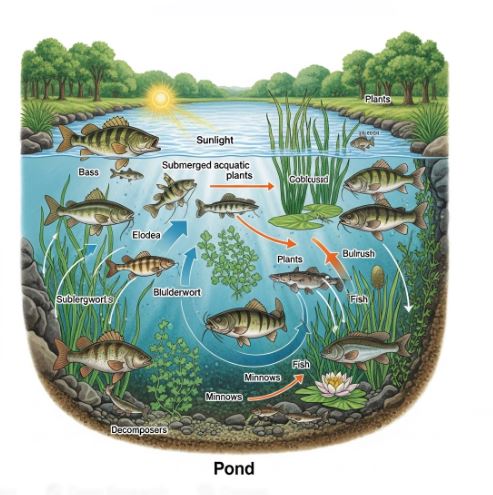
Figure 1: A pond ecosystem. Notice how the fish (biotic) need the water and oxygen (abiotic) to survive.
2.1 Components of an Ecosystem
An ecosystem is made of two main teams:
- Abiotic Components (Non-living): The physical environment like temperature, rainfall, wind, soil, and minerals. Without these, life cannot exist.
- Biotic Components (Living): All the organisms. Based on how they get their food, we divide them into three groups:
- Producers (The Chefs): These are organisms that make their own food using sunlight (photosynthesis). This includes all green plants and blue-green algae. They are the foundation of life.
- Consumers (The Eaters): These organisms cannot cook inside their bodies; they must eat others.
– Herbivores: Eat plants (e.g., Cow, Deer).
– Carnivores: Eat other animals (e.g., Lion, Snake).
– Omnivores: Eat both (e.g., Humans, Crows).
– Parasites: Live on or inside others and steal food (e.g., Lice, Tapeworms). - Decomposers (The Recyclers): Think of fungi and bacteria. When a plant or animal dies, decomposers break down their complex bodies into simple nutrients. These nutrients go back into the soil to help new plants grow. Without them, the world would be covered in dead bodies!
Types of Ecosystems:
– Natural: Forests, ponds, lakes (Nature manages them).
– Artificial (Man-made): Gardens, crop fields, aquariums (We manage them).
3. Food Chains and Food Webs: Who Eats Whom?
Life is basically a continuous transfer of energy. The sun gives energy to plants, plants give it to deer, and deer give it to tigers. This linear sequence of organisms where one eats another is called a Food Chain.
3.1 Trophic Levels
Each step in a food chain is called a Trophic Level. Let’s build a simple one:
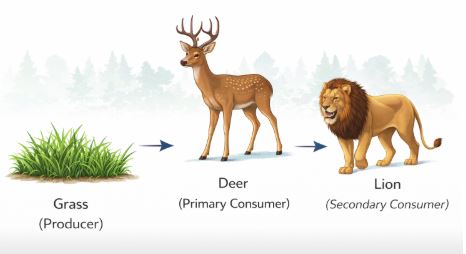
Important Rules:
1. Energy Source: The ultimate source of energy for all food chains is the Sun.
2. Flow Direction: Energy flow is always Unidirectional. Energy goes from Grass to Deer. It never goes back from Deer to Grass!
3.2 The 10% Law of Energy Transfer
This is a critical concept. When a deer eats grass, does it keep 100% of the grass’s energy? No!
– The deer uses most of that energy to run, breathe, digest, and keep warm. Some is lost as heat.
– Only about 10% of the energy is stored in the deer’s meat and is available to the lion.
Raymond Lindeman’s 10% Law: Only 10% of energy is transferred to the next trophic level. The remaining 90% is lost to the environment.
Consequence: This is why food chains rarely have more than 3 or 4 steps. By the 4th step, there is almost no energy left to support another predator.
3.3 Food Webs
In real life, a single organism eats multiple things. A hawk might eat a snake, a mouse, or a small bird. A straight line (food chain) is too simple.
A network of many interconnected food chains is called a Food Web. This is more stable because if one food source disappears, the predator can eat something else.
4. Biological Magnification: The Poison Trap
We learned that energy decreases as we go up the food chain. But there is something that increases: Toxic Chemicals.
Farmers spray pesticides (like DDT) on crops to kill pests. These chemicals are Non-biodegradable (they don’t break down).
1. The chemicals wash into the soil and water.
2. Plants absorb them along with water.
3. Fish eat the plants. Since fish eat many plants, the chemicals accumulate in the fish.
4. Birds eat the fish. Since birds eat many fish, the concentration of chemicals becomes huge.
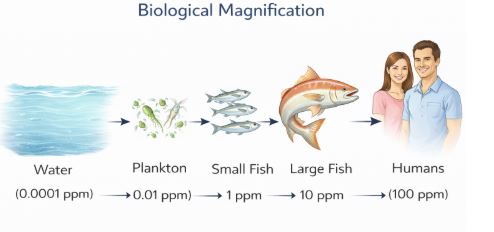
This phenomenon is called Biological Magnification.
5. Environmental Problems: Ozone Depletion
High up in the atmosphere (Stratosphere), there is a layer of gas called Ozone ($O_3$).
Is Ozone good or bad?
– At ground level, Ozone is a deadly poison.
– But high up in the sky, it is a Shield. It protects the Earth from the Sun’s harmful Ultraviolet (UV) radiation. UV rays can cause skin cancer and eye damage (cataracts).
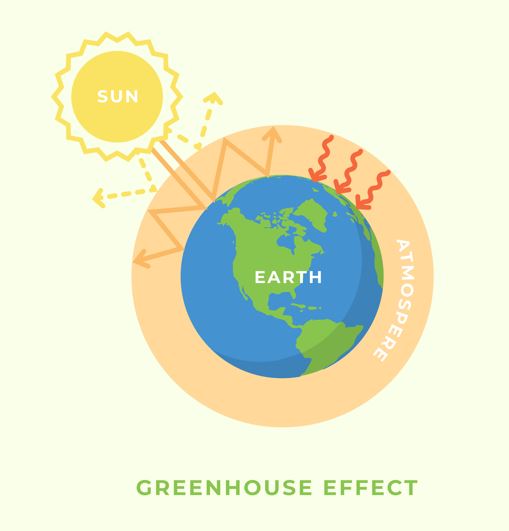
Figure 2: The Ozone Shield. Without it, life on land would be impossible.
5.1 How is Ozone formed?
It’s a natural process involving UV rays:
1. UV splits an Oxygen molecule ($O_2$) into two separate atoms ($O + O$).
2. One single atom ($O$) combines with another molecule ($O_2$) to form Ozone ($O_3$).
5.2 Why is it depleting?
In the 1980s, scientists found a massive hole in the ozone layer over Antarctica. The culprit? Synthetic chemicals called CFCs (Chlorofluorocarbons) used in refrigerators, ACs, and fire extinguishers.
The Solution: In 1987, the United Nations Environment Programme (UNEP) forged an agreement called the Montreal Protocol to freeze CFC production. It worked! The ozone layer is slowly healing today.
6. Waste Management: Cleaning Our Mess
We generate tons of garbage every day. The way we get rid of it matters.
- Biodegradable Waste: Things like vegetable peels, paper, cotton, and wood. Microorganisms (bacteria/fungi) can break them down into harmless substances over time.
- Non-Biodegradable Waste: Things like plastics, glass, and metal cans. Microorganisms cannot break them down. They persist in the environment for hundreds of years, causing pollution and clogging drains.
Responsible Disposal Methods:
1. Biogas Plants: Biodegradable waste is used to produce gas (fuel) and manure.
2. Recycling: Plastic, paper, and metal should be sent to factories to be remade into new products.
3. Composting: Burying kitchen waste in a pit to make fertilizer for your garden.
7. Extensive Practice Set (With Teacher’s Explanations)
Let’s check your understanding with these exam-focused questions.
Part A: Multiple Choice Questions (MCQ)
- Which is an example of a man-made ecosystem?
(a) A river (b) A desert (c) A rice paddy field (d) A rainforestSolution: (c) A rice paddy field.
Reasoning: Rivers, deserts, and forests are natural. A crop field (paddy/wheat) is planted and maintained by humans, making it artificial.
- In the food chain: Grass → Rabbit → Fox, the fox is the:
(a) Producer (b) Primary consumer (c) Secondary consumer (d) DecomposerSolution: (c) Secondary consumer.
Reasoning: Grass = Producer. Rabbit eats grass = Primary Consumer. Fox eats rabbit = Secondary Consumer.
- According to the 10% Law, if a plant has 2,000 J of energy, how much is available to a cow that eats it?
(a) 2,000 J (b) 200 J (c) 20 J (d) 2 JSolution: (b) 200 J.
Reasoning: Only 10% transfers up. 10% of 2000 = (10/100) × 2000 = 200 J.
- The depletion of the ozone layer is mainly caused by:
(a) Carbon dioxide (b) Methane (c) Chlorofluorocarbons (CFCs) (d) Acid rainSolution: (c) Chlorofluorocarbons (CFCs).
Reasoning: CFCs release Chlorine atoms in the upper atmosphere which break down Ozone molecules.
- Which material is non-biodegradable?
(a) A cotton shirt (b) A plastic water bottle (c) A newspaper (d) An apple coreSolution: (b) A plastic water bottle.
Reasoning: Cotton, paper, and fruit are organic and decompose. Plastic is synthetic and persists for centuries.
Part B: Short Answer Questions
- Q: What are the two main components of an ecosystem?
Answer: An ecosystem consists of:
1. Biotic Components: All living organisms like plants, animals, and microorganisms.
2. Abiotic Components: All non-living factors like temperature, soil, rainfall, wind, and minerals. - Q: Why is energy flow in a food chain unidirectional?
Answer: Energy enters the ecosystem from the Sun and is captured by producers. It then flows to consumers. This energy can never go back to the Sun. Similarly, energy eaten by a lion cannot be given back to the deer. Since the energy dissipates as heat at each step and cannot be reused by the previous level, the flow is always one-way (unidirectional).
- Q: What is the role of decomposers?
Answer: Decomposers (bacteria and fungi) are the cleaning agents of nature. They break down dead plants and animals into simple inorganic substances (nutrients). These nutrients mix with the soil and are absorbed by plants again. Without them, the earth would pile up with waste and soil would lose fertility.
Part C: Long Answer Questions
- Q: What is a food web? Explain why it is a more realistic representation than a food chain.
Answer:
A food web is a complex network of interconnected food chains in an ecosystem.
A single food chain (e.g., Grass -> Deer -> Lion) is too simple because in nature, one organism usually eats multiple types of food. For example, a hawk eats snakes, mice, and birds. A snake eats frogs and mice.
A food web captures these multiple connections. It is more realistic because it shows the stability of the ecosystem—if one prey species decreases, the predator can switch to another, preventing the collapse of the system. - Q: What is the “10% Law”? If 1,000,000 J of sunlight is available, calculate the energy for the producer and the tertiary consumer.
Answer:
The 10% Law states that only 10% of the energy is transferred from one trophic level to the next higher level. The remaining 90% is lost as heat or used for metabolism.
Calculation:
Note: Plants usually capture only about 1% of the Sun’s energy falling on them.
1. Sunlight = 1,000,000 J.
2. Producer (Plants): 1% of Sunlight = 10,000 J.
3. Primary Consumer: 10% of 10,000 = 1,000 J.
4. Secondary Consumer: 10% of 1,000 = 100 J.
5. Tertiary Consumer: 10% of 100 = 10 J.
So, the top consumer gets very little energy! - Q: What is biological magnification? Explain how it can be harmful to organisms at the highest trophic level.
Answer:
Biological Magnification is the process where the concentration of harmful, non-biodegradable substances (like pesticides, mercury, or DDT) increases at each successive trophic level.
Why is it harmful?
These chemicals are not digested or excreted; they get stored in body fat. Small organisms consume a little bit. But a larger organism eats many small organisms, collecting all their toxins. By the time it reaches the top level (like humans or eagles), the concentration is lethal. This can cause cancer, organ failure, or thinning of eggshells in birds.
Read Also:
Class 10 Chapter 12- Magnetic Effects of Electric Current
For more check official website of
NCERT