
1. Introduction: The Surprise Discovery | Class 10 Science chapter 12 magnetic effect of electric current notes
Hello students! Welcome to a chapter that bridges two superpowers of physics: Electricity and Magnetism. For centuries, scientists thought these were two completely different things. Electricity was lightning and sparks; magnetism was compasses and finding North.
But in 1820, a Danish physicist named Hans Christian Oersted accidentally discovered something that changed the world. He was performing an experiment with an electric wire, and he noticed that a compass needle kept nearby moved every time he switched the current on.
This was huge! A compass only moves for a magnet. If electricity moved it, that means Electricity creates Magnetism. This connection is called Electromagnetism, and it is the reason we have motors, generators, and speakers today.
2. Magnetic Fields and Field Lines
Before we mix electricity into this, let’s understand magnets properly. Imagine a bar magnet sitting on a table. It has an invisible “aura” or area of influence around it where it can pull iron objects. This invisible area is called a Magnetic Field.
2.1 Visualizing the Invisible
We can’t see the field, but we can draw it using imaginary lines called Magnetic Field Lines. If you sprinkle iron filings around a magnet, they arrange themselves in specific patterns. These patterns are the field lines.
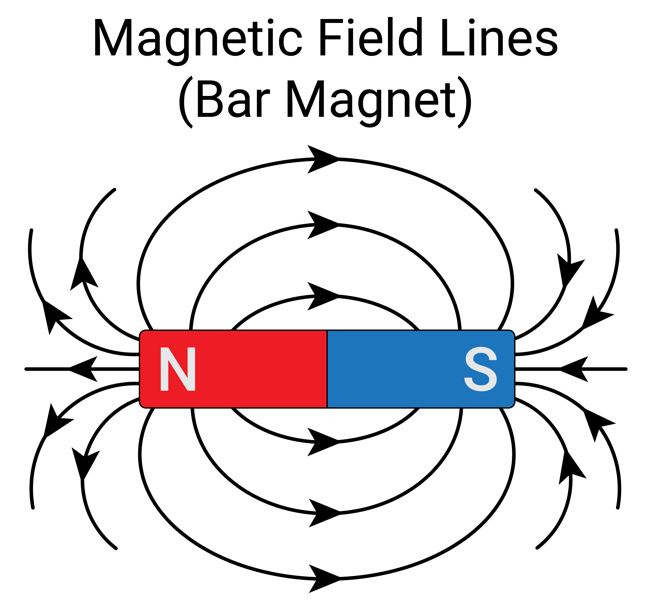
Figure 1: The magnetic field lines of a bar magnet. Notice how they loop from North to South.
2.2 Properties of Magnetic Field Lines
These lines follow strict traffic rules:
- Direction (Outside): They always travel from the North Pole to the South Pole.
- Direction (Inside): Inside the magnet, they travel from South to North. This means they form Closed Loops. (Unlike electric field lines which start and stop).
- Strength: The crowd rule applies here. Where the lines are crowded/closer (at the poles), the magnetic force is Strong. Where they are spread out, the force is Weak.
- No Crossing: Two field lines can NEVER intersect (cross each other). Why? Because if they did, a compass placed at that crossing point would have to point in two directions at once, which is impossible!
3. Magnetic Field Due to a Current-Carrying Conductor
Now, let’s bring Oersted’s discovery back. We know current creates a magnetic field. But what is the shape of that field? It depends on the shape of the wire.
3.1 Field due to a Straight Wire
Imagine a long, straight copper wire carrying current. The magnetic field lines around it are not straight; they are Concentric Circles (circles inside circles) centered on the wire.
The Right-Hand Thumb Rule
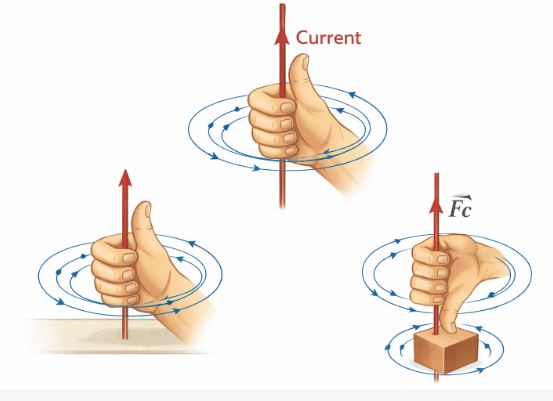
Example: If current flows UP, the field is Anti-Clockwise. If current flows DOWN, the field is Clockwise.
3.2 Field due to a Circular Loop
Now, bend that straight wire into a circle. What happens to the field?
At every point on the wire, there are concentric circles.
– Near the wire, the lines are circular.
– As we move towards the center of the loop, the circles get bigger and bigger.
– At the exact center of the loop, the field lines become straight and parallel.
Note: The magnetic field produced by a current-carrying wire at a given point depends directly on the current passing through it. So, if there is a circular coil having n turns, the field produced is n times as large as that produced by a single turn.
3.3 Field due to a Solenoid (The Electromagnet)
A Solenoid is simply a coil of many circular turns of insulated copper wire wrapped closely in the shape of a cylinder (like a spring).
When you pass current through it, it behaves exactly like a Bar Magnet. One end acts as the North Pole, and the other as the South Pole.
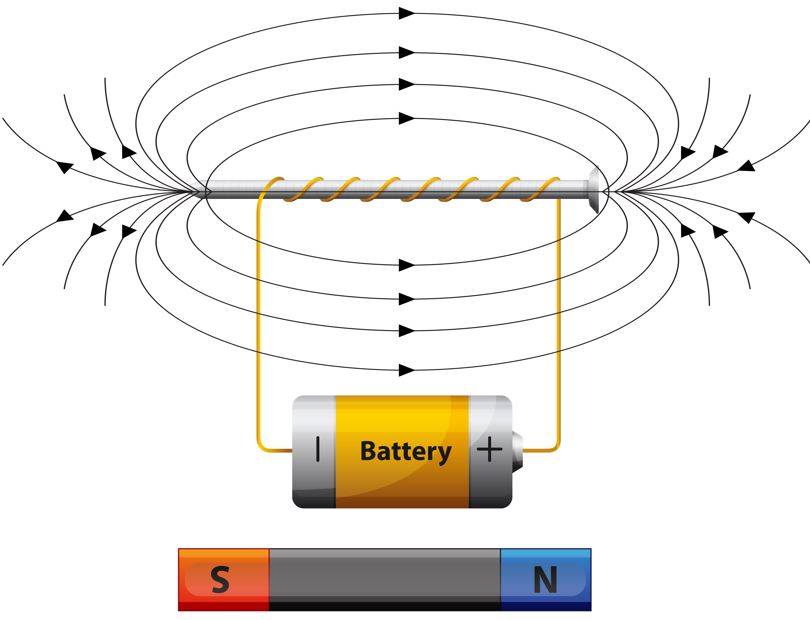
Figure 2: A Solenoid. Notice how the lines inside are straight and parallel.
Important Feature: Uniform Field
Inside the solenoid, the field lines are parallel straight lines. This indicates that the magnetic field is the same (uniform) at all points inside the solenoid.
Making an Electromagnet:
If you place a piece of magnetic material, like Soft Iron, inside the coil, the strong magnetic field magnetizes the iron. This creates an Electromagnet.
– Temporary: It is only a magnet as long as the current is on.
– Strong: It is much stronger than natural magnets. Used in cranes to lift junk cars!
4. Force on a Current-Carrying Conductor
So far, we saw that a current-carrying wire creates a magnetic field. But what happens if we put this wire inside another magnetic field (like between two strong magnets)?
A French scientist, Andre Marie Ampere, suggested that the magnet must exert an equal and opposite force on the current-carrying wire. And he was right!
The Kick: The wire experiences a physical force—it actually moves! This is the principle behind Electric Motors.
Fleming’s Left-Hand Rule
To find the direction of this force (motion), we use our left hand. Stretch your Thumb, Forefinger, and Middle finger so they are perpendicular to each other.
- Forefinger = Field (Magnetic Field – N to S)
- Center Finger = Current (Direction of current)
- Thumb = Thrust (Force/Motion)
Mnemonic: Father (Force), Mother (Magnetic Field), Child (Current).
When is the force maximum?
The displacement of the rod is largest (force is max) when the direction of current is at right angles (90°) to the direction of the magnetic field.
5. Domestic Electric Circuits: Electricity at Home
Now let’s look at how electricity actually comes to our houses. Power plants generate electricity, and it travels through poles to reach our main fuse box.
5.1 The Three Wires
To make wiring safe and standardized, we use color-coded wires:
- Live Wire (Red/Brown): This is the dangerous one. It brings the current from the power station. It is at a high potential of 220 Volts (in India).
- Neutral Wire (Black/Blue): This completes the circuit. It returns the current. It is at nearly 0 Volts potential.
- Earth Wire (Green/Yellow): This is the bodyguard. It is a safety wire connected to a metal plate buried deep in the earth. It is connected to the metal body of appliances (like a fridge or iron). If there is any leakage of current to the metal body, the earth wire sends it safely to the ground, preventing you from getting a severe shock.
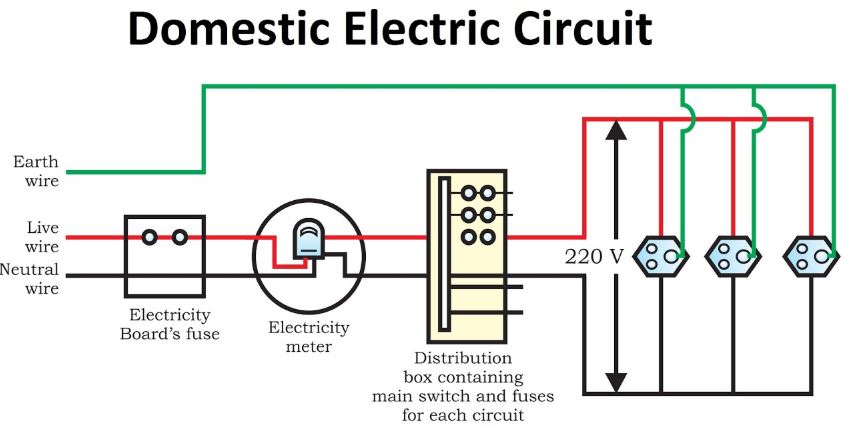
Figure 3: The layout of domestic wiring. Notice the Fuse on the Live wire and the Earthing on the top pin.
5.2 Essential Safety Features
Electricity is useful but dangerous. We use specific setups to stay safe.
1. The Electric Fuse
A fuse is a safety device placed in series with the live wire. It contains a thin wire made of a material with a low melting point (like lead or tin-lead alloy).
How it works: If the current exceeds a safe limit (e.g., 5 Ampere), the fuse wire gets hot (due to Joule’s heating), melts, and breaks the circuit. This stops the current and saves your expensive TV or Fridge from burning out.
2. Parallel Connection
In our homes, all appliances (fans, bulbs, sockets) are connected in Parallel.
Why?
– Independence: If you switch off one light, the others stay on.
– Voltage: Every appliance gets the full 220V voltage it needs to run properly. (In series, voltage would drop).
5.3 Hazards: Short Circuit & Overloading
- Short Circuit: This happens if the Live wire and Neutral wire touch each other directly (maybe the insulation peeled off). The resistance becomes almost zero, causing a massive current flow instantly. This causes sparks and fires.
- Overloading: This happens if you connect too many high-power appliances (AC, Heater, Iron) to a single socket. The total current drawn exceeds the wire’s capacity, causing it to overheat and catch fire.
6. Extensive Practice Set (With Teacher’s Explanations)
Let’s verify your understanding with some questions commonly asked in exams.
Part A: Multiple Choice Questions (MCQs)
- You are looking down at a circular loop with a counter-clockwise current. The magnetic field at the center is:
(a) Downwards (b) Upwards (c) To the left (d) To the rightSolution: (b) Upwards.
Reasoning: Use the Right-Hand Thumb Rule. Curl your fingers in the direction of the current (counter-clockwise). Your thumb points Up (out of the page).
- Which will NOT increase the strength of a solenoid’s magnetic field?
(a) Increasing turns. (b) Increasing current. (c) Inserting a plastic core. (d) Using a soft iron core.Solution: (c) Inserting a plastic core.
Reasoning: Soft iron magnetizes easily and strengthens the field. Plastic is non-magnetic and does nothing. Increasing turns (n) and current (I) both increase field (B).
- An electron moves east into a magnetic field pointing down. The force on it will be towards the:
(a) North (b) South (c) East (d) WestSolution: (b) South.
Reasoning: Careful! An electron is negative. If it moves East, the Conventional Current is West.
Apply Fleming’s Left Hand Rule: Field (Forefinger) = Down. Current (Middle Finger) = West. Thumb points South. - The primary reason for connecting home appliances in parallel is to:
(a) Decrease power use. (b) Ensure all get the same current. (c) Ensure all get the same voltage. (d) Simplify wiring.Solution: (c) Ensure all get the same voltage.
Reasoning: Appliances are designed for 220V. Only parallel connection maintains voltage constant across branches.
- A short circuit occurs when:
(a) A fuse melts. (b) Live and earth wires touch. (c) Live and neutral wires touch. (d) Too many appliances are used.Solution: (c) Live and neutral wires touch.
Reasoning: This direct contact bypasses resistance, leading to massive current flow.
Part B: Short Answer Questions
- Why do two magnetic field lines never intersect?
Answer: The direction of a magnetic field at any point is unique (found by placing a compass). If two lines crossed, it would mean that at the point of intersection, the compass needle would have to point in two different directions at the same time. This is physically impossible. Therefore, field lines never cross.
- What is the function of an earth wire? Why is it necessary to earth metallic appliances?
Answer: The earth wire is a low-resistance safety path connected to the ground. It is necessary for appliances with metallic bodies (like electric irons, toasters, refrigerators).
If the live wire accidentally touches the metal body of the appliance, the current flows through the earth wire to the ground instead of flowing through the user’s body. This prevents a severe electric shock. - A wire carries current vertically upwards. What is the magnetic field direction at a point directly east of it?
Answer: Use the Right-Hand Thumb Rule.
1. Point your thumb Up (direction of current).
2. Curl your fingers around the wire.
3. At a point to the East (right side), your fingers will be curling towards you (Out of the page/North).
Correction for standard map: If Up is vertical, East is right. Curling fingers enters the page at East? No, imagine grasping a pole. On the right side, fingers curl “into” or “away” depending on perspective.
Let’s be precise: Tangent to the circle. At East, the tangent points North.
Part C: Long Answer Questions
- Draw a uniform magnetic field. How can it be created? List two properties.
Answer:
Drawing: Draw a set of parallel, straight lines that are equally spaced.
Creation: A uniform magnetic field is created inside a long, straight, current-carrying Solenoid.
Properties:
1. The field lines are parallel to each other (indicating constant direction).
2. The field lines are equidistant (indicating constant strength everywhere). - Explain short-circuiting and overloading in an electric supply. How does a fuse protect an electric circuit?
Answer:
Short-circuiting: Occurs when the live wire and neutral wire come into direct contact due to damaged insulation. The resistance drops to near zero, causing a huge current to flow, potentially causing fire.
Overloading: Occurs when the total current drawn by all appliances connected to a single circuit exceeds the wire’s current-carrying capacity. This heats up the wire excessively.
Role of Fuse: A fuse is a wire with a low melting point connected in series with the live wire. If current rises above the safe limit (due to short circuit or overload), the heat produced (Joule’s heating) melts the fuse wire. This breaks the circuit, stopping the current and preventing damage or fire. - A proton (positive charge) moves north into a magnetic field pointing up. What is the direction of the force?
Answer:
We use Fleming’s Left-Hand Rule.
1. Current (Center Finger): Since the proton is positive, the direction of current is the same as its motion. So, Current is North.
2. Field (Forefinger): The magnetic field is pointing Up (Vertical).
3. Force (Thumb): Align your left hand. Forefinger Up, Middle finger pointing forward (North). Your thumb will point to the West.
So, the force acts towards the West.