
Chapter 11: Sound
1. Introduction: The World of Vibrations | Sound class 9 NCERT solutions
Welcome to the chapter that explains how we hear the world around us! From the chirping of birds to the music in your headphones, everything is Sound.
But what exactly is sound? In simple terms, Sound is a form of energy which produces a sensation of hearing in our ears. Just like light is energy that helps us see, sound is energy that helps us hear.
The Secret is “Vibration”
If you touch a ringing school bell, your fingers will feel a buzzing sensation. If you touch your throat while singing, you feel it shaking. This shaking is called Vibration.
Vibration means a rapid back-and-forth motion of an object.
The Rule: No vibration = No sound.
When a guitarist plucks a string, the string vibrates. These vibrations bump into air particles, which bump into their neighbors, and eventually, this energy reaches your ear.
2. How Sound Travels: Propagation of Sound
Imagine you are an astronaut on the Moon and your friend is standing 2 meters away. If you shout at him, will he hear you? No! He won’t hear a thing.
This is because sound is “needy.” It needs a material substance to travel through. We call this substance a Medium. A medium can be a solid, a liquid, or a gas.
- Why no sound in space? Space is a vacuum (empty space with no air). Since sound needs particles to bump into each other to travel, it cannot move through a vacuum.
- Mechanical Waves: Sound waves are called mechanical waves because they need material particles (matter) to exist and move. Light, on the other hand, is a non-mechanical wave; it can travel through a vacuum (which is why we can see the sun but can’t hear the explosions on it).
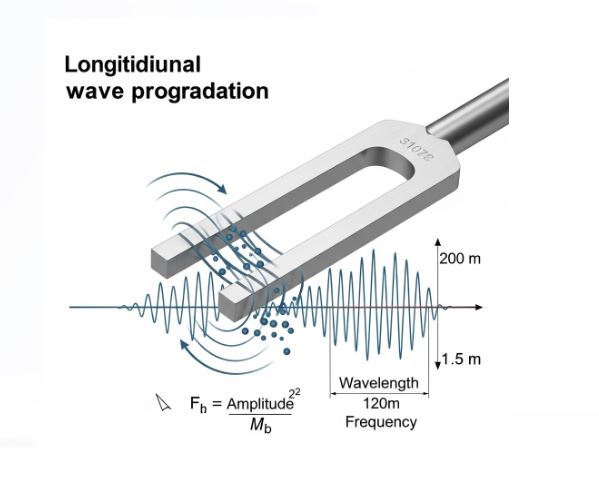
Visualizing Sound: When the prongs of the tuning fork move forward, they push the air particles together (Compression). When they move backward, they create an empty space (Rarefaction).
2.1 Sound as a Longitudinal Wave
There are two main ways waves travel: Transverse and Longitudinal. Sound is a Longitudinal Wave.
What does that mean?
Imagine a line of students waiting for assembly. If the last student pushes the one in front, the push travels forward, but the students themselves just wobble back and forth in their spots. The particles of the medium move parallel to the direction the sound is traveling.
This creates two distinct regions in the air:
- Compression (C): This is the “crowded” zone. Here, particles are pushed close together. The density and pressure are high.
- Rarefaction (R): This is the “relaxed” zone. Here, particles are spread far apart. The density and pressure are low.
So, sound travels as a series of Compressions and Rarefactions.
3. Characteristics of a Sound Wave
We can draw sound waves on a graph to understand them better. Even though sound is longitudinal, we often draw it like a wavy line (sine wave) to measure its properties easily.
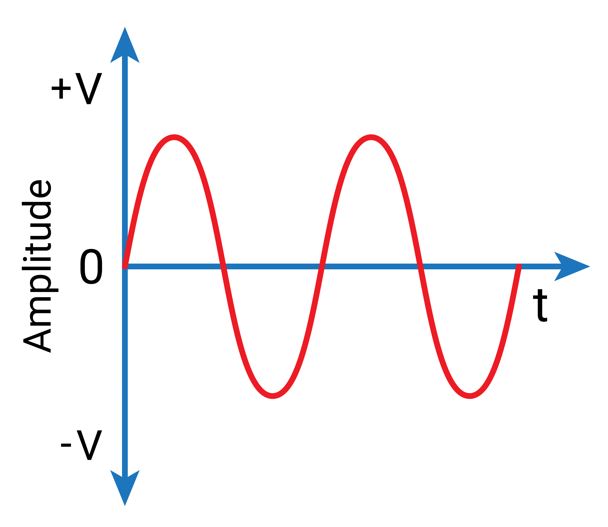
The Anatomy of a Wave: The peaks represent high pressure (Compressions) and the valleys represent low pressure (Rarefactions).
Let’s break down the key terms:
1. Wavelength (λ – Lambda)
This is the length of one complete wave. It is the distance between two consecutive Compressions (peaks) or two consecutive Rarefactions (valleys).
Unit: Meter (m).
2. Frequency (ν – Nu)
This tells us “how frequent” or “how fast” the vibrations are. It is the number of complete waves produced in one second.
Unit: Hertz (Hz).
Connection to Reality: Frequency determines Pitch.
– High Frequency: Whistle, baby’s voice (Shrill sound).
– Low Frequency: Drum beat, lion’s roar (Deep/Bass sound).
3. Time Period (T)
This is the time taken to complete one single oscillation.
Formula: T = 1 / ν (Time Period is the reciprocal of Frequency).
Unit: Second (s).
4. Amplitude (A)
This is the “height” of the wave. It measures how far the particles move from their resting position.
Connection to Reality: Amplitude determines Loudness.
– Large Amplitude: Loud sound (Yelling).
– Small Amplitude: Soft sound (Whispering).
5. Speed of Sound (v)
How fast the sound wave travels. In air at room temperature, it’s about 344 m/s.
The Golden Formula: Speed = Wavelength × Frequency
v = λ × ν
4. Reflection of Sound
You know that light reflects off a mirror. Sound does the same thing! When sound hits a hard surface (like a wall or cliff), it bounces back. This is called the Reflection of Sound.
A. Echo: The Bouncing Sound
If you shout “Hello” in an empty valley, you hear “Hello… hello… hello”. This repetition is an Echo.
The Brain’s Rule: Our brain keeps a sound in memory for 0.1 seconds. If a reflected sound returns before 0.1 seconds, our brain mixes it with the original sound, and we can’t tell them apart. If it returns after 0.1 seconds, we hear it as a distinct Echo.
Calculation for Echo Distance:
Speed = Distance / Time.
Distance = Speed × Time.
Taking speed of sound = 344 m/s and Time = 0.1 s.
Total distance traveled = 344 × 0.1 = 34.4 meters.
Since sound goes to the wall AND comes back, the wall must be half that distance away.
Minimum distance = 34.4 / 2 = 17.2 meters.
B. Reverberation: The Messy Echo
In a large hall, sound bounces off the walls, floor, and ceiling multiple times. These reflections mix together and make the sound last longer, creating a blur. This is called Reverberation.
To fix this, cinema halls use sound-absorbing materials (like heavy curtains, carpets, and cushioned seats) to “eat up” the extra sound.
C. Uses of Multiple Reflection
- Megaphone/Horn: A tube guides the sound waves in one direction by bouncing them off the sides, stopping them from spreading out.
- Stethoscope: Doctors use this to hear your heartbeat. The sound of the heart travels up the tube by reflecting back and forth multiple times until it reaches the doctor’s ears.
- Curved Ceilings: In concert halls, ceilings are curved so that sound reflects and reaches every corner of the audience.
5. Range of Hearing
Humans cannot hear every vibration in the universe. We have a limited range.
- Audible Range: 20 Hz to 20,000 Hz (20 kHz). This is what normal humans hear.
- Infrasound (Below 20 Hz): Sounds that are too low/deep for us to hear.
Examples: Earthquakes produce infrasound before the main shock (that’s why some animals get alerted). Elephants and Whales communicate using infrasound. - Ultrasound (Above 20,000 Hz): Sounds that are too high-pitched for us to hear.
Examples: Bats use ultrasound to navigate in the dark (Echolocation). Dogs can also hear some ultrasound frequencies.
6. Applications of Ultrasound
Ultrasound is not just for bats; it is a super-tool for humans because these high-frequency waves travel in straight lines and don’t bend easily.
- Cleaning: Objects with odd shapes (like spiral tubes or electronic parts) are put in a liquid. Ultrasound waves are sent through the liquid. The high-frequency shaking knocks the dust and grease off.
- Detecting Flaws in Metal: Ultrasound is sent through metal blocks used in buildings. If there is a hidden crack inside, the wave bounces back early, alerting engineers that the metal is defective.
- Echocardiography (ECG): Using ultrasound to get images of the heart.
- Ultrasonography: This is used to see images of internal organs (liver, kidney) and to monitor the growth of a baby (fetus) inside the mother’s womb.
- Lithotripsy (Kidney Stones): Powerful ultrasound waves are used to break kidney stones into fine dust so they can pass out of the body through urine.
- SONAR: (Sound Navigation And Ranging). Ships use this to measure the depth of the ocean or find sunken ships. They send a wave down and measure how long it takes to bounce back from the ocean floor.
7. Detailed Solutions to Practice Set
Here are the complete answers and step-by-step calculations for the questions above.
Part A: Multiple-Choice Questions (MCQs) – Solutions
- Sound waves cannot travel through:
Answer: d) A vacuum
Explanation: Sound is a mechanical wave requiring a material medium (solid, liquid, or gas) to propagate. A vacuum has no particles to transmit the vibration. - The characteristic of a sound that determines its pitch is its:
Answer: c) Frequency
Explanation: Higher frequency equals higher pitch (shrill sound). Amplitude determines loudness, not pitch. - The audible range for a typical human ear is:
Answer: a) 20 Hz to 20,000 Hz
Explanation: This is the standard hearing range for healthy humans. Frequencies outside this range are Infrasound or Ultrasound. - A sound wave has a frequency of 50 Hz and a wavelength of 4 m. What is the speed of the sound wave?
Answer: c) 200 m/s
Explanation: Formula: Speed (v) = Frequency (ν) × Wavelength (λ).
v = 50 Hz × 4 m = 200 m/s. - Reverberation in a large hall is caused by:
Answer: b) Repeated reflections of sound
Explanation: When sound bounces back and forth multiple times from walls and ceilings, it persists in the air. This persistence is reverberation.
Part B: Short Answer Questions – Solutions
- Why are sound waves called longitudinal waves?
Answer: Sound waves are called longitudinal waves because the particles of the medium vibrate back and forth parallel to the direction of propagation of the wave. The disturbance moves in the same direction as the particle motion. - What is the difference between loudness and pitch of a sound?
Answer:- Loudness: Depends on Amplitude. A larger amplitude vibration creates a louder sound. It is the measure of the sound energy reaching the ear per second.
- Pitch: Depends on Frequency. A higher frequency vibration creates a higher pitch (sharper/shriller sound). It distinguishes a shrill sound from a grave/hoarse sound.
- An echo is heard 4 seconds after a person shouts towards a cliff. If the speed of sound is 340 m/s, how far is the cliff from the person?
Answer:
Time taken for echo (t) = 4 s.
Speed of sound (v) = 340 m/s.
The sound travels to the cliff and comes back. So, total distance = 2 × (Distance to cliff).
Formula: Distance (d) = (Speed × Time) / 2
d = (340 × 4) / 2
d = 1360 / 2 = 680 meters. - Give two practical applications of the multiple reflection of sound.
Answer:
1. Stethoscope: Used by doctors to hear heartbeats. The sound undergoes multiple reflections inside the tube to reach the doctor’s ears without fading.
2. Megaphones/Horns: Designed to channel sound in a specific direction by successive reflections, preventing it from spreading out. - What is the difference between infrasound and ultrasound? Give an example of an animal that uses each.
Answer:- Infrasound: Sounds with frequency below 20 Hz. Example animal: Elephants or Whales.
- Ultrasound: Sounds with frequency above 20,000 Hz. Example animal: Bats or Dolphins.
Part C: Long Answer Questions – Solutions
- With the help of a labeled diagram, explain how a vibrating object like a tuning fork produces compressions and rarefactions in the air to create a sound wave.
Answer:
When a tuning fork vibrates, its prongs move back and forth rapidly:
1. Formation of Compression: When the prongs move forward (outward), they push and compress the air in front of them. This creates a region of high pressure and high density called a Compression (C).
2. Formation of Rarefaction: When the prongs move backward (inward), they create a space with fewer air particles. This creates a region of low pressure and low density called a Rarefaction (R).
3. Propagation: As the fork continues to vibrate swiftly, a series of these compressions and rarefactions is generated in the air, creating a sound wave that travels away from the source. - Define the following characteristics of a sound wave:
Answer:- a) Wavelength (λ): The minimum distance in which a sound wave repeats itself. It is the distance between two consecutive centers of compressions or two consecutive centers of rarefactions. SI unit is Meter (m).
- b) Amplitude (A): The maximum displacement of the particles of the medium from their original undisturbed (mean) position. It determines loudness. SI unit is Meter (m).
- c) Time Period (T): The time taken by two consecutive compressions or rarefactions to cross a fixed point. Or, the time taken for one complete oscillation. SI unit is Second (s).
- d) Frequency (ν): The number of complete oscillations (or waves) produced per unit time (per second). SI unit is Hertz (Hz).
- Explain how ultrasound is used in the medical field for imaging internal organs and for breaking kidney stones.
Answer:
Imaging (Ultrasonography): Ultrasound scanner sends high-frequency waves into the body. These waves travel through tissues but reflect (bounce back) when they hit organs or bones with different densities. The machine captures these reflected waves and converts them into an electronic image on a monitor, helping doctors see the liver, gall bladder, or a developing fetus.
Breaking Stones (Lithotripsy): Kidney stones are hard deposits. High-energy ultrasound waves are focused exactly on the stones. The intense energy makes the stones vibrate so violently that they crack and break into fine grains (sand-like powder), which are then easily flushed out of the body through urine. - A person is listening to a tone from a source that is 500 meters away. If the frequency of the sound is 250 Hz and the speed of sound in air is 340 m/s, calculate:
Answer:
Given: Distance (d) = 500 m, Frequency (ν) = 250 Hz, Speed (v) = 340 m/s.a) The wavelength (λ) of the sound wave.
Formula: v = λ × ν
λ = v / ν
λ = 340 / 250 = 1.36 meters.b) The time it takes for the sound to reach the person.
Formula: Time = Distance / Speed
t = 500 / 340
t = 1.47 seconds.c) The time period (T) of the sound wave.
Formula: T = 1 / Frequency
T = 1 / 250
T = 0.004 seconds. - What is an echo? Explain the minimum conditions required to hear a distinct echo. Why are the ceilings and walls of concert halls often covered with sound-absorbent materials?
Answer:
Echo: An echo is the repetition of sound caused by the reflection of sound waves from a hard surface (like a cliff or wall).
Conditions:
1. The time interval between the original sound and the reflected sound must be at least 0.1 seconds.
2. For sound traveling at 344 m/s in air (at 22°C), the minimum distance between the source of sound and the reflecting obstacle must be 17.2 meters.
Sound-Absorbent Materials: Concert halls are covered with carpets and curtains to reduce reverberation. If sound reflects too many times, it becomes garbled and unclear. Absorbent materials absorb the excess reflected sound, ensuring the audience hears the music or speech clearly and crisply.
Read Also:
Class 9 Chapter 10- Work and Energy
For more check official website of
NCERT