
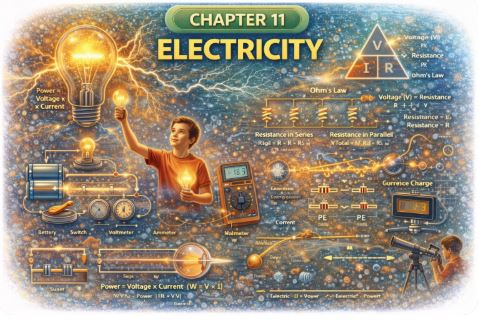
1. Introduction: The Invisible Energy | Class 10 Science Chapter 11 Electricity Notes
Hello students! Welcome to one of the most powerful chapters in science—literally! Look around you. The lights, the fan, your phone charging, the refrigerator humming in the kitchen—none of this would work without Electricity.
But what is electricity? You can’t see it, but you can see what it does. In this chapter, we are going to unmask this invisible force. We will learn how it flows, what stops it, and how we can control it to do useful work for us. Imagine electricity as a team of tiny, invisible runners carrying energy from one place to another. Let’s meet these runners!
2. Electric Current and Circuits
To understand electricity, the best analogy is Water.
Imagine a pipe connected to a tank of water. If you open the tap, water flows. Why? Because water flows from high pressure to low pressure. Similarly, Electric Current is the flow of electric charge through a conductor (like a copper wire).
2.1 What is flowing? (Electric Charge)
Everything is made of atoms. Atoms have electrons (negative charge) and protons (positive charge). In metals like copper or aluminum, some electrons are free to move around. These free electrons are the “runners” we talked about.
- Electric Charge (Q): It is the property of matter that causes electrical force.
– SI Unit: Coulomb (C).
– Value: One electron has a tiny charge of 1.6 × 10⁻¹⁹ C.
– Fun Fact: It takes about 6 × 10¹⁸ electrons to make just 1 Coulomb of charge!
2.2 Electric Current (I)
Current is simply the rate of flow of electric charge. It tells us how many coulombs of charge are passing through a point every second.
Formula: I = Q / t
Where I is Current, Q is Charge, and t is Time.
Unit: Ampere (A).
One Ampere is defined as the flow of 1 Coulomb of charge per second.
Instrument: We measure current using an Ammeter. It is always connected in Series (in line with the wire) so that all the current has to pass through it.
2.3 Direction of Current (The Historical Mistake)
Here is a funny story. When scientists first discovered electricity, they didn’t know about electrons. They thought positive charges moved. So, they decided that current flows from Positive (+) to Negative (-).
Later, we found out they were wrong! It is actually the negative electrons that move from Negative to Positive.
But out of respect for tradition (and to avoid rewriting all books), we still follow the old rule:
– Conventional Current: Positive → Negative.
– Electron Flow: Negative → Positive.
2.4 Electric Circuit
Current is lazy; it won’t flow unless it has a complete, unbroken path back home. This closed loop is called an Electric Circuit.
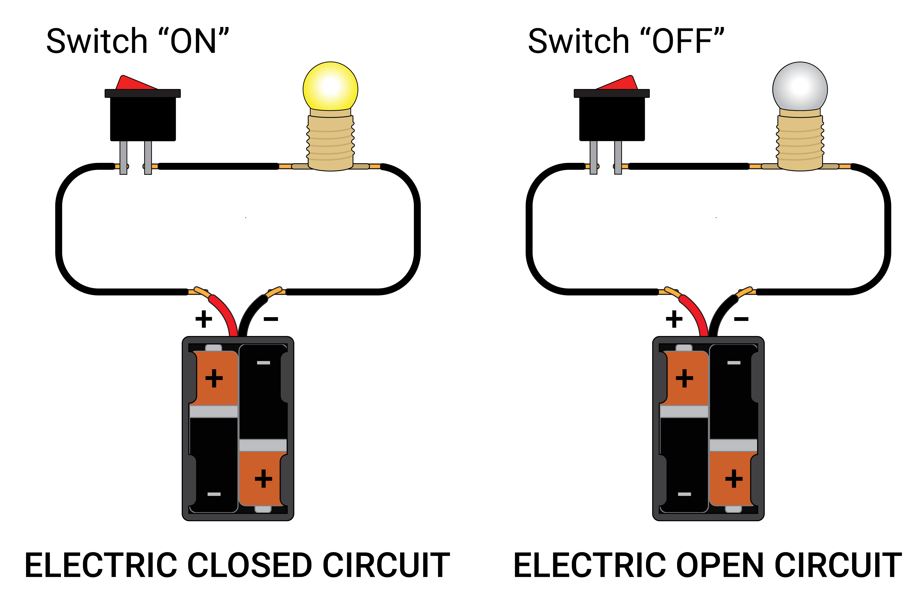
Figure 1: A simple circuit. The battery pushes, the wire carries, the bulb uses, and the switch controls.
- Source: Battery/Cell (Provides energy).
- Load: Bulb/Fan (Uses energy).
- Control: Switch/Key (Breaks or completes the path).
- Conductor: Wire (The road for electrons).
3. Electric Potential and Potential Difference
Water in a flat pipe won’t flow. You need a pump to push it or a height difference. Similarly, electrons in a copper wire won’t move unless there is an “electric pressure” difference.
3.1 Potential Difference (V)
This electric pressure difference is called Potential Difference or Voltage.
Think of a battery. It has a high-pressure side (+) and a low-pressure side (-). This difference forces the electrons to move.
Scientific Definition: Potential difference between two points is the Work Done (W) to move a unit charge (Q) from one point to the other.
Formula: V = W / Q
Unit: Volt (V).
1 Volt = 1 Joule of work done to move 1 Coulomb of charge.
Instrument: We measure this using a Voltmeter. It is always connected in Parallel (across the points) because we want to measure the difference between two points, not the flow through them.
4. Ohm’s Law: The Golden Rule
In 1827, a German physicist named Georg Simon Ohm found a beautiful relationship. He asked: “If I increase the voltage (push), does the current (flow) increase?”
The answer is YES!
4.1 The Statement
Ohm’s Law states: The electric current (I) flowing through a metallic wire is directly proportional to the potential difference (V) across its ends, provided the temperature remains the same.
Mathematically: V ∝ I
Or: V = I × R
Here, R is a constant called Resistance.
4.2 What is Resistance?
Imagine running through a crowded market. You bump into people, you slow down.
Resistance is exactly that. As electrons rush through a wire, they bump into the atoms of the wire. This collision opposes their flow. This property of opposing current is called Resistance.
Unit: Ohm (symbol: Ω – Omega).
4.3 Factors Affecting Resistance
Why do some wires get hot and others don’t? Why use copper and not iron? Resistance depends on four things:
Short Wire
Low Resistance
Long Wire
High Resistance (More bumps!)
Thick Wire
Low Resistance (Wide road)
Thin Wire
High Resistance (Narrow road)
Figure 2: Visualizing how length and thickness change resistance.
- Length (l): Longer wire = More atoms to bump into = More Resistance. (R ∝ l)
- Area of Cross-section (A): Thicker wire = More space to pass = Less Resistance. (R ∝ 1/A)
- Nature of Material: Copper has low resistance; Nichrome has high. This intrinsic property is called Resistivity (ρ).
- Temperature: For metals, higher temperature = atoms vibrate more = more collisions = higher resistance.
Combining these, we get the resistivity formula: R = ρ (l / A).
5. Resistors in Series and Parallel
In real life, we use many resistors (bulbs, fans) together. We can connect them in two ways.
5.1 Series Combination (The Chain)
Think of holding hands in a human chain. If one person lets go, the whole chain breaks.
- Connection: End-to-end.
- Current: Same current flows through every resistor (One path).
- Voltage: The total voltage gets divided among the resistors.
- Total Resistance (Rs): It simply adds up.
Rs = R1 + R2 + R3 - Disadvantage: If one bulb fuses, the whole circuit stops working (like old Diwali lights).
5.2 Parallel Combination (The Ladder)
Think of a ladder. You can climb up using the left rail or the right rail. Multiple paths.
- Connection: All heads connected together, all tails connected together.
- Voltage: Same voltage across every resistor (Full battery power for everyone!).
- Current: The current divides into different branches.
- Total Resistance (Rp): The reciprocal adds up.
1/Rp = 1/R1 + 1/R2 + 1/R3
Note: The total resistance in parallel is always less than the smallest resistor. - Advantage: This is how our homes are wired. If you switch off the fan, the TV still works!
R1 — R2 — R3
One Path
|— R1 —|
|— R2 —|
Multiple Paths
6. Heating Effect of Electric Current
Have you touched your phone charger after it’s been plugged in for a while? It feels warm. Why?
When electrons travel through a wire, they collide with atoms. These collisions create friction, and just like rubbing your hands together creates heat, this electrical friction generates heat. This is called Joule’s Heating Effect.
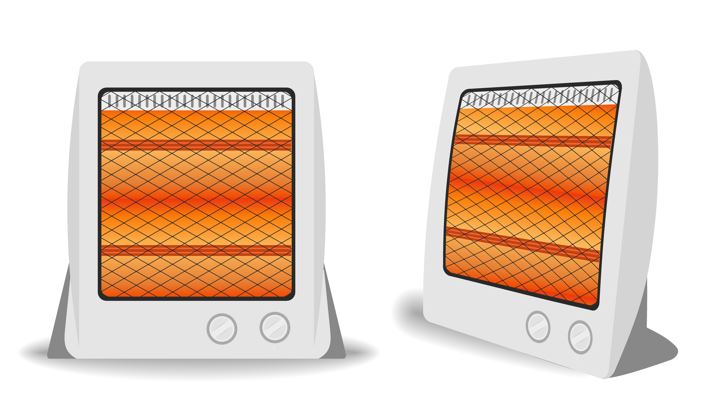
Figure 3: A toaster uses the heating effect intentionally. The nichrome wire gets red hot to toast your bread.
6.1 Joule’s Law of Heating
James Prescott Joule found that the Heat (H) produced depends on three things:
- Current (I): More current = More collisions = More heat. (H ∝ I²)
- Resistance (R): More resistance = More friction = More heat. (H ∝ R)
- Time (t): Longer time = More heat accumulated. (H ∝ t)
Formula: H = I² R t
6.2 Applications
- Electric Iron/Toaster: We use high-resistance alloys like Nichrome because they get very hot without melting or burning (oxidizing).
- Electric Bulb: We use a thin Tungsten filament. It gets so hot (2500°C) that it emits light! Tungsten is used because it has a very high melting point.
- Fuse: A safety device. It is a thin wire with a low melting point. If current gets too high (dangerous), the fuse wire heats up, melts, and breaks the circuit, saving your expensive TV!
7. Electric Power: The Bill You Pay
When you buy a bulb, you ask for a “10 Watt” or “20 Watt” bulb. What is this?
Electric Power (P) is the rate at which electrical energy is consumed. It tells you how “hungry” an appliance is.
Formulas:
1. P = V × I (Basic formula)
2. P = I² × R (Using Ohm’s law)
3. P = V² / R (Useful for parallel circuits)
SI Unit: Watt (W).
1 Watt = 1 Volt × 1 Ampere.
7.1 Commercial Unit of Energy
The “Watt” is too small for real life. For houses, we use the Kilowatt-hour (kWh).
What is 1 kWh?
If you run a 1000 Watt (1 kW) heater for 1 Hour, you consume 1 kWh of energy.
Commonly, we call 1 kWh simply “1 Unit” on your electricity bill.
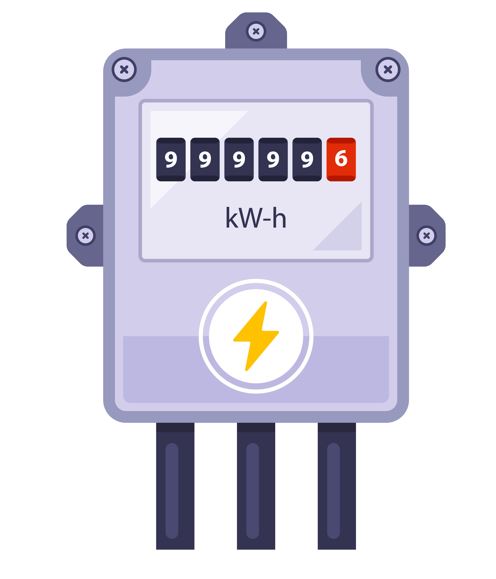
Figure 4: Your home electricity meter measures energy in kWh, not Joules.
Conversion to Joules:
1 kWh = 1000 Watts × 3600 Seconds
1 kWh = 3.6 × 10⁶ Joules.
8. Practice Questions & Solutions
Let’s test your knowledge with some exam-style questions.
Part A: Multiple Choice Questions (MCQ)
- If a wire’s length is doubled and its area is halved, its resistance will:
(a) Halve (b) Double (c) Become four times (d) Remain unchangedSolution: (c) Become four times.
Reasoning: R ∝ l/A. If l becomes 2l and A becomes A/2, then R_new ∝ (2l)/(A/2) = 4(l/A) = 4R.
- Three resistors of 2Ω, 4Ω, and 6Ω are in parallel. The equivalent resistance will be:
(a) 12Ω (b) Less than 2Ω (c) More than 6Ω (d) Between 4Ω and 6ΩSolution: (b) Less than 2Ω.
Reasoning: In parallel combination, the equivalent resistance is always less than the smallest individual resistor (which is 2Ω here).
- The unit kilowatt-hour (kWh) is the unit of:
(a) Power (b) Electric Charge (c) Electrical Energy (d) CurrentSolution: (c) Electrical Energy.
Reasoning: Power × Time = Energy. kW is power, h is time.
- If the current through a resistor is doubled, the heat produced becomes:
(a) Half (b) Double (c) Four times (d) Sixteen timesSolution: (c) Four times.
Reasoning: H = I²Rt. Heat is proportional to the square of current. If I becomes 2I, H becomes (2)² = 4 times.
- A voltmeter is always connected in:
(a) Series (b) Parallel (c) Either (d) A combinationSolution: (b) Parallel.
Reasoning: Voltmeter measures potential difference between two points, so it must be connected across those two points.
Part B: Short Answer Questions
- Q: What is the difference between an open and a closed circuit?
Answer:
Closed Circuit: The path is complete and unbroken (Switch is ON). Current flows, and the device works.
Open Circuit: The path is broken somewhere (Switch is OFF or wire is cut). Current cannot flow, and the device stops. - Q: Why are alloys like nichrome used in heating devices instead of pure metals?
Answer: Two main reasons:
1. High Resistivity: Alloys have higher resistance than pure metals, so they produce more heat.
2. High Melting Point & Non-oxidizing: They don’t burn or melt easily even at red-hot temperatures, making them durable for heaters and irons. - Q: An electric bulb is rated ‘220 V, 100 W’. What does this mean?
Answer: It acts as a label for the bulb’s appetite. It means that if you connect this bulb to a standard household supply of 220 Volts, it will consume electrical energy at the rate of 100 Joules per second (100 Watts).
Part C: Long Answer Questions (Numerical Solving)
- Q: Two resistors (10Ω, 20Ω) are in parallel, then connected in series with a 5Ω resistor and a 12V battery. Find (a) R_parallel, (b) R_total, (c) total current.
Answer:
(a) Resistance of Parallel part (Rp):
Formula: 1/Rp = 1/R1 + 1/R2
1/Rp = 1/10 + 1/20 = (2+1)/20 = 3/20.
Rp = 20/3 ≈ 6.67 Ω.(b) Total Resistance (Rt):
Now, Rp is in series with the 5Ω resistor.
Rt = Rp + R3 = 6.67 + 5 = 11.67 Ω.(c) Total Current (I):
Ohm’s Law: I = V / Rt
I = 12 V / 11.67 Ω ≈ 1.03 A. - Q: Derive the expression for equivalent resistance of three resistors in series.
Answer:
Consider three resistors R1, R2, and R3 connected in series.
1. In series, the Current (I) is the same through all.
2. The Voltage (V) is divided. So, Total V = V1 + V2 + V3.
3. Apply Ohm’s Law (V=IR) to each:
V1 = I×R1, V2 = I×R2, V3 = I×R3.
4. Substitute into the voltage equation:
V = I×R1 + I×R2 + I×R3
5. Let Rs be the equivalent resistance. Then V = I×Rs.
I×Rs = I(R1 + R2 + R3)
Cancel ‘I’ from both sides:
Rs = R1 + R2 + R3. - Q: An electric iron of resistance 50Ω is connected to a 220V source. Calculate the heat developed in 1 minute.
Answer:
Given: R = 50 Ω, V = 220 V, Time t = 1 min = 60 seconds (Always convert to SI units!).Step 1: Find Current (I).
I = V / R = 220 / 50 = 4.4 A.Step 2: Find Heat (H).
Formula: H = I² R t
H = (4.4)² × 50 × 60
H = 19.36 × 3000
H = 58,080 Joules.
(Alternatively, use H = (V²/R)t -> (220*220/50)*60 = 58,080 J).
Read Also:
Class 10 Chapter 10- The Human Eye and the Colourful World
For more check official website of
NCERT