
Chapter 10: Work and Energy
Start Chapter MCQ QuizSimplified Notes: Work and Energy class 9 NCERT solutions
Class 9 Science Notes | Chapter 10 | Complete Guide with Solutions
1. Introduction: The Driving Forces of the Universe| Work and Energy class 9 NCERT solutions
Welcome to one of the most interesting chapters in Physics! In the previous chapters, we talked about how things move (Motion) and why they move (Force). Now, we are going to look at the “currency” that makes everything in the universe happen. That currency is Energy.
Think about your own body. You need food to run, study, or even sleep. Machines like cars need fuel (petrol or diesel) to move. Even your mobile phone needs a battery charge to work. In all these cases, there is a hidden requirement: Energy.
In this chapter, we will connect two very important words: Work and Energy. In our daily life, we use these words loosely. We say, “I worked hard for the exam,” or “I don’t have the energy to talk.” But in Science, these words have very strict and specific definitions. Let’s dive in and understand what they really mean in the language of Physics.
2. Work: More Than Just Effort
This is where things get a bit tricky compared to real life. Imagine you are standing in front of a giant wall. You push it with all your strength for 2 hours. You are sweating, you are tired, and your muscles are aching. In real life, you worked hard. But in Physics, you have done ZERO WORK.
Why? Because the wall didn’t move.
The Scientific Definition of Work | NCERT work and energy class 9
For work to be considered “done” in science, two specific conditions must be satisfied simultaneously:
- A Force must act: You must push or pull an object.
- Displacement must happen: The object must actually move from its original position in the direction of the force (or at least have a component of movement in that direction).
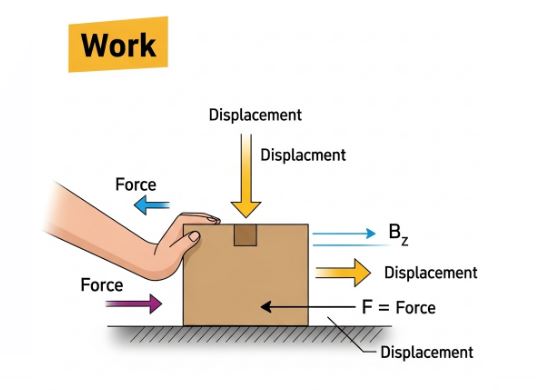
Notice in the image: The person applies Force (F) and the box actually moves distance (s). This is Work.
The Formula of Work
Mathematically, we define work as the product of the force applied and the displacement produced.
Work (W) = Force (F) × Displacement (s)
The Unit of Work: Since Force is measured in Newtons (N) and Displacement in meters (m), the unit of work is Newton-meter (Nm). We call this the Joule (J).
Definition of 1 Joule: 1 Joule is the amount of work done when a force of 1 Newton moves an object by 1 meter.
Types of Work
Work isn’t always just “done.” Depending on the direction of force and movement, work can be positive, negative, or even zero.
- Positive Work (+W): This happens when the force helps the motion.
Example: A horse pulling a cart. The horse pulls forward, and the cart moves forward. The angle between force and displacement is 0°. - Negative Work (-W): This happens when the force opposes the motion.
Example: Friction. When you slide a book on a table, the book moves forward, but friction acts backward to stop it. Here, friction does negative work. Similarly, when you apply brakes in a car, the force is opposite to the motion. - Zero Work (0): This is the most interesting one. Work is zero if:
- The displacement is zero (pushing a wall).
- The force acts at a 90-degree angle (perpendicular) to the motion.
Classic Example: A porter carrying a heavy load on his head and walking on a straight platform.
Why? The force he applies is UPWARD (to hold the box against gravity). His movement is FORWARD. The angle is 90°. In physics, Force perpendicular to motion does no work on the object!
3. Energy: The Capacity to Do Work
If Work is the action, Energy is the bank balance that allows you to do that action. You cannot do work if you don’t have energy.
Definition: Energy is the capacity or ability to do work.
Unit: Since energy is just “stored work,” it has the same unit: Joule (J).
Energy acts like a shapeshifter; it exists in many forms: Light energy, Heat energy, Chemical energy, Electrical energy, etc. However, in this chapter, we focus on Mechanical Energy, which is the sum of Kinetic Energy and Potential Energy.
3.1 Kinetic Energy (Eₖ)
The word “Kinetic” comes from the Greek word “kinesis,” which means motion. Kinetic Energy is the energy an object has because it is moving.
- A stationary cricket ball has no kinetic energy.
- A fast-moving cricket ball can hurt you because it has a lot of kinetic energy (it can do work on your hand).
The Formula:
Eₖ = ½ mv²
Where ‘m’ is mass and ‘v’ is velocity.
Critical Insight: Notice that velocity (v) is squared. This means velocity is very important. If you double the mass of a car, its energy doubles. But if you double the speed of a car, its energy becomes four times (2² = 4). This is why high-speed accidents are so dangerous.
3.2 Potential Energy (Eₚ)
Potential Energy is “stored” energy. It is the energy an object has due to its position or shape.
1. Potential Energy due to Position (Gravitational PE):
When you lift a stone from the ground to the roof, you do work against gravity. This work gets stored in the stone as Gravitational Potential Energy. If you drop it, that stored energy turns back into motion.
The Formula: Eₚ = mgh
(mass × gravity × height)
2. Potential Energy due to Shape (Elastic PE):
When you stretch a rubber band or the string of a bow, you distort its shape. You do work to stretch it. This energy sits inside the bow. The moment you release the string, that stored potential energy shoots the arrow forward (turning into Kinetic Energy).
4. Law of Conservation of Energy
The Universe is very strict about its energy accounts. It never loses energy, and it never creates new energy from nothing.
The Law States: Energy can neither be created nor destroyed. It can only change from one form to another. The total energy of an isolated system remains constant.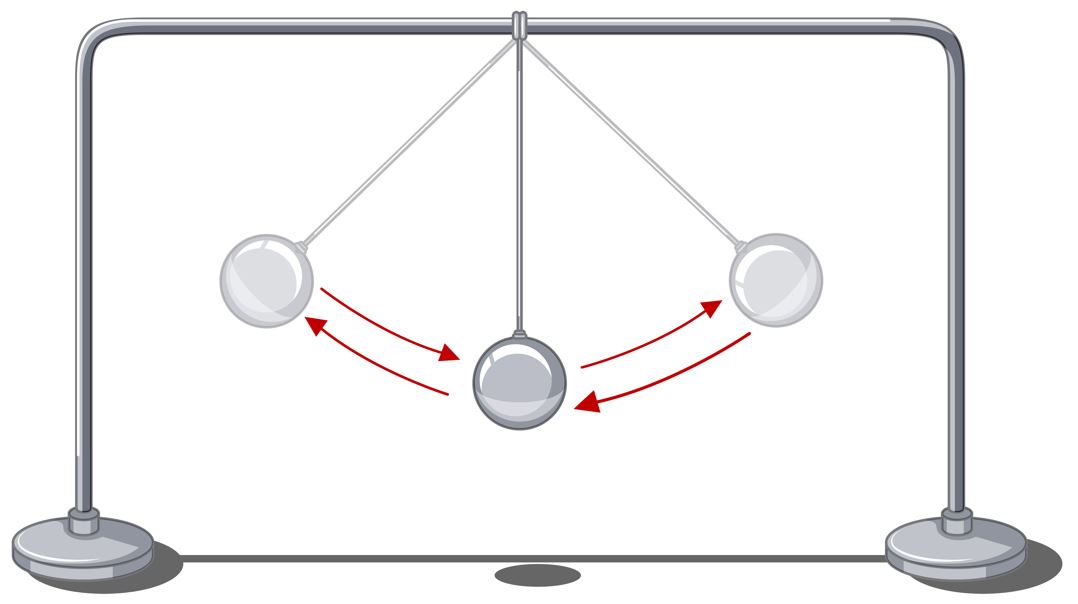
The Pendulum Example: Look at the image above.
1. At the extreme ends (Highest points): The bob stops for a micro-second. Velocity is zero, so Kinetic Energy is zero. But Height is maximum, so Potential Energy is Maximum.
2. At the center (Lowest point): The bob is moving fastest. Velocity is maximum, so Kinetic Energy is Maximum. Height is zero (lowest point), so Potential Energy is minimum.
3. In between: Energy is a mix of both. But at any point, PE + KE = Constant.
Real Life Note: You might ask, “If energy is conserved, why does the pendulum eventually stop?” The answer is air resistance (friction). The mechanical energy is slowly converted into heat energy (warming up the air slightly) and sound energy. The energy didn’t disappear; it just leaked out into the environment.
5. Power: The Rate of Doing Work
Imagine two students, A and B. Both have to lift ten 20kg boxes to the roof.
Student A does it in 5 minutes.
Student B takes 20 minutes.
Both did the same work (lifted same weight to same height). But Student A is more powerful. Why? Because he did it faster.
Definition: Power is the rate of doing work. It tells us how fast energy is being used.
Formula: Power (P) = Work (W) / Time (t)
Unit: The unit is Joules per second (J/s), which is called the Watt (W), named after James Watt.
- 1 Watt = 1 Joule per second. (This is very small).
- 1 Kilowatt (kW) = 1000 Watts.
Commercial Unit of Energy
The Joule is a very tiny unit. Using it for household electricity bills would result in huge numbers. So, we use a bigger unit called the Kilowatt-hour (kWh).
1 Unit of electricity (on your bill) = 1 kWh.
This means running a 1000 Watt appliance for 1 Hour.
Conversion to Joules:
1 kWh = 1000 W × 3600 seconds = 3,600,000 Joules = 3.6 × 10⁶ J.
6. Detailed Solutions to Practice Set
Here are the complete answers and explanations for the questions listed in the practice set.
Part A: Multiple-Choice Questions (MCQs) – Solutions
- In which of the following cases is scientific work being done?
Answer:d) A horse pulling a cart.
Explanation:- (a) Studying involves mental effort but no displacement of an object by physical force. Work = 0.
- (b) Holding a box implies displacement is zero. Work = 0.
- (c) Pushing a wall implies displacement is zero. Work = 0.
- (d) The horse applies force, and the cart moves in the direction of force. This is scientific work.
- An object of mass 10 kg is moving with a velocity of 4 m/s. What is its kinetic energy?
Answer: b) 80 J
Explanation: Formula: Eₖ = ½mv².
Mass (m) = 10 kg, Velocity (v) = 4 m/s.
Eₖ = ½ × 10 × (4)² = 5 × 16 = 80 J. - The energy possessed by a stretched bow is an example of:
Answer: c) Potential energy due to configuration
Explanation: When a bow is stretched, its shape (configuration) is changed. Work is done to distort it, which is stored as elastic potential energy. It is not kinetic (not moving yet) and not gravitational (height didn’t change). - A 2000 W engine runs for 10 seconds. How much work does it do?
Answer: b) 20,000 J
Explanation: Power = Work / Time. Therefore, Work = Power × Time.
Work = 2000 W × 10 s = 20,000 Joules. - According to the law of conservation of energy, during an energy transformation:
Answer: c) The total energy remains constant.
Explanation: Energy is never lost or created; it just changes form (e.g., from potential to kinetic). The sum total remains the same.
Part B: Short Answer Questions – Solutions
- Define 1 joule of work.
Answer: 1 Joule is defined as the amount of work done on an object when a force of 1 Newton displaces the object by 1 meter along the line of action of the force. (1 J = 1 N × 1 m). - A porter lifts a suitcase weighing 20 kg from the ground and puts it on his head 1.8 m above the ground. Calculate the work done by the porter on the suitcase. (Take g = 10 m/s²)
Answer:
Mass (m) = 20 kg
Displacement/Height (h) = 1.8 m
Gravity (g) = 10 m/s²
The work done against gravity is calculated as: W = m × g × h
W = 20 × 10 × 1.8
W = 200 × 1.8 = 360 Joules. - What is the difference between kinetic energy and potential energy? Give one example of each.
Answer: Kinetic Energy (KE) Potential Energy (PE) Energy possessed by an object due to its motion. Energy possessed due to position or shape. Example: A running car, flowing water. Example: Water stored in a dam (high position), compressed spring. - Define power and state its SI unit.
Answer: Power is defined as the rate of doing work or the rate at which energy is transferred.
Formula: Power = Work / Time.
The SI unit of power is the Watt (W). - A freely falling object eventually stops upon reaching the ground. What happens to its kinetic energy? Does this violate the law of conservation of energy? Explain.
Answer: When the object hits the ground, its kinetic energy does not disappear. It is converted into other forms of energy, primarily:
1. Sound Energy: (The thud sound).
2. Heat Energy: (The ground and the object get slightly warm due to impact).
3. Deformation: (Changing the shape of the ground or object).
This does not violate the law of conservation of energy because the energy was simply transformed, not destroyed.
Part C: Long Answer Questions – Solutions
- A car of mass 1200 kg is moving at a velocity of 36 km/h. Brakes are applied, and it stops after traveling 10 m.
a) Calculate the initial kinetic energy of the car.
First, convert velocity to SI units (m/s): 36 km/h = 36 × (5/18) = 10 m/s.
Mass (m) = 1200 kg.
KE = ½mv² = ½ × 1200 × (10)² = 600 × 100 = 60,000 Joules (or 60 kJ).
b) Calculate the work done by the brakes to stop the car.
According to the Work-Energy Theorem, Work done = Change in Kinetic Energy.
Final KE = 0 (since it stops).
Initial KE = 60,000 J.
Work Done = Final KE – Initial KE = 0 – 60,000 = -60,000 Joules.
(The negative sign indicates the work is done against the motion).
c) Calculate the magnitude of the force applied by the brakes.
Work (W) = Force (F) × Displacement (s)
Ignoring the negative sign for magnitude: 60,000 = F × 10
F = 60,000 / 10 = 6,000 Newtons. - State the law of conservation of energy. Illustrate this law using the example of a simple pendulum.
Answer:
Statement: Energy can neither be created nor destroyed, but can only be transformed from one form to another. The total energy of an isolated system is constant.
Illustration (Simple Pendulum):- Position A (Mean/Center position): The pendulum bob is at the lowest height but moving at maximum speed. Here, Potential Energy (PE) is minimum (0), and Kinetic Energy (KE) is maximum.
- Position B & C (Extreme positions): As the bob swings up, its speed decreases but height increases. KE converts into PE. At the extreme top point, it stops momentarily. Here, KE is zero, and PE is maximum.
- Downward Swing: As it falls back down, PE converts back to KE.
At all points, Total Energy = PE + KE = Constant. - A boy of mass 40 kg runs up a flight of 50 stairs, each 20 cm high, in 10 seconds. Calculate:
a) The work done by the boy against gravity.
Mass (m) = 40 kg.
Total Height (h) = Number of stairs × Height of one stair
h = 50 × 20 cm = 1000 cm = 10 meters.
Work (W) = mgh = 40 × 10 × 10 = 4000 Joules.
b) The power developed by the boy.
Power (P) = Work / Time
Time (t) = 10 s.
P = 4000 J / 10 s = 400 Watts. - Explain with examples when the work done by a force is (a) positive, (b) negative, and (c) zero.
Answer:- (a) Positive Work: When force and displacement are in the same direction.
Example: Kicking a football. The force of the kick and the motion of the ball are in the same direction. - (b) Negative Work: When force and displacement are in opposite directions (angle 180°).
Example: A goalkeeper catching a ball. The ball is moving towards the goal, but the goalkeeper applies force in the opposite direction to stop it. The work done by the goalkeeper is negative relative to the ball’s motion. Also, friction always does negative work. - (c) Zero Work: When force and displacement are perpendicular (angle 90°), or displacement is zero.
Example: The Earth revolving around the Sun. The gravitational force acts towards the center (Sun), but the Earth moves tangentially (sideways). The angle is 90°, so work done by gravity is zero.
- (a) Positive Work: When force and displacement are in the same direction.
- An object of mass 10 kg is dropped from a height of 5 m. Complete the following table. (Take g = 10 m/s²)
Calculations: Total Energy is constant at all points = mgh (at top) = 10×10×5 = 500 J.
Height (m) Potential Energy (PE = mgh) Kinetic Energy (KE = Total – PE) Total Energy (TE) 5 10×10×5 = 500 J 500 – 500 = 0 J 500 J 3 10×10×3 = 300 J 500 – 300 = 200 J 500 J 0 (Just before hitting ground) 10×10×0 = 0 J 500 – 0 = 500 J 500 J
Read Also: Class 9 Chapter 9- Gravitation
For more check official website of NCERT