1. Introduction: The World Through Our Natural Lens | Class 10 Science Chapter 10 Human Eye and Colourful World Notes
Hello students! Welcome to one of the most beautiful chapters in physics. In the previous chapter, we learned about lenses, mirrors, and how light bends. That was all about glass and plastic. But did you know you carry two of the most sophisticated cameras in the world right in your head? Yes, your Human Eyes!
The human eye is an incredibly sensitive instrument. It allows us to see the vibrant colors of a rainbow, the sparkle of a star, and the words on this page. Without eyes, the world would just be a concept, not a visual reality. In this chapter, we will open up the machinery of the eye to see how it works, what goes wrong when we need glasses, and then we will step outside to look at rainbows and sunsets.
Part 1: The Human Eye – How Does It Work?
Think of your eye as a high-tech camera. It has a lens, a shutter (the eyelid), an aperture (the pupil), and a film sensor (the retina). Let’s take a tour of its parts.
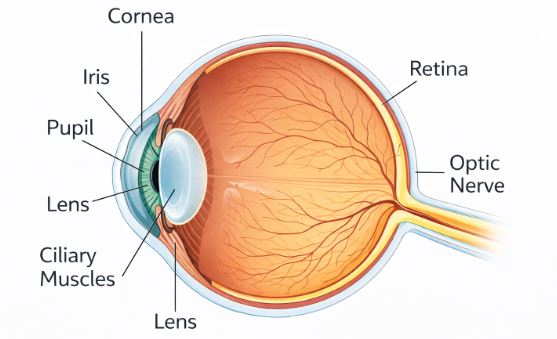
Figure 1: The Anatomy of the Human Eye. Light enters from the left and focuses on the back.
1.1 Anatomy of the Eye (The Parts)
Let’s break down the eye part by part, from the outside in:
1. Cornea (The Windshield)
This is the transparent, bulging outer layer at the very front of your eye. Think of it as the clear glass on a watch. Its main job is to protect the eye, but scientifically, it does most of the refraction (bending of light). Light enters here first.
2. Iris (The Curtain)
Behind the cornea is a dark, muscular diaphragm called the Iris. This is the part that gives your eye its color (Blue, Brown, Green). It acts like a curtain.
3. Pupil (The Window)
Look in the mirror. See that black dot in the center? That’s actually a hole! It looks black because no light comes back out of it. The Iris controls the size of this hole.
– Bright Light: The Iris expands, making the pupil small (so you don’t get blinded).
– Dim Light: The Iris contracts, making the pupil large (to let more light in).
4. Crystalline Lens (The Autofocus)
Behind the pupil sits a jelly-like, convex lens. Unlike glass lenses, this one is flexible! It can change its shape to focus on things near or far. This flexibility is key to our vision.
5. Ciliary Muscles (The Mechanics)
These muscles hold the lens in place. They are the workers that squeeze or relax the lens to change its shape.
6. Retina (The Screen)
This is the most important part at the very back of the eye. It acts like the film in a camera. It contains millions of light-sensitive cells:
– Rods: Help us see in dim light (Black & White).
– Cones: Help us see color and detail in bright light.
7. Optic Nerve (The Cable)
It carries the electrical signals from the Retina to the Brain. The brain then interprets these signals as an image.
1.2 Power of Accommodation
Have you ever tried to take a photo of a flower very close up, and the background gets blurry? Or focused on a mountain, and the flower gets blurry? A camera needs to move its lens back and forth to focus.
Your eye is smarter. It doesn’t move the lens; it changes the shape of the lens. This ability is called the Power of Accommodation.
How does it work?
1. Seeing Distant Objects (Relaxed Mode):
When you look at a star or a distant tree, the ciliary muscles relax. The lens becomes thin. A thin lens has a long focal length, perfect for focusing distant light onto the retina.
2. Seeing Nearby Objects (Active Mode):
When you read a book, the ciliary muscles contract. They squeeze the lens, making it thick and round. A thick lens has a short focal length, bending light strongly to focus the nearby text onto the retina.
Limits of Vision:
– Near Point: The closest distance you can see clearly without strain is about 25 cm for a normal adult. If you bring a book closer than this, it gets blurry because the lens cannot bulge any further.
– Far Point: The farthest distance you can see. For a normal eye, this is Infinity (we can see stars!).
Part 2: Defects of Vision – Why We Need Glasses
Sometimes, the eye loses its ability to focus perfectly. The lens might become too stiff, or the eyeball might be too long or too short. This leads to refractive defects. Let’s study the big three.
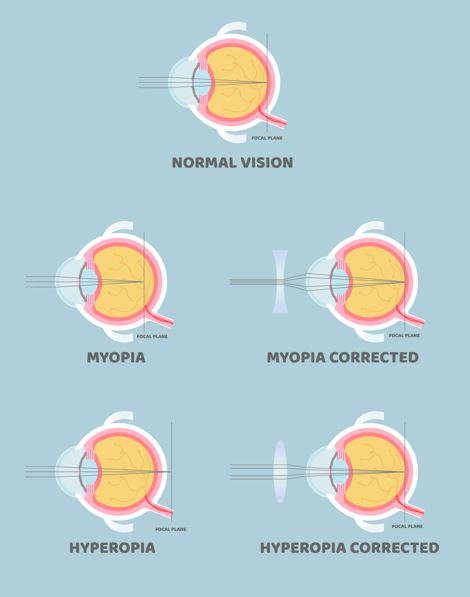
Figure 2: Visualizing Eye Defects. Top: Myopia (Near-sighted). Bottom: Hypermetropia (Far-sighted).
1. Myopia (Near-Sightedness)
The Problem: A person with Myopia can see nearby objects clearly (like reading a phone screen) but distant objects are blurry (like reading the blackboard from the back bench).
The Physics Cause:
1. The eyeball is too long.
2. Or, the eye lens is too curved (too strong).
Because of this, the light from distant objects bends too much and focuses in front of the retina instead of on it.
The Fix: We need to spread the light out before it hits the eye. So, we use a Concave Lens (Diverging Lens). This pushes the focus point back onto the retina.
2. Hypermetropia (Far-Sightedness)
The Problem: A person can see distant objects clearly but nearby objects are blurry. They have to hold the newspaper far away to read it.
The Physics Cause:
1. The eyeball is too short.
2. Or, the focal length of the lens is too long (lens is too weak).
Because of this, the light from nearby objects doesn’t bend enough and focuses behind the retina.
The Fix: We need to help the eye bend the light more. So, we use a Convex Lens (Converging Lens). This adds extra converging power.
3. Presbyopia (Old-Age Sight)
The Problem: As people get older (usually 40+), they find it hard to read small print. It’s essentially Hypermetropia but caused by aging.
The Physics Cause: The ciliary muscles become weak, and the eye lens becomes stiff/hard. It loses flexibility and cannot bulge enough to focus on near objects.
The Fix: Bifocal lenses. The upper part is concave (for distance), and the lower part is convex (for reading).
Part 3: The Prism Experiment – Breaking Light
Now let’s play with light. Isaac Newton was the first to do this famous experiment. He let a beam of sunlight pass through a glass prism.
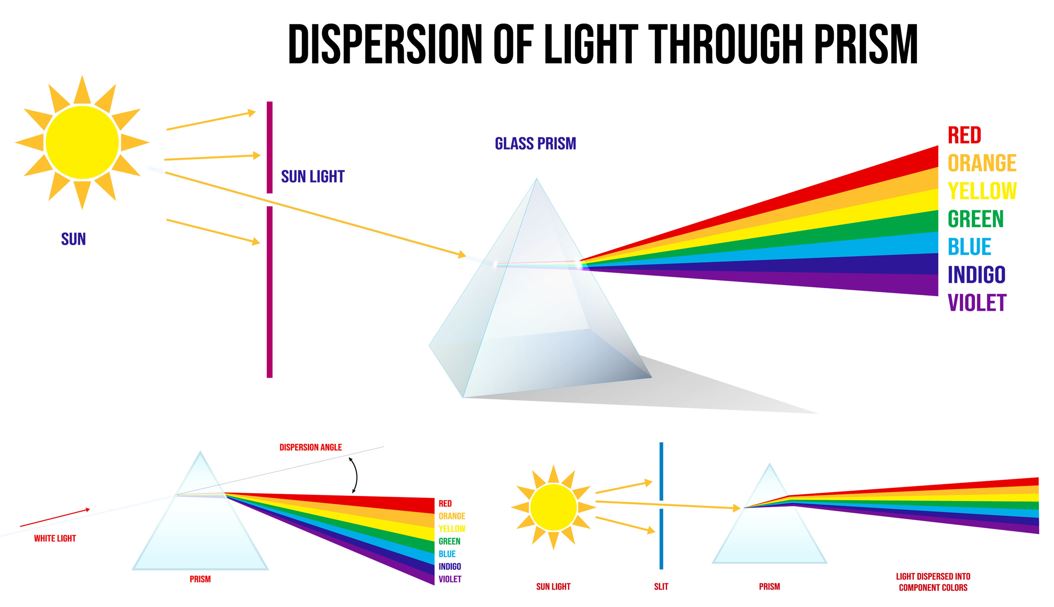
Figure 3: Dispersion of Light. White light enters, and a rainbow exits.
3.1 Refraction Through a Prism
A prism is a triangular piece of glass. Because its sides are angled (not parallel like a glass slab), something special happens.
When light enters, it bends towards the base. When it exits, it bends again towards the base.
The angle between the incident ray and the final emergent ray is called the Angle of Deviation.
3.2 Dispersion: The Rainbow Maker
Newton found that white light isn’t just white—it is a mixture of seven colors. When white light passes through the prism, different colors bend by different amounts.
- Violet bends the most (Maximum deviation).
- Red bends the least (Minimum deviation).
This separation of white light into its component colors is called Dispersion. The band of colored components is called a Spectrum.
Memory Tip: Remember VIBGYOR (Violet, Indigo, Blue, Green, Yellow, Orange, Red).
3.3 The Natural Rainbow
A rainbow in the sky is just a giant version of Newton’s experiment. Here, tiny raindrops act as thousands of mini prisms.
1. Sunlight enters a raindrop.
2. It refracts and disperses (splits into colors).
3. It reflects internally off the back of the drop.
4. It refracts again as it comes out.
This sends a spectrum of colors to your eye. You always see a rainbow opposite to the sun.
Part 4: Atmospheric Refraction – Twinkling Stars
Our atmosphere isn’t uniform. It has layers of hot air and cold air. Cold air is denser; hot air is lighter (rarer). Light travels faster in hot air and slower in cold air. This constant changing of speed causes light to bend continuously.
4.1 Why Do Stars Twinkle?
Stars are very far away, so they act like tiny point sources of light. As starlight travels through the earth’s turbulent atmosphere, its path keeps changing slightly due to moving air currents.
Sometimes more light hits your eye (star looks bright), sometimes less light hits your eye (star looks dim). This rapid fluctuation is called Twinkling.
4.2 Why Don’t Planets Twinkle?
Planets are much closer to Earth. They act like extended sources (a collection of many points of light). Even if light from one point flickers, light from another point balances it out. The total amount of light entering our eye remains roughly constant, so they don’t twinkle.
4.3 Advanced Sunrise and Delayed Sunset
Did you know you see the sun 2 minutes before it actually rises?
When the sun is just below the horizon, its light enters the Earth’s atmosphere. The air gets denser near the ground, so the light bends downwards. This bending makes the sun appear slightly higher than it actually is. So, we see it before it physically crosses the horizon!
Part 5: Scattering of Light – Why is the Sky Blue?
When light hits a particle, it can bounce off in random directions. This is called Scattering.
The Tyndall Effect: Have you seen dust particles dancing in a beam of sunlight in a dark room? Or sunlight filtering through a misty forest? That is the Tyndall effect—the scattering of light by colloidal particles.

Figure 4: Scattering in action. Blue scatters easily; Red cuts through.
5.1 Why is the Sky Blue?
The molecules of air (Nitrogen and Oxygen) are very tiny. Physics says that tiny particles scatter short wavelengths (Blue/Violet) much more strongly than long wavelengths (Red).
So, when sunlight hits the atmosphere, the blue color gets scattered all over the sky. When you look up, this scattered blue light enters your eyes.
Note: Violet scatters even more than blue, but our eyes are more sensitive to blue, so we see the sky as blue.
5.2 Why is the Sunset Red?
At sunrise or sunset, the sun is near the horizon. The light has to travel a very long distance through the thick atmosphere to reach you.
During this long journey, most of the Blue light gets scattered away completely. The only light that survives the journey is the Red light (because it has the longest wavelength and scatters the least). That is why the sun and the sky around it look red/orange.
Astronaut View: If you go to space where there is no atmosphere, there is no scattering. The sky looks completely dark/black, even during the day!
6. Extensive Practice Set (With Explanations)
Physics requires practice. Let’s solve some important questions that often appear in exams.
Part A: Multiple Choice Questions (MCQs)
- Which part of the eye controls the amount of light entering it?
(a) Cornea (b) Retina (c) Pupil (d) IrisSolution: (c) Pupil.
Note: The Iris controls the size of the pupil, but the Pupil itself is the gateway that light enters through. (Often ‘Iris’ is also accepted as it operates the pupil).
- A person cannot see objects distinctly closer than 1 meter. This defect is:
(a) Myopia (b) Hypermetropia (c) Presbyopia (d) CataractSolution: (b) Hypermetropia.
Reasoning: A normal eye can see from 25cm. If the near point has receded to 1 meter, it means they can’t see near things. That is Long-sightedness (Hypermetropia).
- The danger signals installed at the top of tall buildings are red in colour. This is because red light:
(a) is scattered the most by smoke or fog.
(b) is scattered the least by smoke or fog.
(c) is absorbed the most by smoke or fog.
(d) moves fastest in air.Solution: (b) Is scattered the least.
Reasoning: Red has the longest wavelength. It cuts through fog and smoke without scattering, so it can be seen from far away.
Part B: Short Answer Questions
- Why does the clear sky appear blue?
Answer: The molecules of air and other fine particles in the atmosphere have a size smaller than the wavelength of visible light. These are more effective in scattering light of shorter wavelengths at the blue end than light of longer wavelengths at the red end. When sunlight passes through the atmosphere, the fine particles scatter the blue color more strongly than red. The scattered blue light enters our eyes, making the sky appear blue.
- What is meant by the ‘power of accommodation’ of the eye?
Answer: The ability of the eye lens to adjust its focal length is called accommodation. The ciliary muscles modify the curvature of the eye lens to some extent. The change in the curvature of the eye lens can thus change its focal length. Consequently, we can see nearby as well as distant objects clearly.
- Why do stars twinkle but planets do not?
Answer: Stars are point-sized sources of light far away. Atmospheric refraction causes the path of starlight to vary slightly, so the apparent position of the star fluctuates and the amount of light entering the eye flickers (twinkling). Planets are much closer and appear as extended sources (collections of points). The fluctuations from different points cancel each other out, resulting in a steady average brightness, so they don’t twinkle.
Part C: Long Answer Questions
- A student has difficulty reading the blackboard while sitting in the last row. What could be the defect the child is suffering from? How can it be corrected? Draw ray diagrams.
Answer:
Defect: The student can likely see nearby things (notebook) but cannot see distant things (blackboard). This is Myopia or Near-sightedness.
Cause: The eye lens is too converging (powerful), or the eyeball is too long. The image forms in front of the retina.
Correction: A Concave Lens of suitable power is used. This lens diverges the incoming light rays just enough so that the eye lens can then focus them precisely onto the retina. - Describe the formation of a rainbow in the sky with the help of a diagram.
Answer:
A rainbow is a natural spectrum appearing in the sky after a rain shower. It is caused by the dispersion of sunlight by tiny water droplets, present in the atmosphere.
Process:
1. Sunlight enters a water droplet. It gets refracted and dispersed (split into colors).
2. It strikes the inner surface of the droplet and undergoes Internal Reflection.
3. It gets refracted again as it comes out of the droplet.
Different colors emerge at different angles, creating the rainbow effect observed by an observer standing with their back to the sun.
Read Also:
Class 10 Chapter 9- Light – Reflection and Refraction
For more check official website of
NCERT