

1. Welcome to the World of Curved Surfaces!
Hello Student! In our earlier classes, we learned a lot about plane mirrors—the flat mirrors we use every morning to comb our hair. We know that a plane mirror always forms an erect (upright) image that is exactly the same size as the object. But what happens if the mirror is not flat?
Have you ever looked at your reflection in a shiny, brand-new steel spoon? If you look at the inner curved side, your face might appear upside down. But if you flip it and look at the outer bulging side, your face suddenly looks upright but much smaller! Why does this happen? The answer lies in the fascinating world of spherical mirrors and lenses. Let’s dive in and understand how curved surfaces play magic tricks with light.
2. What Are Spherical Mirrors?
Curved mirrors, like that shiny spoon we just talked about, can be specially crafted in laboratories and factories. The most common type of curved mirrors are called spherical mirrors because they are shaped as if they are a part of a hollow glass sphere.
Imagine you have a hollow glass ball. If you cut a small piece out of it, you get a curved piece of glass. Now, depending on which side you polish and coat with a reflective material (like a thin layer of aluminium), you can create two different types of spherical mirrors:
- Concave Mirror: If the reflecting surface curves inwards (like looking into a cave or the inner side of a spoon), it is called a concave mirror. The outer bulging side is painted.
- Convex Mirror: If the reflecting surface curves outwards (like the back of a spoon), it is called a convex mirror. The inner hollow side is painted.
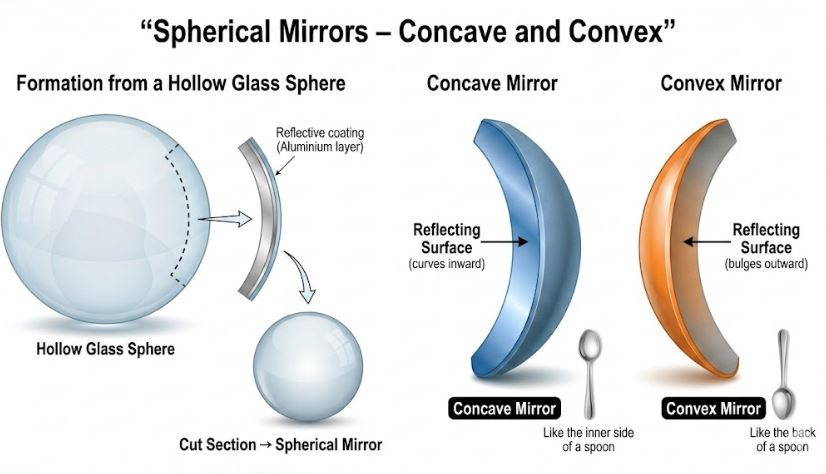
Figure-1: A concave mirror curves inwards, while a convex mirror bulges outwards. Think of a spoon to remember the difference!
3. Characteristics of Images Formed by Spherical Mirrors
Now, let’s play with these mirrors. If you place an object in front of them, they behave very differently from the flat mirrors in your bedroom.
In a Concave Mirror:
- When you keep an object very close to the mirror, the image formed is erect (upright) and larger than the object (enlarged).
- As you slowly move the object farther away from the mirror, something interesting happens: the image turns upside down (inverted)!
- Initially, this inverted image is large, but as you keep moving the object further away, the image keeps getting smaller and smaller.
In a Convex Mirror:
- Convex mirrors are much more predictable. The image formed by a convex mirror is always erect and smaller than the object (diminished).
- Even if you move the object farther away, the image remains upright, though its size decreases slightly.
Teacher’s Note: Did you know that lateral inversion (where your left hand appears as your right hand in the mirror) happens in ALL three types of mirrors—plane, concave, and convex!
4. Real-Life Applications: Where Do We Use Them?
Science is not just in textbooks; it’s all around us! Because these mirrors change the size and orientation of images, we use them for very specific jobs in our daily lives.
Uses of Concave Mirrors:
- Dentist’s Mirror: Dentists use small concave mirrors. When held close to your teeth, it provides an enlarged, upright view, helping the dentist spot tiny cavities easily.
- Reflectors: Look inside the headlights of a car, scooter, or a torch. The shiny bowl behind the bulb is a concave mirror. It helps throw a strong, focused beam of light forward.
- Telescopes: Modern reflecting telescopes use large concave mirrors to gather light from distant stars.
Uses of Convex Mirrors:
- Vehicle Side-View Mirrors: The mirrors on the sides of cars and bikes are always convex. Why? Because they always form an upright, smaller image. Since the mirror curves outwards, it covers a much wider area, allowing the driver to see a lot of traffic behind them. Have you noticed the warning “Objects in mirror are closer than they appear”? That’s because the diminished image makes vehicles look farther away than they actually are!
- Safety and Surveillance: Big convex mirrors are placed at blind turns or sharp road intersections to prevent collisions by letting drivers see vehicles approaching from the other side. They are also used in large stores to monitor a wide area and prevent theft.
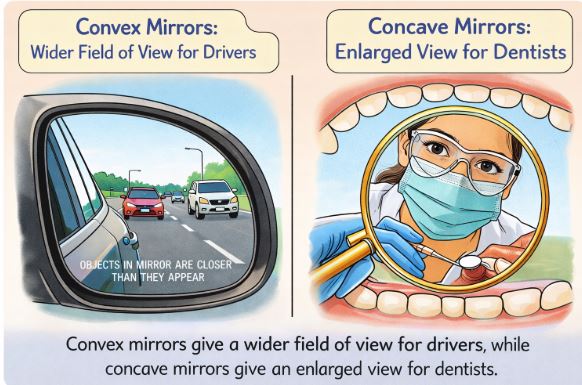
Figure-2: Convex mirrors give a wider field of view for drivers, while concave mirrors give an enlarged view for dentists.
Shutterstock
Explore
5. The Unbreakable Laws of Reflection
Whether a mirror is perfectly flat, deeply concave, or bulging convex, light always obeys strict rules when it bounces off them. Let’s understand how we draw and measure light first. We represent light using straight lines with arrows, called rays, which show the path light travels.
When a ray of light strikes a mirror, it is called the incident ray. The ray that bounces back is the reflected ray. If we draw an imaginary line strictly at a 90-degree angle (perpendicular) to the mirror’s surface at the exact point where the light hits, we call it the normal.
Here are the two fundamental Laws of Reflection that light NEVER breaks:
- First Law: The angle between the normal and the incident ray (Angle of Incidence, i) is exactly equal to the angle between the normal and the reflected ray (Angle of Reflection, r). So, angle i = angle r.
- Second Law: The incident ray, the normal at the point of incidence, and the reflected ray all lie in the same plane (the same flat surface, like a single sheet of paper). If you bend the paper, the reflected beam breaks its alignment.
Remember, these laws are valid for ALL kinds of mirrors—plane and spherical.
6. Converging and Diverging Mirrors
If the laws of reflection apply to all mirrors, why do curved mirrors behave so differently? It’s because of their shape! When multiple parallel rays of light fall on a mirror, the curved surface changes where the normal points at each spot.
- Concave Mirrors Converge: When parallel beams of light hit a concave mirror, the reflected beams bend inwards and get closer to each other. We call this converging. Because they bring light to a single bright point, concave mirrors can concentrate sunlight to produce intense heat. This principle is used in solar concentrators and solar furnaces to generate electricity, cook food, or even melt steel!
- Convex Mirrors Diverge: When parallel beams of light hit a convex mirror, the reflected beams spread outwards. We call this diverging.
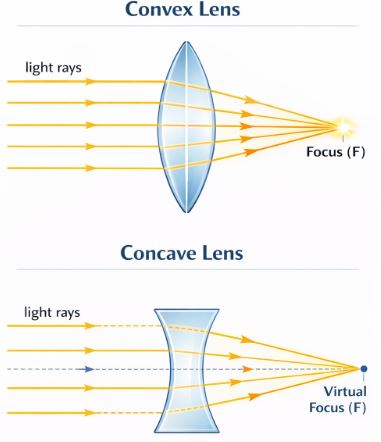
Figure-3: Concave mirrors converge parallel light rays to a point, while convex mirrors spread them out (diverge).
7. What is a Lens? Exploring Refraction
So far, we talked about mirrors, which bounce light back (reflection). But what if the material is transparent, like glass, clear plastic, or even water? Have you ever looked at a tiny drop of water sitting on a printed page? The letters underneath the water drop look unusually large! The curved surface of the water drop acts like a simple lens.
A lens is a piece of transparent material, usually made of glass or plastic, which has curved surfaces. Unlike mirrors, lenses allow light to pass through them, and we see things through a lens rather than in it.
Just like mirrors, there are two main types of lenses:
- Convex Lens: A lens that is thicker in the middle and thinner at the edges.
- Concave Lens: A lens that is thicker at the edges and thinner in the middle.
8. How Do Lenses Change Images?
Let’s look at an object through these lenses and see what happens.
Looking through a Convex Lens:
- When you place an object close behind a convex lens, the object appears erect and enlarged. This is exactly how a magnifying glass works!
- If you keep moving the object farther away from the lens, the image flips and appears inverted. Initially, it is enlarged, but as you move it further, it shrinks in size.
Looking through a Concave Lens:
- A concave lens is simple: it always makes an object look erect and diminished in size, no matter where you place it. The size changes as the distance increases, but it stays upright and small.
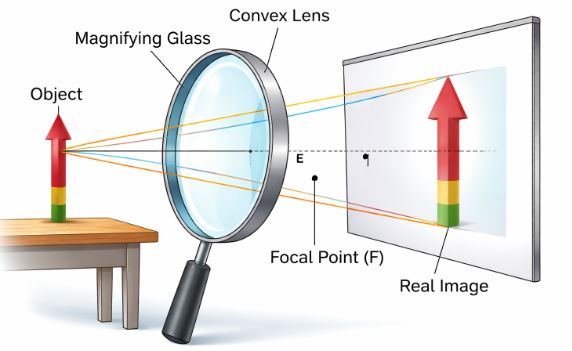
Figure-4: A magnifying glass uses a convex lens to make objects placed close to it look upright and much larger.
9. Converging and Diverging in Lenses
Mirrors and lenses have opposite personalities when it comes to their names and functions!
- A Convex Lens is a converging lens. When parallel beams of light pass through it, the lens bends them inward to meet at a point. Just like a concave mirror, a convex lens can concentrate sunlight to a sharp, bright point that can burn a hole in a piece of paper!
- A Concave Lens is a diverging lens. When parallel light passes through it, the rays spread out.
Lenses are incredibly important in our daily lives. The eyeglasses we wear to correct vision are lenses. Cameras, telescopes, and microscopes all rely on lenses. Even our own human eye contains an amazing natural convex lens that can change its shape to help us read a book up close or look at distant mountains!
10. Common Student Misconceptions (Teacher’s Tip)
In my 15 years of teaching, the most common mistake students make is confusing the converging/diverging actions of mirrors and lenses. Let’s make it super simple:
- Concave MIRROR = Converges light.
- Convex LENS = Converges light.
- Convex MIRROR = Diverges light.
- Concave LENS = Diverges light.
Notice how they are opposites? The mirror that curves in (concave) converges, but the lens that bulges out (convex) is the one that converges!
Practice Questions (CBSE Pattern)
A. Very Short Answer Questions
Q1: Which type of spherical mirror always forms an erect and diminished image?
Answer: A convex mirror always forms an erect and diminished image.
Q2: Name the two laws of reflection.
Answer: 1. The angle of incidence is equal to the angle of reflection. 2. The incident ray, normal, and reflected ray all lie in the same plane.
Q3: Which lens is thicker in the middle and thinner at the edges?
Answer: A convex lens is thicker at the middle compared to the edges.
B. Short Answer Questions
Q1: Why are convex mirrors preferred for observing traffic behind us in vehicles?
Answer: Convex mirrors are preferred because they always form an erect image of the traffic behind, and because they curve outwards, they provide a much wider viewing area of the road behind.
Q2: What happens to a parallel beam of light when it falls on a concave mirror vs a convex mirror?
Answer: When parallel beams of light fall on a concave mirror, they get closer together, meaning they converge. When they fall on a convex mirror, they spread apart, meaning they diverge.
Q3: If a light ray falls exactly along the normal on a plane mirror, what will be the angle of incidence and angle of reflection?
Answer: If a light ray falls along the normal, both the angle of incidence and the angle of reflection would be zero.
C. Long Answer Questions
Q1: Explain how the image formed by a concave mirror changes as you move an object away from it.
Answer: When an object is placed very close to a concave mirror, the image is erect and enlarged. However, as the object is moved farther away, the image becomes inverted. Initially, this inverted image is enlarged, but as the distance continues to increase, the image keeps getting smaller (diminished).
Q2: Describe an activity to show that a convex lens acts as a converging lens.
Answer: Take a convex lens and hold it directly facing the Sun. Place a thin sheet of paper behind the lens and adjust the distance until a sharp, bright spot of light forms on the paper. This spot is the sunlight being concentrated (converged) by the convex lens into a small area. If held steady, the focused heat can even burn the paper, proving it converges light rays. (Note: Never look directly at the Sun ).
D. Case-Based Question
A student visits a science museum and walks into a room filled with strange mirrors. Standing in front of one specific tall mirror, she notices that her image is upright, but she looks tiny compared to her real size. As she steps back, her image remains upright but gets slightly smaller.
Q1: Identify the type of mirror the student is standing in front of.
Answer: Convex mirror, because it forms an image that is always erect and diminished.
Q2: Give one common real-world use of the mirror identified above.
Answer: They are installed in big stores to monitor large areas for surveillance.
E. Assertion–Reason
Assertion: The laws of reflection are not applicable to spherical mirrors like concave and convex mirrors.
Reason: Spherical mirrors have curved surfaces that cause light rays to converge or diverge instead of travelling parallel.
Answer: Assertion is incorrect, but Reason is correct. The laws of reflection are completely valid for all kinds of mirrors—plane and spherical. Even though curved surfaces cause beams to converge or diverge, each individual ray of light still strictly follows the laws of reflection at its specific point of incidence.
Read Also
For official syllabus and textbooks, visit the
NCERT Official Website.